Domenikos Theotokópoulos, immortalized as El Greco, transcends mere biography to become a symbol. His legacy, a pictorial universe of stylized figures, vibrant colors, and palpable spirituality, continues to fascinate generations. El Greco not only painted paintings; he captured a vision of the world, a personal interpretation of faith, beauty, and the human condition that sets him apart as one of the most singular geniuses in the history of art.

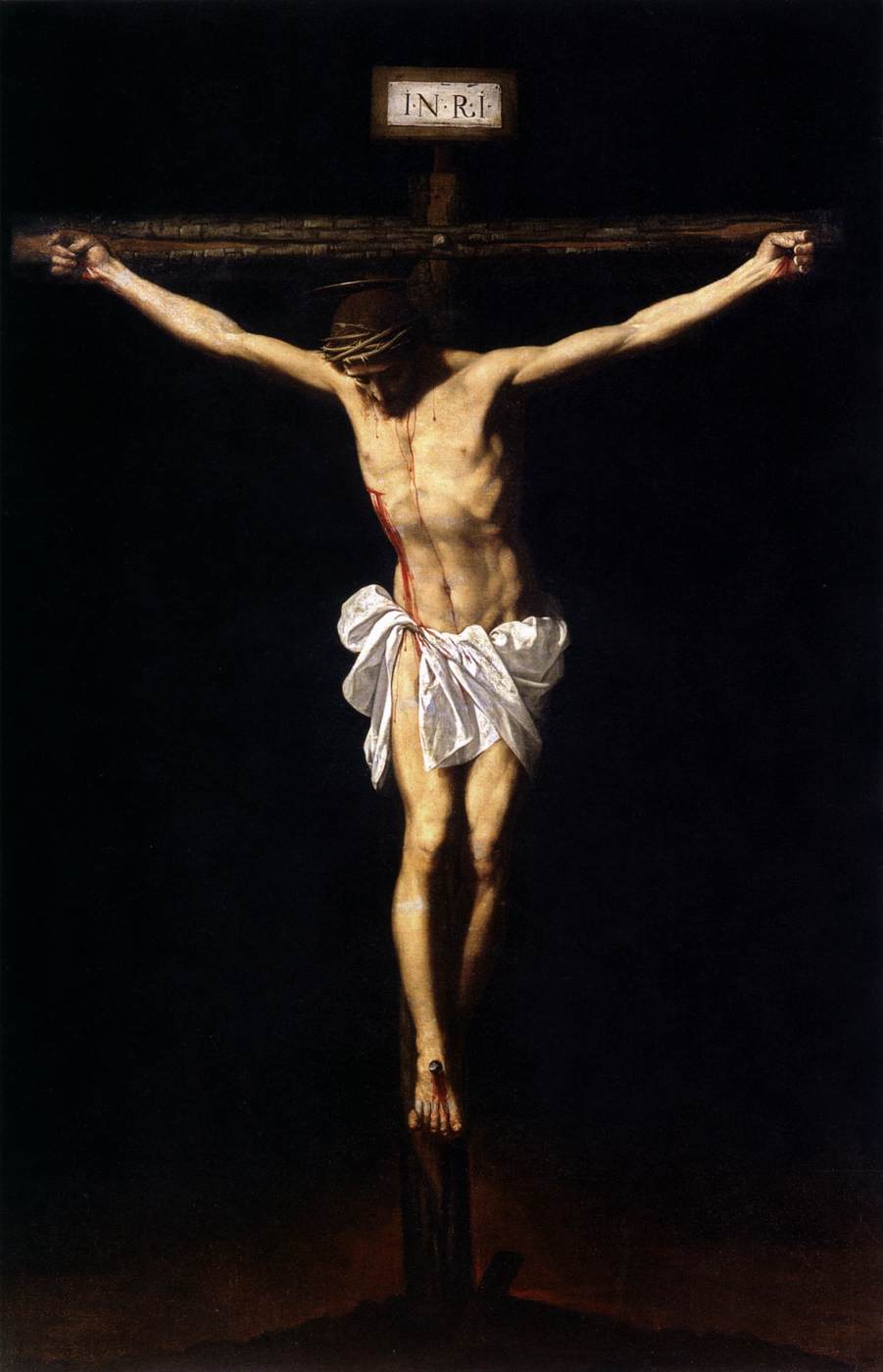
Elongated figure in the painting Christ on the Cross, El Greco
The name El Greco immediately evokes images of elongated figures, intense faces, and dynamic compositions. His uniqueness lies in his ability to fuse diverse influences—the Byzantine art of his native Crete, the color of the Venetian school, and Italian Mannerism—into a distinctive style of his own. This fusion, far from being mere imitation, became an original artistic voice that broke with the conventions of his time. Considered by some to have been misunderstood in his own era, his value was rediscovered centuries later, becoming a source of inspiration for artistic movements such as Expressionism and Cubism.
El Greco’s life journey is an artistic odyssey that took him from the island of Crete, where he was born in 1541, to Venice and Rome, key centers of the Italian Renaissance, before settling permanently in Toledo, Spain. Each stage of his journey left a mark on his artistic development. In Crete, he trained in the tradition of Byzantine icon painting. In Venice, he learned color and light handling from masters such as Titian and Tintoretto. His stay in Rome, although brief, allowed him to study the works of Michelangelo and Raphael. The decision to move to Toledo, in Counter-Reformation Spain, would mark the beginning of his most creative and personal period, where he fully developed his unique style.
Beyond his artistic genius, El Greco was a man of his time, a cultured intellectual and a passionate defender of his own ideas. His complex and at times eccentric personality was reflected in his writings and in the anecdotes preserved about his life. He was a man of deep religious convictions, but also an independent and rebellious artist, willing to challenge established norms. It is said that he maintained a workshop full of musicians and scholars, seeking inspiration in debate and reflection. One example: he turned down commissions if he was not allowed to express his artistic vision without restrictions, a trait that distinguishes him from many artists of the period.

A View of Toledo, El Greco
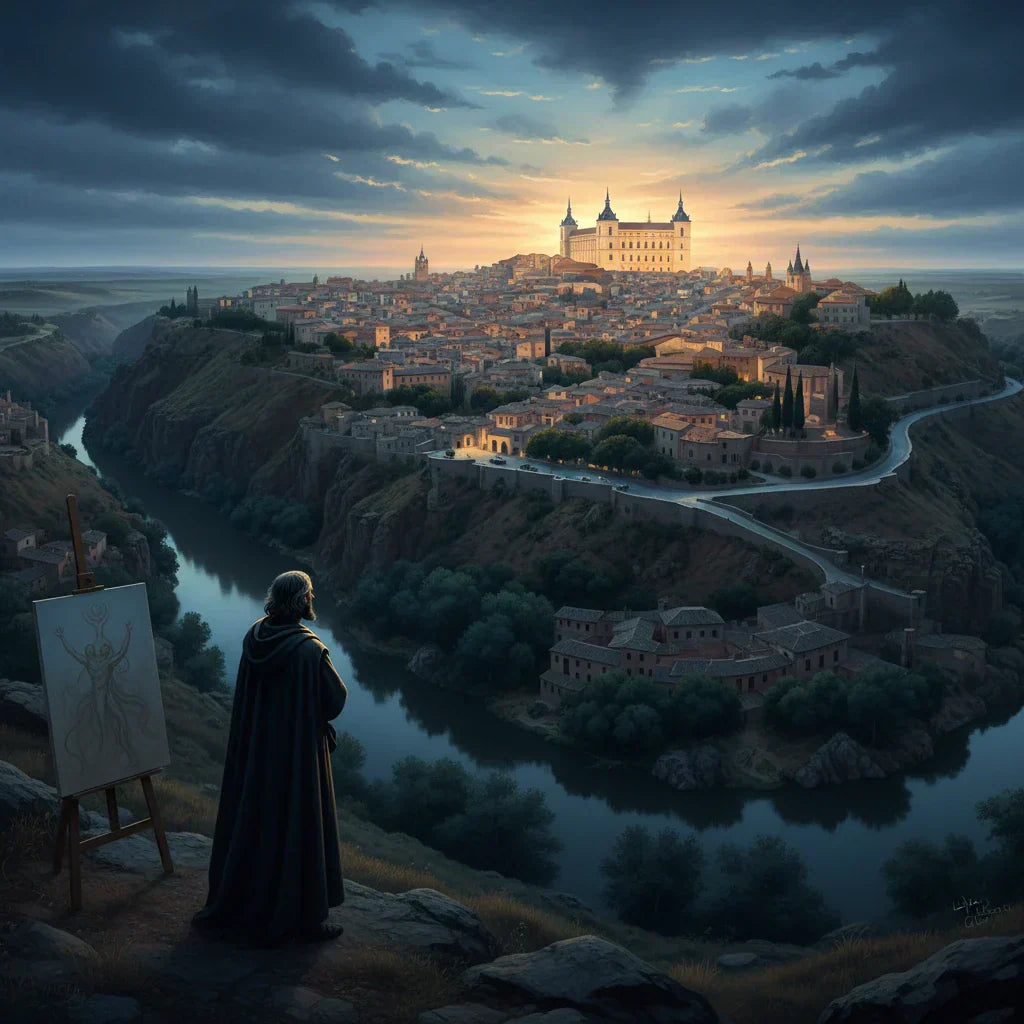
Toledo, the former capital of the Spanish Empire, became the setting and soul of El Greco's work. The city, with its rich history, mystical atmosphere, and religious fervor, exerted a profound influence on his style. The imposing cathedrals, narrow alleyways, and surrounding landscape, with the Tagus River winding through the hills, provided the perfect backdrop for his compositions. More than just a place of residence, Toledo was a constant source of inspiration that permeated his entire artistic output. The atmosphere of religious fervor that permeated the city in the 16th century profoundly influenced his palette and his approach to religious themes.
El Greco became fully integrated into 16th-century Toledan society, forming relationships with important figures in the church, nobility, and intellectual circles. His patrons included cardinals, bishops, and members of the aristocracy, who commissioned works from him to decorate churches, monasteries, and palaces. His success in Toledo allowed him to live comfortably and maintain a prosperous workshop, where he trained disciples and collaborated with other artists. Despite his integration into Toledan society, El Greco always kept a certain distance, preserving his artistic independence and critical spirit. Example: Although he enjoyed the favor of important prelates, he did not hesitate to defend his fees and his artistic vision when he felt he was being treated unfairly.
Toledo was much more than a simple place of work for El Greco; it was a refuge where he could develop his talent without the pressures and restrictions he might have found in other artistic centers. In Toledo, he found an environment conducive to experimentation and innovation, where he could give free rein to his imagination and create works that challenged the conventions of the time. The city provided him with a rich religious iconography, an audience receptive to his mystical vision, and a landscape that stimulated his creativity. Example: It is said that El Greco spent hours contemplating the landscape of Toledo, studying the effects of light on the city and the surrounding hills, a practice that undoubtedly influenced his distinctive use of lighting in his paintings.
El Greco's profound religiosity was the main creative force behind his work. His paintings are not mere representations of biblical scenes or saints' lives, but expressions of an intense, personal faith. Through his stylized figures, vibrant colors, and dynamic compositions, El Greco seeks to convey religious emotion and the experience of mystical ecstasy. His approach was not so much realism or historical accuracy, but rather the evocation of a transcendent spiritual state. El Greco understood painting as a form of prayer, a means to communicate his faith and to inspire devotion in the viewer.
El Greco used a rich iconography and complex religious symbolism in his works, drawing on elements of Byzantine art, the Italian Renaissance, and Spanish tradition. Every detail of his paintings, from the gestures and expressions of the characters to the colors and objects depicted, has a symbolic meaning. For example, the use of golden yellow to represent divinity, or the frequent depiction of angels and saints with their eyes raised to the sky, are resources El Greco uses to convey the idea of the sacred and the transcendent. A deep analysis of his work reveals a complex network of biblical, theological, and philosophical references.
One of the most distinctive features of El Greco's work is his ability to express ecstasy and religious devotion. His figures, often depicted in contorted poses and with ecstatic faces, seem to be in a state of trance, elevated above the earthly world. El Greco used devices such as elongating figures, distorting proportions, and intensifying colors to create a sense of unreality and transcendence. These techniques, far from being merely stylistic devices, are tools he uses to communicate the intensity of religious experience. His works invite the viewer to immerse themselves in a state of contemplation and to connect with the divine.
El Greco revolutionized the use of color and lighting in painting. His palette, rich in intense and contrasting colors, creates an atmosphere of unreality and mysticism. He used color not only to represent reality, but also to express emotions and moods. His lighting, often artificial and dramatic, highlights the key elements of the composition and creates a sense of movement and dynamism. El Greco did not limit himself to copying natural light, but transformed it into his own pictorial language, using light to express divinity and transcendence. His innovative use of color and lighting influenced generations of later artists, from the Expressionists to the Fauves, as can be seen in the work of Matisse.

El Greco Chiaroscuro
El Greco was a master of chiaroscuro, the technique that consists of using extreme contrasts of light and shadow to create dramatic effects. Through chiaroscuro, El Greco succeeds in highlighting the main figures in his compositions, creating a sense of depth and volume, and generating an atmosphere of tension and mystery. This technique, which had already been used by artists such as Leonardo da Vinci and Caravaggio, reaches a new expressive dimension in El Greco's work. Chiaroscuro becomes a fundamental tool for conveying religious emotion and the experience of mystical ecstasy. The use of chiaroscuro in "The Burial of the Count of Orgaz" is a paradigmatic example of his mastery of this technique.
In El Greco’s work, light is not only a technical element, but also a metaphor for the sacred. Divine light illuminates saints and angels, revealing their heavenly nature. Darkness, by contrast, represents sin and ignorance. El Greco uses light to guide the viewer’s eye toward the most important elements of the composition, creating a visual hierarchy that reflects spiritual hierarchy. Light, ultimately, is the element that connects the earthly world with the divine world, allowing the viewer to glimpse the glory of God. His technical innovations, in fact, can be compared with those of Rembrandt, although applied in a very different context.

El Greco The Burial of the Count of Orgaz
The elongation of the figures in El Greco’s work is not a mere aesthetic whim, but a conscious decision to convey a sense of spiritual elevation and transcendence. This anatomical distortion, which may seem strange at first glance, serves to direct the viewer’s gaze toward the sky, toward the divine. El Greco sacrifices realistic accuracy in favor of greater expressiveness. Let us observe, for example, the hands and faces of the figures in "The Burial of the Count of Orgaz"; their slenderness and stylization contribute to the atmosphere of solemnity and mysticism. The painter uses this technique not to distort reality, but to reveal a deeper truth, a spiritual reality that escapes literal representation. This artistic device was not entirely new, but El Greco took it to an extreme that set him apart from his contemporaries. A possible mistake when trying to imitate this style is to fall into caricature or into purposeless distortion, thus losing the emotional and spiritual charge that El Greco intended to convey. The key lies in intentionality and technical mastery so that the elongation serves the visual narrative and does not distract from it.
El Greco’s early training in Crete, where Byzantine art was cultivated, and his later time in Venice and Rome exposed him to the artistic currents of the Renaissance and, in particular, Mannerism. The latter, with its emphasis on elegance, sophistication, and the distortion of forms, left an indelible mark on his style. Mannerism sought to break with classical conventions and explore new forms of expression, something El Greco embraced enthusiastically. The Mannerist influence can be appreciated in the use of intense, contrasting colors, in the dynamic composition, and in the aforementioned stylization of the figures. However, El Greco did not limit himself to copying the Mannerist style; instead, he transformed it and adapted it to his own vision, infusing it with a unique emotional intensity and mysticism. While other Mannerist artists focused on grace and ornamentation, El Greco used the same tools to express the anguish and spirituality of his characters. Mannerism offered him a visual vocabulary, but it was his personal genius that allowed him to create a completely original artistic language. His mastery of chiaroscuro, also visible in the work of Rembrandt, is also evident in his works, although with a very different intention.

El Greco The Disrobing of Christ
Beyond the formal characteristics of his style, what truly distinguishes El Greco’s work is the emotional intensity that emanates from his characters. Their faces, often pale and emaciated, reflect deep spiritual anguish and a longing for the divine. Their eyes, large and expressive, seem to look inward, toward a world of emotions and beliefs. This emotional intensity is not gratuitous; it is the result of deep reflection on the human condition and on the relationship between man and God. El Greco does not settle for representing the physical appearance of his characters; instead, he seeks to reveal their soul. Every gesture, every glance, every detail of their clothing helps create an atmosphere of tension and drama. Looking at "The Disrobing of Christ," one can feel Christ’s anguish before his imminent crucifixion, as well as the cruelty and indifference of his executioners. El Greco manages to convey these emotions through composition, color, and above all, the expression on the faces. One of the dangers when analyzing El Greco’s work is reducing it to a mere expression of subjectivity or to a reflection of his own neurosis. While it is true that his work is deeply personal, it is also a reflection of the religious and spiritual concerns of his time.
"The Burial of the Count of Orgaz", painted between 1586 and 1588 for the church of Santo Tomé in Toledo, is perhaps El Greco's most emblematic work. The painting depicts the miraculous descent of Saint Augustine and Saint Stephen to attend the burial of the pious Count of Orgaz, a legendary event that took place in the 14th century. The work is divided into two clearly differentiated zones: the earthly realm, where the burial itself takes place, and the heavenly realm, where the glory of heaven is represented. In the earthly zone, the figures crowd around the count's body, creating a dense and dynamic composition. The faces, individualized and portrayed with great realism, reflect a variety of emotions, from sadness to admiration. In the heavenly zone, the figures rise toward the sky in a whirlwind of light and color. Christ, the Virgin Mary, and Saint John the Baptist preside over the scene, surrounded by angels and saints. The work is a perfect synthesis of El Greco's style: elongated figures, vibrant colors, dynamic composition, and an intense emotional charge. The painting also serves as a historical document, as it includes portraits of Toledo figures of the period, among them El Greco himself and his son Jorge Manuel. The work is a powerful affirmation of the Catholic faith and a celebration of virtue and piety.
Unlike his religious works and portraits, "View of Toledo" is a landscape, but not just any landscape. It is a subjective and emotional representation of the city, imbued with an aura of mystery and drama. The sky, stormy and menacing, dominates the composition, casting a spectral light over the city. The buildings, rendered in great detail, rise on a hill, creating a sense of monumentality and solidity. The Tagus River, which winds along the foot of the city, adds an element of dynamism and movement. El Greco does not limit himself to representing Toledo's physical appearance, but seeks to capture its spirit, its essence. The city becomes a symbol of 16th-century mystical and religious Spain, a place of history, tradition, and spirituality. Some critics have interpreted the landscape as a metaphor for the human soul, with its storms and its moments of clarity. It is interesting to contrast this personal and subjective vision with the more realistic and objective depictions of the city made by other artists. Like the later Fauvists, El Greco uses color to express his emotions and create a particular atmosphere.
"The Disrobing of Christ", painted between 1577 and 1579 for the sacristy of Toledo Cathedral, depicts the moment when Christ is stripped of his garments before being crucified. The work is full of drama and tension. Christ, at the center of the composition, looks toward the sky with an expression of resignation and pain. His face, illuminated by a divine light, contrasts with the darkness and cruelty of the soldiers surrounding him. The secondary figures, rendered with great realism, reflect a variety of emotions, from indifference to mockery. The composition, dense and crowded, helps create a sense of oppression and claustrophobia. El Greco uses intense, contrasting colors to highlight Christ's figure and to create an atmosphere of tension. The red of his tunic contrasts with the dark blue of the sky, while the golden light illuminating his face contrasts with the darkness of the shadows. The work is a powerful reflection on human suffering and on the divinity of Christ. El Greco succeeds in conveying Christ's anguish and pain in a moving and visceral way. The work generated some controversy in its time due to the depiction of the secondary figures, considered unworthy and disrespectful of the sacred scene.
The reception of El Greco's work in the 16th century was varied and complex. While it had the support of some important patrons, such as the Church and the nobility of Toledo, his unconventional style and personal artistic vision were not always understood or appreciated by his contemporaries. Some critics considered his elongated figures and use of color to be extravagant and unrealistic. Others, however, admired his originality and his ability to convey intense emotions. It is important to remember that El Greco worked in a time of great changes and artistic transformations. The Renaissance, with its ideal of beauty and perfection, was giving way to Mannerism, with its emphasis on elegance, sophistication, and the distortion of forms. El Greco was at the forefront of this movement, but his radical style and personal vision set him apart from his contemporaries. His success in Toledo, where he spent most of his life, shows that his work found a receptive audience in that city. However, his fame did not extend much beyond the borders of Spain until centuries later.
To better understand El Greco's uniqueness, it is useful to compare him with other masters of the Renaissance and Mannerism. Unlike Renaissance artists such as Raphael or Leonardo da Vinci, who sought perfection and harmony in their works, El Greco focuses on expressiveness and emotional intensity. His figures are not idealized or proportioned, but elongated and stylized, with faces that reflect deep spiritual anguish. In comparison with Mannerist artists such as Parmigianino or Bronzino, who focused on elegance and sophistication, El Greco imbues his works with a unique mysticism and spirituality. While he shares with them a taste for the distortion of forms and the use of intense colors, his aim is to convey a transcendent vision of reality. While Michelangelo, whose rebellious art we explored in another article , searched for physical perfection and heroic drama, El Greco seeks spiritual transcendence and introspection. El Greco occupies an intermediate position between the Renaissance and Mannerism, but his personal style and artistic vision make him a unique and uncategorizable artist. It is important to note that these comparisons are not intended to establish a hierarchy of values, but simply to help us better understand the uniqueness of each artist.
Although his work was not fully appreciated in his time, El Greco exerted a considerable influence on later generations of artists. His unique style and personal vision inspired many painters, especially from the 20th century onward, when his work was rediscovered and valued at its true worth. German Expressionists, such as Emil Nolde or Ernst Ludwig Kirchner, found in El Greco's work a source of inspiration for their own search for expressiveness and emotional intensity. The Surrealists, such as Salvador Dalí or Max Ernst, admired his ability to create dreamlike and unsettling images. Even abstract artists, such as Jackson Pollock or Mark Rothko, recognized El Greco's influence on their own artistic development. The use of color, dynamic composition, and emotional intensity in his work remain relevant today. El Greco demonstrated that art does not have to be a mere representation of reality, but can be an expression of the artist's subjectivity and personal vision. His legacy lives on in the work of many contemporary artists, who continue to find inspiration in his unique and unmistakable style. El Greco's legacy is a testament to the importance of originality and personal vision in art.
Although El Greco is mainly known for his painting, he also ventured into sculpture and architecture, albeit to a lesser extent. These facets of his work are less well known, but equally interesting, as they reveal a comprehensive vision of art and a constant pursuit of creative expression. His early training in Crete, where both painting and sculpture were cultivated, gave him a solid foundation in both disciplines. In addition, his time in Venice and Rome exposed him to the artistic currents of the Renaissance, which valued the integration of the different arts. Although not many sculptures attributed to El Greco have survived with certainty, it is known that he designed and oversaw the execution of several altarpieces, which combined sculptural and pictorial elements. These altarpieces, such as the one in the church of Santo Tomé in Toledo, are a demonstration of his ability to integrate the different arts into a coherent creative vision. Exploring these lesser-known facets of El Greco allows us to better understand his artistic genius and his vision of art as an integrated whole.
El Greco's contribution to altarpiece design is particularly significant, as it reveals his ability to integrate painting, sculpture, and architecture into a total work of art. The altarpieces designed by El Greco are not merely frames for his paintings, but rather independent artworks that complement and enhance the meaning of the depicted images. El Greco designed both the structure of the altarpiece and the arrangement of the sculptures and the paintings, creating a harmonious and balanced composition. His altarpieces are characterized by their verticality, dynamism, and ornamental richness. He used Solomonic columns, sculptures of angels and saints, and an abundance of decorative details to create an atmosphere of solemnity and grandeur. The choice of materials, such as gilded wood, marble, and alabaster, also helped enhance the beauty and value of the work. The altarpieces designed by El Greco are a testament to his artistic genius and his ability to create artworks that transcend the boundaries of different disciplines.
El Greco's foray into sculpture and architecture is a reflection of his comprehensive vision of art. For him, painting, sculpture, and architecture were not separate disciplines, but different manifestations of the same pursuit of beauty and creative expression. His training in Crete, his time in Venice and Rome, and his later work in Toledo allowed him to develop a vision of art that integrated the different disciplines. El Greco did not limit himself to painting paintings, but also designed altarpieces, supervised the construction of buildings, and took part in the decoration of churches and palaces. His goal was to create a total artistic environment that would stimulate the senses and elevate the spirit. In his view, art should be a multisensory experience that engaged the viewer on every level. This comprehensive vision of art is one of the features that distinguish El Greco from his contemporaries and make him a unique and unclassifiable artist. His work is a testament to the importance of creativity, innovation, and personal vision in art.
Despite the relative neglect El Greco suffered after his death, the 20th century witnessed a spectacular revival of his figure, driven largely by the modernist movement and the artistic avant-gardes. The modernists, in their search for a break with academicism and tradition, found in El Greco a precursor of subjective expression and distortion of form. His unique style, characterized by elongated figures, intense colors, and a mystical atmosphere, resonated with the sensibility of artists seeking new ways to represent reality. German Expressionism, for example, was influenced by the emotional intensity and loose brushwork of El Greco, while the surrealists appreciated his ability to evoke a dreamlike and transcendent world.
The decision to embrace subjectivity and move away from mimetic representation, which was central to modernism, found a valuable precedent in the work of El Greco. Artists of this period sought to express their emotions and inner states through distortion and exaggeration, qualities already present in the painting of the master Cretan master. A clear example of this influence can be seen in the work of painters such as Emil Nolde and Oskar Kokoschka, who admired the emotional intensity and expressive brushwork of El Greco. However, the appropriation of El Greco's style was not always successful; some artists fell into superficial imitation, losing the originality and depth that characterized the master.
This artistic rediscovery was accompanied by a critical and historical revaluation of his work. Art critics and historians began to analyze his work from a more modern perspective, recognizing his originality and importance in the history of art. His mastery of color, his ability to create complex compositions, and his capacity to convey profound emotions were highlighted. Extensive research revealed details about his life, training, and influences, allowing for a more complete understanding of his work. It began to be understood that El Greco was not simply an eccentric painter or an artist out of his time, but a visionary genius who anticipated many trends in modern art. Studies such as those carried out by Manuel Bartolomé Cossío at the beginning of the 20th century were fundamental to understanding the complexity of his art and its historical context. El Prado played a crucial role in this revaluation, preserving and displaying his most important works.
The impact of El Greco on contemporary artists is reflected in the exploration of spiritual and existential themes, as well as in experimentation with form and color. Artists such as Francis Bacon, for example, recognized El Greco's influence on their own work, particularly in the representation of the human figure and the expression of existential anguish. The distortion of form, characteristic of El Greco's style, became a common device for expressing alienation and the fragility of human beings in the modern world. However, it is important to note that inspiration from El Greco does not necessarily imply a direct imitation of his style, but rather an appropriation of his aesthetic principles and a reinterpretation of his worldview. The magic of color and the form explored by Paul Klee also echoes in El Greco's legacy.
Today, El Greco is recognized as one of the great masters figures in world painting and an icon of Spanish culture. His works are exhibited in the most important museums in the world, from the Prado Museum in Madrid to the Metropolitan Museum of Art in New York, attracting millions of visitors every year. His artistic legacy is the subject of study and admiration, and his influence extends across generations of artists and art lovers. The presence of his works in private collections is also significant, although access to them by the public is limited. A museum’s decision to acquire a work by El Greco is an event that generates great anticipation and helps consolidate his status as one of the most highly valued artists in the art market. A possible drawback in appreciating his work is the difficulty of accessing his original works, which makes temporary exhibitions highly sought-after events.
The figure and work of El Greco have transcended the realm of painting to inspire creators in other artistic disciplines. In film, movies such as "El Greco" (1966), directed by Luciano Salce, have attempted to recreate his life and era, although with mixed results. In literature, numerous writers have devoted poems, novels, and essays to his work, exploring its meaning and its impact on culture. In music, composers such as Cristóbal Halffter have created works inspired by his paintings, seeking to translate the mystical atmosphere and emotional intensity of his art into sound. However, portraying El Greco in other artistic disciplines presents the challenge of capturing the essence of his unique style and worldview. A film adaptation, for example, can fall into simplification or idealization, losing the complexity and depth that characterize his work.
For Spain, El Greco represents a symbol of identity and national pride. His figure is associated with the city of Toledo, where he developed most of his work, and his unique style is considered a genuine expression of the Spanish spirit. El Greco is seen as an artist who knew how to combine influences from different cultures – Greek, Italian, and Spanish – to create his own unmistakable pictorial language. His work is a testament to the richness and diversity of Spanish culture, and his legacy continues to inspire artists and creators throughout the country. The commemoration of important anniversaries related to his life and work are occasions to celebrate his figure and reaffirm his importance in the history of Spanish art. Nevertheless, it is important to avoid the nationalist appropriation of his work, recognizing its universal dimension and its influence on art throughout the world.
Despite the extensive existing bibliography on El Greco, his life and work continue to be the subject of new research and reinterpretations. Technological advances, such as the digitization of archives and the application of scientific analysis techniques to his paintings, are making it possible to uncover details that were previously unknown about his creative process, his materials, and his influences. In addition, new theoretical perspectives, such as gender studies and cultural criticism, are shedding new light on the interpretation of his work, revealing aspects related to its social, political, and religious context. For example, the analysis of his portraits from a gender perspective can reveal details about the representation of identity and power in the society of his time. The decision to invest in research on El Greco is essential to keep his legacy alive and to continue learning from his genius.
Research and conservation are essential to ensure the preservation of El Greco's legacy for future generations. The conservation of his works requires a multidisciplinary approach that combines knowledge of art history with the most advanced restoration techniques. It is essential to carry out exhaustive studies on the state of conservation of his paintings, identify the factors that threaten them, and apply appropriate treatments to prevent deterioration. Research, in turn, is essential to better understand his painting technique, his materials, and his historical context, which in turn makes it possible to make more informed decisions about their conservation. The decision to invest in the conservation and research of his work is a collective responsibility that requires the collaboration of public and private institutions, as well as the commitment of experts and art lovers. However, the scarcity of financial resources and the lack of specialized staff can make these tasks difficult.
El Greco, as one of the great masters in the history of art, will continue to be a source of inspiration for future generations of artists and creators. His unique style, his personal vision, and his ability to convey deep emotions continue to resonate with contemporary audiences. His work invites reflection, contemplation, and the search for beauty in an increasingly complex and changing world. Encouraging the study and dissemination of his legacy among young people is essential to ensure that his creative spirit remains alive and that his influence extends through time. The organization of exhibitions, lectures, and workshops on his work, as well as the creation of accessible and engaging educational materials, are some of the strategies that can be used to bring his figure closer to new generations. However, it is important to avoid idealizing or oversimplifying his work, presenting a complete and nuanced view of his creative genius.
The 20th century witnessed a rediscovery of El Greco's genius, driven largely by the influence of Modernism and the artistic avant-gardes. Artists of these movements found in his work a source of inspiration to break with academic conventions and explore new forms of expression. The distortion of figures, the expressive use of color, and the emotional intensity of his compositions resonated with the ideals of an art that sought to reflect the subjectivity and inner life of the artist.
The reassessment of El Greco’s work in the 20th century was also driven by critics and art historians who recognized his uniqueness and his importance within the history of Western art. Extensive studies were carried out on his life and work, his sources of inspiration were analyzed, and his output was placed within the historical and cultural framework of his era. Thanks to these efforts, El Greco was recognized as one of the great masters of universal painting, whose work transcends the boundaries of time and space.
The legacy of Doménikos Theotokópoulos, universally known as El Greco, lies not only in his technical mastery but also in his ability to convey a mystical and emotional vision of the world. His works, often characterized by elongated figures, intense colors, and a supernatural atmosphere, have influenced generations of artists, from the Expressionists to the Surrealists, consolidating his position as a key figure in the history of Western art. To understand his art is to delve into the historical and cultural context of 16th-century Spain, a period marked by the Counter-Reformation and deep religiosity. El Greco knew how to capture the essence of this spirit, translating it into images that defy realistic representation and seek to convey a spiritual experience.
To fully appreciate El Greco’s art, it is crucial to consider his stylistic evolution. Initially influenced by Byzantine and Venetian art, he gradually developed his own pictorial language, characterized by the distortion of forms, the expressive use of color, and dramatic lighting. This transformation was not a linear process, but a constant search for a style that could express his personal vision. A notable example of this evolution can be seen by comparing his early Italian works, such as "The Healing of the Blind Man", with his later works from Toledo, such as "The Burial of the Count of Orgaz". While the former show a greater influence of the Italian Renaissance, the latter reveal a creative freedom and emotional intensity that are distinctive characteristics of his mature style.
El Greco was much more than a mere painter; he was a visionary who was able to capture in his works a profound spiritual experience and a personal vision of the world. His legacy endures in the history of art as an example of originality and expressiveness. His command of color may even evoke in some respects later movements such as Fauvism, for its boldness and focus on emotion through the palette.
KUADROS ©, a famous painting on your wall. Hand-made oil painting reproductions, with the quality of professional artists and the distinctive seal of KUADROS ©. paintings reproduction service with satisfaction guaranteed. If you are not completely satisfied with the replica of your painting, we will refund 100% of your money.