

Description
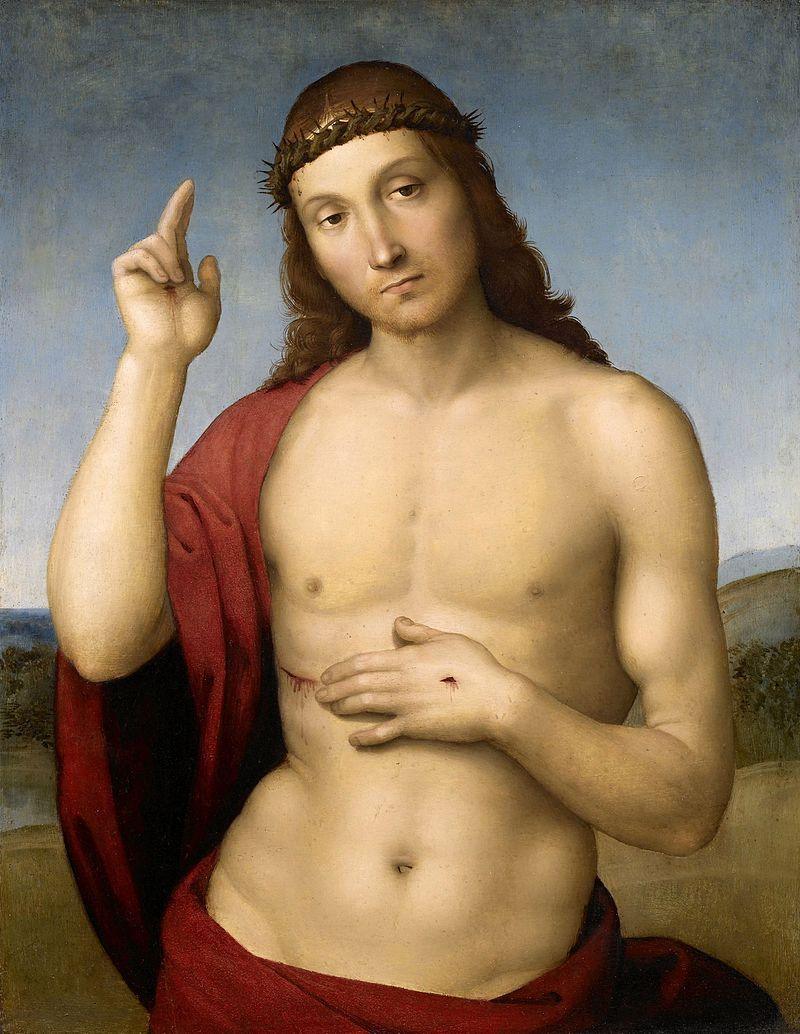
The painting shows Christ from the waist up, facing forward and commanding the composition, against a grayish-blue sky and a low landscape that occupies only the bottom strip. His bare torso is partly wrapped in a dark red cloth, draped over his shoulder and around the lower part of his figure. He has long, wavy hair and a crown of thorns framing his head. One hand is raised beside his face, with the index finger extended, while the other rests horizontally on his abdomen. The small visible wounds on his hands and side complete a serene presence, though one marked by suffering.
The work presents Christ in a devotional image that brings together 2 central dimensions of his representation: the spiritual authority of the raised gesture and the memory of the Passion. The crown of thorns refers to the episode of suffering before the crucifixion, while the wounds make the sacrificed body recognizable. The composition does not unfold a complex narrative scene; it focuses attention on the sacred figure and his direct relationship with the viewer. In this sense, the title Christ Blessing directs the interpretation toward the gesture of the hand, which can be understood as a sign of blessing, teaching or proclamation, without diminishing the symbolic weight of the signs of the Passion.
The iconography is shaped by carefully articulated contrasts. The crown of thorns creates an irregular line around the face and makes the head the spiritual center of the composition. The wounds connect the present body with the account of the Crucifixion, allowing the serenity of the expression to coexist with a tangible awareness of pain. The red cloth lends chromatic intensity that reinforces the gravity of the scene, while the open, dark landscape places Christ in a secluded space, almost suspended between earth and heaven. The raised finger focuses a vertical energy and establishes a visual link between the face, the horizon, and the transcendent dimension suggested by the background.
Formally, the composition is vertical, centered, and monumental in scale within the picture plane. The body occupies almost the entire surface, so the viewer first encounters the face, the crown, and the raised gesture, then moves down to the hands, abdomen, and cloth. The raised arm introduces a diagonal rhythm that balances the more horizontal position of the hand resting on the body. The cool tones of the sky and landscape provide a restrained, stable background, against which the warm hues of the skin and the deep red of the fabric stand out. Soft lighting models the torso without creating theatrical effects, encouraging quiet contemplation. The reduced, dark forms of the landscape serve as a spatial counterpoint to the clarity of the central figure.
Attributed to Raphael, the work rests above all on the clarity of its image and the devotional focus of its design. The frontal composition eliminates distractions and makes each attribute—the crown, the wounds, the cloth, and the raised hand—part of a unified reading. It is worth noting how the gesture rising toward the sky does not disrupt the overall stillness but instead gives it structure: it guides the eye, asserts Christ’s presence, and transforms the suffering figure into a presence of serene authority. The painting’s power lies in this tension between blessing and sacrifice, bringing contemplation, humanity, and symbolism together within an open, silent visual space.
Have questions about our oil painting reproductions? See our frequently asked questions.