Michelangelo Buonarroti, a name that resonates with the force of a hammer striking marble, a genius whose art defined an era and continues to inspire awe. Beyond the postcards of the Sistine Chapel and reproductions of David lies a story of passion, rebellion, and an unrelenting pursuit of perfection that consumed his life. This article not only celebrates his masterpieces, but also delves into the soul of an artist tormented by the tension between divinity and humanity, between ideal and reality.
Michelangelo was not simply an artist; he was a man consumed by his art. His biography is marked by a constant tension between his fervent desire to achieve perfection and the limitations imposed by his own humanity. He was known for his irascible temper, his relentless perfectionism, and his profound loneliness. This duality was expressed in his work, where idealized beauty was juxtaposed with representations of suffering and internal conflict. Creation was both torture and liberation. His choice of marble, a hard and resilient material, reflects his own nature: relentless in his pursuit of the perfect form, but also vulnerable to imperfections and challenges. His correspondence reveals a man tormented by doubts, pressures, and the constant demand to surpass himself.
The Italian Renaissance, with its cultural effervescence and renewed interest in classical antiquity, was the crucible in which Michelangelo's genius was forged. Florence, under the patronage of the Medici, and Rome, with the power of the papacy, were the main settings of his life and work. The political instability of the era, rivalries among the city-states, and religious tensions deeply influenced his artistic vision. The Sack of Rome in 1527, for example, marked him deeply and was reflected in the apocalyptic tone of later works such as The Last Judgment. The Renaissance not only provided him with the inspiration and tools for his art, but also confronted him with the complexities of power, ambition, and the fragility of the human condition. The renewed interest in human anatomy, exemplified by Leonardo da Vinci's studies, also influenced the precision and realism of Michelangelo's figures.

David: a symbol of political defiance and anatomical perfection
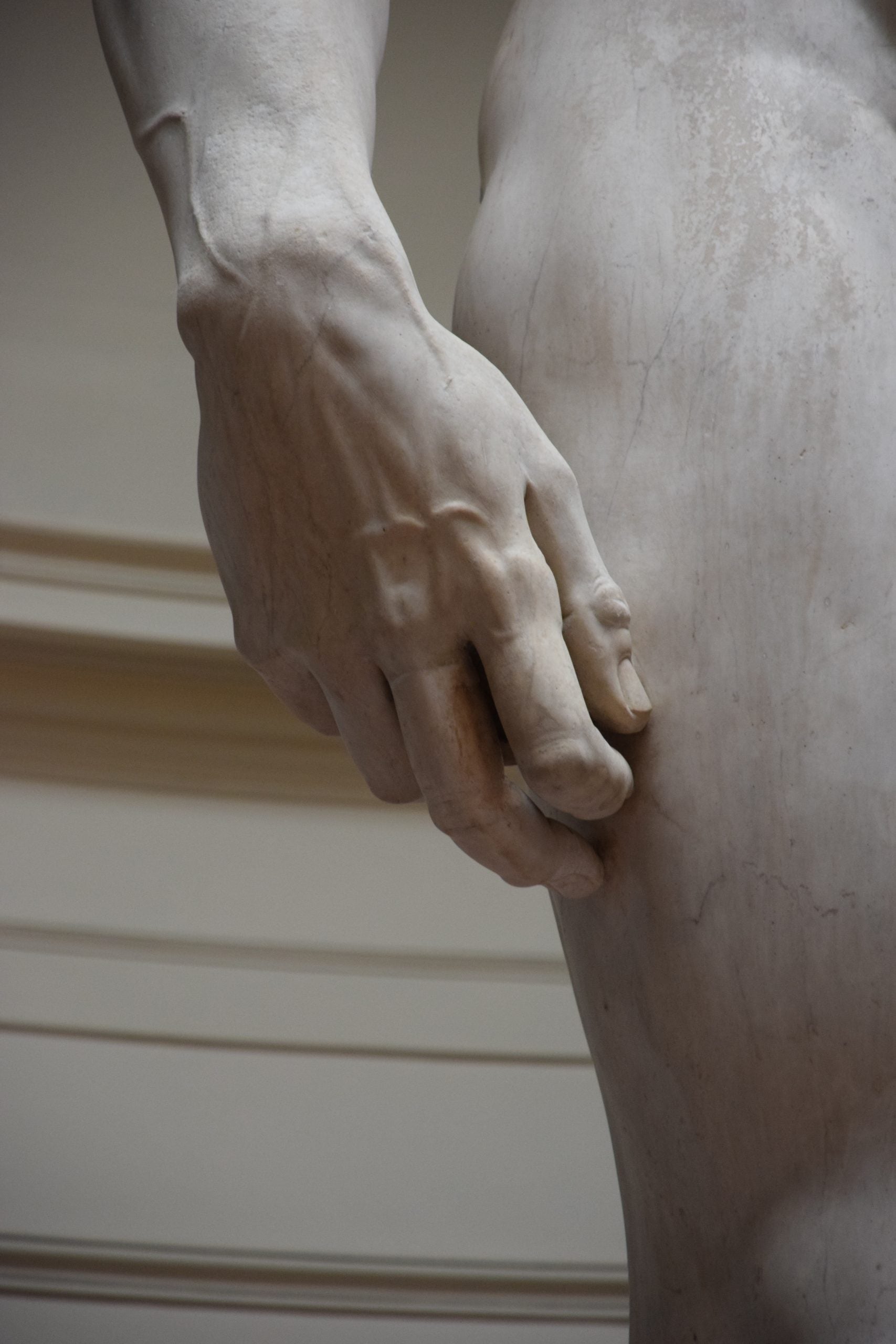
David, carved between 1501 and 1504, is much more than a representation of the biblical figure; it is a symbol of the Florentine Republic, defying the tyranny of the Medici and the threat of neighboring states. Its nudity, contrary to tradition, symbolizes the Republic’s vulnerability and purity. The choice of a moment before the battle, with David focused and full of tension, conveys the determination to defend freedom. The anatomical perfection, the result of meticulous studies of the human body, reflects the Renaissance ideal of classical beauty. Originally intended to adorn the Florence Cathedral, its final placement in front of the Palazzo Vecchio, seat of government, underscores its political significance. The work became a beacon of hope and resistance for the Florentines. The precision with which Michelangelo captured David’s musculature, facial expression, and dynamic pose established him as a master sculptor.

Pietà: a masterpiece of youth and its subversive message
The Pietà, sculpted when Michelangelo was only 24 years old, is a masterpiece of technical virtuosity and deep emotion. It depicts the Virgin Mary holding the body of Christ after the crucifixion. Despite his youth, Michelangelo managed to capture serenity and transcendent beauty in the faces of Mary and Jesus. The softness of the forms, the anatomical precision, and the impeccable polishing of the marble create a sense of unreality and divine perfection. Unlike other depictions of the Pietà, Mary appears young and beautiful, which caused controversy in its time. Some interpreted this youthfulness as a symbol of purity and the timelessness of faith. The work is located in St. Peter’s Basilica in the Vatican and is one of the most admired sculptures in the world. Michelangelo’s signature on the band crossing Mary’s chest is the only known one on a sculpture.

Moses: fury contained in marble
The Moses, part of the monumental unfinished project for the tomb of Pope Julius II, is an imposing representation of the biblical figure. What sets this Moses apart is his strength and his contained rage. Michelangelo captured the moment when Moses descends from Mount Sinai and finds his people worshiping a golden calf. The horns on his head, the result of a mistranslation of the Bible, have become an iconic feature of the sculpture. The powerful musculature, the imposing beard, and the piercing gaze convey the leader’s authority and fury. The tension in the muscles and the facial expression reveal the inner conflict between his love for his people and his disappointment at their unfaithfulness. The sculpture is a masterful example of how Michelangelo could infuse marble with life and emotion, creating figures of unmatched dramatic intensity. This Moses is not just a religious leader; he is a symbol of the struggle between faith and idolatry, between law and sin.

The Last Judgment: an apocalyptic vision and its impact on the Church
The Last Judgment, painted on the altar wall of the Sistine Chapel decades after the ceiling, is a work of unprecedented scale and dramatic intensity. It depicts the second coming of Christ and the final judgment of humanity. The chaotic composition and the multitude of nude figures sparked controversy and criticism from the Church. Michelangelo defied the artistic conventions of the time, creating an apocalyptic vision of human destiny. The figure of Christ, with his imposing musculature and stern gaze, dominates the scene. Angels and demons struggle for the souls of the righteous and the damned. Michelangelo’s self-portrait as the flayed skin of Saint Bartholomew reflects his own anguish and sense of guilt. The work marked a turning point in the history of art, influencing generations of later artists and generating debate about the role of religious art. Some saw it as a masterpiece of genius, while others considered it a blasphemy.

The Creation of Adam: a universal icon and its modern interpretation
The Creation of Adam, part of the fresco cycle on the ceiling of the Sistine Chapel, is one of the most recognizable and reproduced images in art history. It depicts the moment when God breathes life into Adam, the first man. The simple yet powerful composition, with the hands of God and Adam almost touching, conveys the divine spark that gives rise to humanity. The figure of God, surrounded by angels and wrapped in a form that resembles a human brain, has been the subject of numerous interpretations. Some believe Michelangelo intended to portray divine intelligence and knowledge as the source of life. The beauty and perfection of the figures, as well as the intensity of the moment, have captivated viewers for centuries. The image has been reinterpreted and adapted in countless contexts, from advertising to popular culture, becoming a universal symbol of creation and the connection between the divine and the human. This work continues to inspire wonder and reflection on the origin and purpose of life.

Sistine Chapel - Michelangelo
The fresco technique, which consists of painting on a wet plaster surface, requires exceptional precision and speed. Michelangelo mastered this technique to perfection, creating works of astonishing durability and luminosity. He worked in sections, applying the plaster and painting each section in a single day. This demanded meticulous planning and flawless execution. His mastery of color, perspective, and anatomy allowed him to create figures of impressive three-dimensionality and realism. Despite the technical difficulties, he managed to capture his artistic vision with extraordinary freedom and expressiveness. The Sistine Chapel is a testament to his technical genius and his ability to overcome the challenges of the medium. The restoration process of the Sistine Chapel in the 20th century revealed the brilliance of Michelangelo's original colors, challenging the common belief that his palette was dark and somber.

St. Peter's dome: a feat of engineering and religious symbolism
After the death of Bramante and other architects, Michelangelo, by then an established artist, took on the task of designing the dome of St. Peter's Basilica in Rome. This architectural masterpiece combines classical and Renaissance elements, creating an imposing and majestic structure. The dome is not only an engineering feat, but also a symbol of the Catholic Church and its power. Its design, inspired by the dome of the Pantheon in Rome, incorporates ribs that rise toward the sky, creating a sense of elevation and spirituality. The lantern at the top of the dome allows natural light to enter, illuminating the interior of the basilica and symbolizing the divine presence. The construction of the dome was an ambitious and challenging project that required the innovation and expertise of numerous engineers and craftsmen. Its completion cemented Michelangelo's reputation as a universal genius, capable of mastering both the visual arts and architecture. A replica of the ceiling of the Sistine Chapel, alongside works by Botticelli and Raphael, can be seen at the Prado Museum in this article.

The Laurentian Library: an architectural gem in Florence
The Laurentian Library, commissioned by the Medici family, is an example of Michelangelo’s architectural genius in a more intimate and functional context. Designed to house the Medici’s vast collection of books and manuscripts, the library is characterized by its innovation and its break with the architectural conventions of the time. The monumental staircase leading to the reading room is a masterpiece in itself, with its sinuous forms and its play of light and shadow. The reading room, with its windows that illuminate the desks and its richly decorated ceilings, creates an atmosphere of study and contemplation. Michelangelo designed both the structure and the furnishings of the library, creating a harmonious and functional space. The Laurentian Library is a testament to his versatility as an artist and his ability to create artworks on different scales and in different contexts. Despite its functionality, the library is a work of art in itself, reflecting Michelangelo’s creative genius and innovative vision. The art of painting and sculpture, as well as other forms of AI marketing are entering a new era.
Mannerism, which emerged in the High Renaissance and extended into the Baroque, is unthinkable without the imposing figure of Michelangelo. Mannerist artists, admirers of his virtuosity, sought to emulate the compositional complexity, exaggerated anatomy, and terribilità characteristic of his work. However, they often fell into affectation and empty virtuosity, moving away from the emotional depth and authenticity that defined the master. Mannerism was characterized by elongated figures, forced poses, and an unnatural color palette, seeking elegance and sophistication above realistic representation. A clear example is the work of Parmigianino, whose slender and elegant figures evoke, in a stylized way, the restrained force found in Michelangelo’s sculptures. Nevertheless, this approach carried the risk of prioritizing technique over content, which sometimes resulted in visually striking works but lacking the emotional charge that Michelangelo’s original creations did possess. Michelangelo’s influence on Mannerism is a testament to his technical skill, but also a warning about the dangers of superficial imitation.
Baroque, with its exuberance and drama, also owes a great deal to Michelangelo. While Baroque art departs stylistically from the Renaissance, the grandeur and emotional intensity present in Michelangelo's works resonated deeply with Baroque artists. The power of his figures, the complexity of his compositions, and his ability to convey intense emotions set a precedent for Baroque aesthetics. Artists such as Bernini, although with their own distinct language, acknowledged their debt to Michelangelo in their pursuit of monumentality and dramatic expression. Bernini, for example, took the idea of the figure in motion, as we see it in Michelangelo's David, and brought it to a new level of dynamism and theatricality in his sculptures. The key difference lies in the fact that, while Michelangelo sought the idealized perfection of the human body, Baroque artists focused on the representation of emotion and movement, using light and shadow to create dramatic effects. Bernini's Cornaro Chapel, with its Ecstasy of Saint Teresa, is a paradigmatic example of this aesthetic. Michelangelo's legacy in the Baroque is manifested in the ambition to create works that impact the viewer, both visually and emotionally, but with an exuberance and theatricality that distinguish it from Renaissance classicism.
Michelangelo's influence is not limited to the artistic periods immediately following the Renaissance. His work continues to inspire contemporary artists who find in his mastery of anatomy, his ability to convey emotions, and his monumental vision an inexhaustible source of ideas. Although styles and media have evolved, the pursuit of human expression and the exploration of the human condition remain central themes for many current artists, who often turn to Michelangelo as a point of reference. For example, some contemporary sculptors, influenced by his work with marble, explore new techniques and materials to create works that dialogue with Michelangelo's legacy. Other artists, such as Jake and Dinos Chapman, although in an irreverent and provocative way, have reinterpreted Michelangelo's iconography to criticize contemporary society. His impact extends even to areas such as character design for video games and films, where the anatomy and expressiveness of Michelangelo's figures serve as a model for creating visually striking and emotionally complex characters. Michelangelo's enduring relevance lies in his ability to transcend time and continue inspiring artists across all disciplines, who find in his work a mirror in which to reflect their own concerns and a source of inspiration for creating new forms of artistic expression.
Michelangelo’s life was marked both by his artistic genius and by complex personal relationships. His relationship with his patrons, especially Popes Julius II and Leo X, was crucial to his career, but it was also riddled with tensions and conflicts. While these patrons gave him the opportunity to create monumental works such as the Sistine Chapel and the tomb of Julius II, they also imposed deadlines and demands that often frustrated him. His relationship with other artists, such as Leonardo da Vinci and Raphael, was ambivalent. While he admired their talent, he also felt strong competition, which gave rise to rivalries and tensions. For example, the competition with Leonardo da Vinci for the execution of frescoes in the Palazzo Vecchio in Florence was well known and reflected the stylistic and personality differences between them. Despite his fame and success, Michelangelo was a solitary and reserved man, who preferred work to company and who often seemed distrustful and distant toward others. His obsessive dedication to art and his constant pursuit of perfection led him to isolate himself and to sacrifice his personal life for the sake of his work.
Michelangelo’s correspondence, preserved to a large extent to this day, offers a valuable window into his inner world. Through his letters, we can glimpse his thoughts, emotions, and concerns. The letters addressed to his family, especially his father and brothers, reveal his sense of responsibility and concern for their well-being. The letters to his friends and collaborators show us his most intimate and personal side. In these letters, Michelangelo speaks not only about art, but also about his personal worries, his fears, and his hopes. For example, in a letter to his friend Giovanni da Pistoia, Michelangelo complains about the difficult working conditions in the Sistine Chapel and expresses his frustration at the constant interruptions and demands of his patrons. These letters allow us to better understand the artist’s complex and tormented personality, as well as the pressures and challenges he had to face throughout his life. Michelangelo’s correspondence is an invaluable testament to his artistic genius and his humanity.
Michelangelo’s sexuality has been the subject of debate and speculation for centuries. While there is no conclusive evidence about his sexual orientation, his poems and letters reveal intense admiration and affection for some men. Some scholars have interpreted these poems as evidence of possible homosexuality, while others regard them as platonic expressions of friendship and admiration. It is important to note that, in the context of the Renaissance, relationships between men were often idealized and did not necessarily imply a sexual relationship. Regardless of his sexual orientation, the truth is that Michelangelo maintained intense and meaningful relationships with some men, who played an important role in his personal and artistic life. The controversy surrounding his sexuality reflects the attitudes and prejudices of each era, as well as the difficulty of interpreting human relationships through social and cultural conventions. Ultimately, Michelangelo’s sexuality remains a mystery, and his artistic legacy transcends any label or definition. As in the case of Leonardo da Vinci, the analysis of his work and his writings allows us to glimpse his genius, but not necessarily reveal the secrets of his private life.
Carrara marble, extracted from the quarries of Tuscany, was Michelangelo’s material of choice. Its purity, whiteness, and fine grain made it the ideal medium for capturing his sculptural vision. Michelangelo personally traveled to Carrara to select the marble blocks, looking for those with the right veining and shape for the work he had in mind. He believed that the sculpture was already contained within the marble block, and his job was to free it. This obsession with perfection led him to reject blocks that did not meet his standards, even if that meant delays and additional costs. The process of carving marble was arduous and required great technical skill. Michelangelo used a variety of tools, such as chisels, point tools, and claw chisels, to shape the stone, working gradually from the overall forms to the most minute details. His mastery of the technique allowed him to create works of great anatomical precision and emotional expressiveness. As the Encyclopaedia Britannica notes, his technical mastery of marble was unmatched.
Although Michelangelo is better known for his sculpture, he was also an accomplished painter. His color palette, although relatively limited compared with that of other Renaissance artists, was carefully selected and used with great mastery. In the Sistine Chapel, for example, he used a range of vibrant and luminous colors, such as ultramarine blue, vermilion red, and ocher yellow, to create an effect of grandeur and solemnity. The choice of pigments was not random, but loaded with symbolism. Ultramarine blue, obtained from lapis lazuli, was the most expensive and precious color, and was used to represent the sky and the divine. Vermilion red, obtained from cinnabar, symbolized blood and sacrifice. Ocher yellow, obtained from clay, represented the earth and humanity. Michelangelo used these colors to create contrasts and dramatic effects, enhancing the expressiveness of his figures and conveying a religious and moral message. His skill in combining colors and creating light and shadow effects contributed to the monumentality and visual impact of his pictorial works.
Deep knowledge of human anatomy was fundamental to Michelangelo's art. He studied anatomy through the dissection of cadavers, which allowed him to understand the structure and functioning of the human body in detail. This knowledge is reflected in the precision and realism with which he represented the human body in his sculptures and paintings. His figures are not only idealized representations of beauty, but also precise and detailed anatomical studies. For example, the muscles, bones, and joints are represented with an accuracy that can only be achieved through a deep knowledge of anatomy. Michelangelo used this knowledge to create figures of great strength and expressiveness, capable of conveying intense emotions through their posture, gesture, and musculature. His mastery of anatomy allowed him to create works that pushed the boundaries of artistic representation and that are still admired for their beauty and realism. The representation of the human body in Michelangelo's work is a testament to his artistic genius and his dedication to the study of anatomy.
Michelangelo's work has transcended the field of art history and has had a significant impact on popular culture. His iconic images, such as The Creation of Adam and David, have been reproduced and reinterpreted in countless contexts, from advertising to film. For example, the image of The Creation of Adam has been used in ads of all kinds, from clothing brands to insurance companies. David, on the other hand, has become a symbol of male beauty and perfection, appearing in films, television series, and video games. Michelangelo's work has also inspired contemporary artists from different disciplines, who have created works that engage with his legacy. For example, some artists have reinterpreted his sculptures using modern materials and techniques, while others have created works that question his vision of the human body and beauty. Michelangelo's impact on popular culture is a testament to the universality and timelessness of his work. His images remain relevant and meaningful to today's audiences, conveying messages of hope, beauty, and transcendence.
The restoration of Michelangelo’s works has been the subject of debate and controversy for decades. Some experts argue that restoration is necessary to preserve the works for future generations, while others fear that it may damage their authenticity and historical value. The restoration of the Sistine Chapel, carried out between 1980 and 1994, was especially controversial. Critics argued that cleaning the frescoes had removed some of the original patina and had altered Michelangelo’s color palette. Supporters of the restoration, on the other hand, claimed that the cleaning had revealed the true beauty and luminosity of the frescoes, which had been darkened by centuries of dirt and smoke. The debate over the restoration of Michelangelo’s works highlights the complexity of the task of preserving artistic heritage. There is no easy or definitive answer, and each case must be carefully assessed, taking into account the risks and benefits of intervention. Today, restoration techniques are increasingly sophisticated and respectful of the original work, but the debate over the balance between preservation and authenticity remains relevant.
Determining the exact value of a work by Michelangelo is a complex task, almost impossible in many cases. Most of his sculptures and paintings most famous works, such as David, the Pietà, or the frescoes of the Sistine Chapel, belong to public collections and are considered world heritage, so they are not available for sale. Their value, therefore, goes beyond the monetary and is measured in terms of cultural and historical importance. However, there are works by Michelangelo in private hands, although they are considerably rarer. These works, generally drawings or sketches, fetch astronomical prices at auctions, easily exceeding several million euros. The final price depends on factors such as provenance, condition, the subject depicted and, of course, authenticity, which is a crucial aspect.
Michelangelo’s drawings and sketches are especially prized by collectors and museums, as they offer an intimate view of the artist’s creative process. These preparatory works reveal the meticulousness with which Michelangelo studied human anatomy, composition, and the expressiveness of his figures. A simple pencil line could be the starting point for a masterpiece. For example, a study of a leg for David or a sketch for a figure in the Sistine Chapel can fetch high prices on the art market. In 2000, a drawing of a male nude study, attributed to Michelangelo, sold for more than 8 million British pounds. The value of these drawings also lies in their fragility and rarity; many of them are in museums and private collections, which limits their availability and increases their value.
The authentication of a work by Michelangelo is a rigorous process involving experts in Renaissance art, historians, restorers, and scientists. The style, technique, materials used, provenance, and historical documentation of the work are analyzed. Comparative studies are carried out with authenticated works by the artist, and dating techniques and pigment analysis are used to verify the period of creation. A key factor is the study of the artist's signature or identifying marks, although the absence of a signature does not rule out authenticity, since many drawings and sketches are unsigned. The authentication process is costly and complex, and often requires the intervention of several experts to reach a conclusion. Even with all these precautions, the attribution of a work to Michelangelo can be the subject of debate among specialists.
Michelangelo was a master in the representation of the human figure, and his mastery of anatomy was fundamental to his success. Unlike other artists of his time, who relied on idealized models, Michelangelo meticulously studied real anatomy, dissecting corpses to understand muscular and skeletal structure. He used live models in his workshop, asking them to pose in various positions to study the movement and tension of the body. His anatomical drawings are proof of his dedication to the study of the human form, and reveal his deep knowledge of anatomy. These studies allowed him to create figures with powerful musculature and realistic expressiveness, conveying a sense of life and dynamism. We can consider this intense pursuit of knowledge to be one of the many characteristics that set Michelangelo apart from other artists of his time.
Michelangelo was a virtuoso of the fresco technique, a painting technique that consists of applying color pigments onto a surface of fresh plaster (recently applied). This technique requires great precision and speed, since the painter must complete the work before the plaster dries. Michelangelo perfected the fresco technique in the Sistine Chapel, where he painted scenes from Genesis and the Last Judgment. His mastery of the technique allowed him to create figures with great detail and realism, using a palette of vibrant colors and dramatic lighting. To master the fresco technique, Michelangelo carefully prepared the wall, applying several layers of plaster of different thicknesses. He also used stencils and preparatory drawings to guide his work. The fresco technique requires a deep knowledge of materials and mastery of brushwork, and Michelangelo proved to be a master in both.
Despite his genius, Michelangelo did not work alone. In his workshop, he had the help of apprentices and collaborators who assisted him in preparing materials, carrying out secondary tasks, and executing some parts of the works. These collaborators were chosen for their skill and talent, and they learned from master by observing his work and receiving his instructions. Although Michelangelo directed the workshop and supervised every detail of the works, the work of his collaborators was essential to carry out large-scale projects such as the Sistine Chapel. It is difficult to determine exactly the participation of each collaborator in Michelangelo's works, but it is known that some of them went on to become recognized artists in their own right. Michelangelo's workshop was therefore a center of learning and creation where some of the best artists of the Renaissance were trained.

The Crucifixion of Saint Peter
The Crucifixion of Saint Peter, located in the Pauline Chapel in the Vatican, is one of Michelangelo's last works, painted between 1546 and 1550. Often overshadowed by the frescoes of the Sistine Chapel, this masterpiece reveals the artist's profound spirituality and inner torment in his final years. The composition presents a chaotic and tension-filled scene, with figures struggling to raise the cross on which Saint Peter will be crucified upside down, at his own request, because he did not consider himself worthy to die like Christ. The color palette is darker and more restrained than in his earlier works, reflecting the artist's maturity and pessimism. The Crucifixion of Saint Peter is a testament to Michelangelo's genius, even in his later years, and reveals his ability to convey complex emotions through imagery.

The Holy Family (Doni Tondo)
The Holy Family, also known as the Doni Tondo, is a tempera painting on panel made by Michelangelo around 1506. This work, commissioned by Agnolo Doni to celebrate his marriage, is one of the few paintings easel paintings attributed with certainty to Michelangelo. The composition features the Virgin Mary, Saint Joseph, and the Baby Jesus in the foreground, with a group of male nudes in the background. The work stands out for its innovative design and bold use of color, which foreshadows Mannerism. The Holy Family is a display of Michelangelo's technical mastery and creative originality, as he was able to combine classical and Renaissance elements to create a unique and innovative work. This painting also reflects Michelangelo's interest in human anatomy and his skill in depicting the beauty and strength of the human body. Those interested in the painting technique of this period can find relevant information by consulting the catalogs of museums such as El Prado.

The Tomb of Julius II - Michelangelo
The Tomb of Julius II was one of the most ambitious and frustrating projects of Michelangelo's career. Commissioned by Pope Julius II in 1505, the original tomb was conceived as a monumental mausoleum that would house more than forty sculptures. However, due to financial problems and disagreements with the Pope, the project was gradually scaled back and modified over the years. Finally, the tomb was completed in 1545, on a much smaller scale than originally planned. Even so, the Tomb of Julius II remains an impressive work, housing some of Michelangelo's most famous sculptures, such as the Moses. This unfinished project is a testament to Michelangelo's ambition and genius, but also to the difficulties and frustrations he faced throughout his life.
Michelangelo's contribution to art history is incalculable. His mastery of sculpture, painting, and architecture makes him one of the most important and influential artists of all time. His works, such as the David, the Pietà, the Sistine Chapel, and the dome of St. Peter's, are considered masterpieces of Western art and have inspired generations of artists. Michelangelo revolutionized the representation of the human figure, creating figures with powerful musculature and realistic expressiveness. He also innovated in fresco and sculpture techniques, using groundbreaking materials and methods. His influence spread throughout Europe, and his style became a model for Renaissance and Baroque artists. Michelangelo, in short, was a creative genius who transformed art and left an indelible legacy in the history of humanity. His artistic legacy is comparable to that of artists such as Da Vinci, with whom he shared an innovative vision.
Michelangelo Buonarroti's mastery was not limited to a single discipline; he was an accomplished sculptor, painter, architect, and poet. Each facet of his genius is intertwined, enriching his artistic vision and allowing him to break creative boundaries. His approach not only revolutionized the way the human body was represented, but also infused his works with unprecedented emotional intensity.
In sculpture, Michelangelo sought to free the human figure from the stone, believing it already existed within the marble block. This process required a deep understanding of anatomy, which he studied tirelessly. His David, for example, is not just a perfect anatomical representation, but an embodiment of strength, determination, and idealized beauty. By choosing to depict David before the battle with Goliath, Michelangelo captured a moment of latent tension, a powerful symbol of the Florentine Republic.
His work in the Sistine Chapel is a testament to his ambition and mastery of fresco technique. The creation process for these frescoes was exhausting, requiring years of work on scaffolding, often in uncomfortable positions. He faced considerable technical challenges, such as maintaining color consistency and ensuring the paint adhered to the plaster. However, his perseverance resulted in a masterpiece that continues to inspire awe and admiration around the world. If you’d like to learn more about other equally brilliant artists, you can read about Da Vinci and his work.
Michelangelo’s legacy endures through his works, which continue to influence contemporary art and culture. His ability to fuse technique, emotion, and symbolism has set a standard for artistic excellence. Consider, for example, his innovative use of *contrapposto* in sculpture, where the weight of the body shifts onto one leg, creating a sense of movement and dynamism. This technique, which dates back to ancient Greek sculpture, was revitalized by Michelangelo and became a fundamental element of his style.
Michelangelo’s focus on emotional expression influenced generations of artists. Rather than simply depicting the human form, he sought to capture the essence of the soul. This search for emotional truth is evident in his portrayals of biblical figures, such as the Virgin Mary in the Pietà, where he conveys a deep sense of grief and compassion. This commitment to emotion and humanity is what makes his works so powerful and resonant, even centuries after their creation.
Michelangelo’s artistic rebellion lay in his constant pursuit of perfection, his challenge to convention, and his deep connection to the human condition. His works are not mere representations, but passionate expressions of his genius and his vision of the world.
KUADROS ©, a famous painting on your wall. Hand-made oil painting reproductions, with the quality of professional artists and the distinctive seal of KUADROS ©. paintings reproduction service with a satisfaction guarantee. If you are not completely satisfied with your painting replica, we will refund 100% of your money.