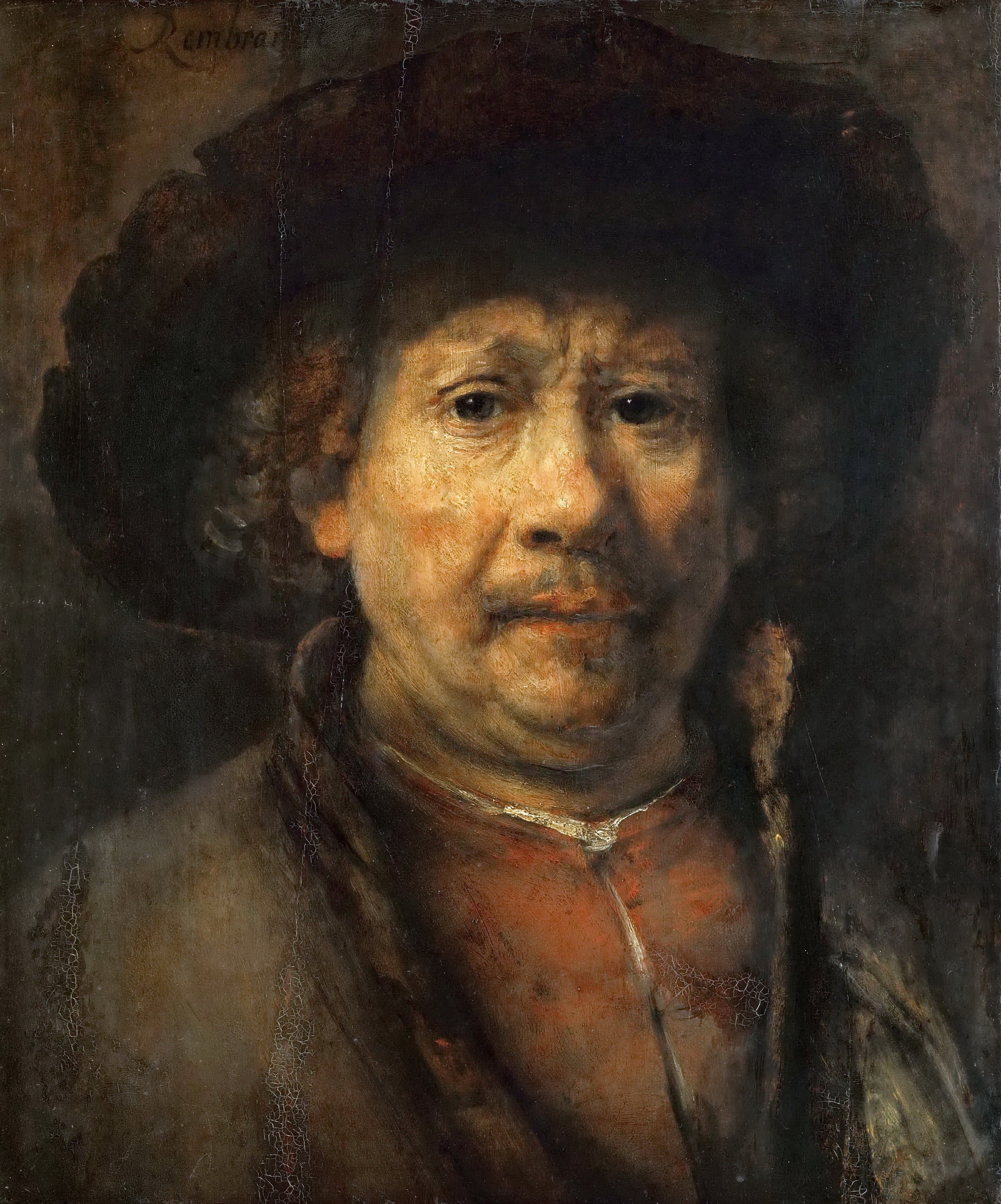
There are artists who paint faces. And then there is Rembrandt van Rijn, who seemed to paint the soul itself. Before one of his portraits, one has the uncomfortable —and fascinating— feeling of being watched by someone who understands human secrets that even we ourselves have not managed to decipher. His figures breathe, hesitate, age, fear, remember. They are not models frozen in an elegant pose: they are human beings trapped in a moment of truth.
In the art of portraiture, few names carry the emotional and psychological weight of Rembrandt. While many painters of his time focused on the beauty, wealth, or social prestige of their clients, he seemed obsessed with something much more complex: human interiority. Every wrinkle, every shadow under the eyes, every barely perceptible gesture becomes an emotional clue. His paintings do not try to idealize. They try to understand.

Portrait of Rembrandt
Rembrandt was born in Leiden, the Netherlands, in 1606. He lived during the so-called Dutch Golden Age, a time of enormous economic prosperity, international trade, and cultural expansion. Amsterdam was then a vibrant, wealthy, and sophisticated city, full of merchants, intellectuals, and art collectors. But even amid that explosion of visual wealth, Rembrandt stood out for something very different: his ability to reveal human vulnerability.
Perhaps part of this sensitivity came from his own life. Although he achieved fame and fortune at a relatively young age, he also suffered devastating losses. His wife Saskia died prematurely. Three of his children died before reaching adulthood. Later he would also lose his companion Hendrickje Stoffels and end up practically ruined. His life was marked by both success and pain. And that pain slowly seeped into his painting.
Many historians believe that the emotional depth of his portraits cannot be separated from these personal experiences. Unlike other Baroque artists obsessed with outward theatricality, Rembrandt developed a deeply introspective gaze. His figures seem to exist in silence, immersed in private thoughts. There is an almost brutal humanity in them.
One of Rembrandt's most extraordinary qualities is his use of light. It is not simply a matter of technical illumination. His chiaroscuro works as a psychological tool. Light reveals emotions while darkness hides doubts, guilt, or melancholy. In many of his portraits, the eyes emerge from deep shadows as if the figure were slowly stepping out of their own inner world.

Portrait with Two Circles - Rembrandt
His famous self-portraits are probably the best example of this psychological exploration. No great master in history painted himself as many times as Rembrandt. It is estimated that he made around eighty self-portraits among paintings, drawings, and etchings. But these were not narcissistic exercises. They worked more like an emotional diary.
In them we see the ambitious young man, the elegant and successful man, the confident artist. But we also observe fatigue, aging, economic ruin, and fragility. As the years pass, his face becomes heavier, the bags under his eyes more visible, the expression more introspective. There is something almost painfully honest in that visual sequence.
One of the most moving is his Self-Portrait with Two Circles, painted around 1665. Rembrandt appears before the viewer with a mix of exhaustion and quiet dignity. He is no longer trying to impress us. There is no vanity. Only human presence. The thick texture of the paint seems almost like living flesh. The eyes contain decades of experience.

Portrait of Rembrandt
Rembrandt's psychological genius also emerges powerfully in his group portraits. His most famous work, The Night Watch, completely revolutionized the genre. Before him, group portraits were generally rigid and static. The figures posed neatly, almost like school photographs. Rembrandt transformed that into a living scene, full of movement and tension.
But what is most impressive is not only the dynamic composition. It is the emotional individuality of each figure. Each face seems to belong to a real person with his own thoughts. Some look on alert. Others seem distracted. Some convey pride. Others a certain uncertainty. The painting as a whole works as a complex psychological choreography.

Rembrandt understood something essential about human nature: people rarely show a single emotion. In his portraits, pride and fear, serenity and sadness, power and vulnerability coexist. That emotional ambiguity is precisely what makes his works seem so modern even centuries later.
While other painters beautified the skin and softened imperfections, Rembrandt did the opposite. He exaggerated textures. He showed blemishes, scars, wrinkles, and fatigue. But never cruelly. Rather, with compassion. His portraits seem to tell us that human dignity does not depend on physical perfection.
This is particularly visible in his portraits of elderly people. Rarely in art history has old age been portrayed with such humanity. Instead of hiding the passage of time, Rembrandt makes it the star. The aged faces contain memory, experience, and emotional depth.
Works such as Portrait of an Old Man with a Beard or Old Woman Reading have an almost spiritual atmosphere. They do not impress through luxury or grandeur. They make an impact through the silent intensity of the human gaze.

Old Man in Red - Rembrandt
Another fascinating aspect is the relationship between Rembrandt and the viewer. His portraits are not decorative in the conventional sense. They force us to look slowly. They often create a strange sense of intimacy. One feels that the figure could start speaking at any moment.
Part of this effect comes from his pictorial technique. Rembrandt used thick layers of paint, known as impasto, to build almost sculptural textures. Light reflects differently on each surface, creating an extraordinary physical sensation. In person, his paintings seem to vibrate.
He also mastered engraving brilliantly, a technique that allowed him to explore human expressions even further through lines and light contrasts. His engravings possess impressive emotional intensity, even while using visual resources far more limited than oil painting.
Rembrandt’s influence on later generations was immense. Painters such as Goya, Van Gogh, Francis Bacon, and Lucian Freud inherited from him the idea that a portrait can be a psychological exploration rather than a physical representation. Even contemporary photography and cinema owe much to his way of using light to build emotion.
Film directors such as Stanley Kubrick and Ridley Scott have been compared to Rembrandt because of their dramatic use of lighting. Many photographers today try to recreate the famous “Rembrandt light,” characterized by a small triangle of light beneath one of the subject’s eyes.
But reducing Rembrandt to a lighting technique would be unfair. What is truly extraordinary is his visual empathy. Few artists have observed other human beings with such depth.
In an era obsessed with filters, digital perfection, and carefully controlled images, Rembrandt’s portraits feel surprisingly contemporary. They remind us of something we often forget: human faces are interesting precisely because of their imperfections, contradictions, and emotional traces.
Perhaps that is why we keep returning to him. His paintings do not age because they speak of universal emotions. Fear, pride, sadness, hope, exhaustion, tenderness. It is all still there, beating beneath layers of oil more than three centuries old.
Looking at a portrait by Rembrandt is not just observing a painting. It is encountering another human being across time. And few artistic experiences are as intense as that.
The 5 most representative works by Rembrandt
1. The Night Watch (1642)

This monumental work revolutionized the European group portrait. Rembrandt broke with the usual rigidity of this genre and created a scene full of movement, tension, and life. The composition feels almost cinematic. Each figure has its own personality and occupies a different psychological role within the scene.
The dramatic lighting turns the painting into a hypnotic visual experience. The figures emerge from dark areas like actors lit on a theater stage. The sense of movement is so intense that many viewers feel the action continues even after they look away.
The work was initially misunderstood because many clients expected more conventional portraits in which everyone would appear clearly visible. Rembrandt preferred to create art rather than simply satisfy social expectations.
2. Self-Portrait with Two Circles (c. 1665)
One of the most profound self-portraits in the entire history of art. Rembrandt appears aged, tired, but filled with inner dignity. The brushwork is thick, almost brutal, and the texture of the skin feels tangible.
The mysterious circles in the background have generated multiple interpretations. Some believe they symbolize artistic perfection; others think they are simply a compositional experiment. But what is truly unforgettable are the artist's eyes: direct, aware, and deeply human.
The work conveys extraordinary emotional honesty. It does not try to hide human fragility. It embraces it.
3. The Anatomy Lesson of Dr. Nicolaes Tulp (1632)

This painting made Rembrandt a celebrity in Amsterdam. Although it is a scientific scene, the true power of the work lies in the psychological reactions of the figures.
Each doctor observes the corpse differently: curiosity, concentration, fascination, tension. Rembrandt transforms an anatomical demonstration into a visual reflection on life and death.
The triangular composition and the handling of light guide the viewer's gaze with masterful precision. The illuminated corpse seems almost supernatural in contrast with the living figures surrounding it.
4. The Return of the Prodigal Son (c. 1669)

Considered by many to be Rembrandt's most emotional work. Inspired by the biblical parable, it shows the moment of forgiveness between father and son.
The emotional intensity of the painting is almost unbearable. The elderly father embraces the exhausted son with a silent tenderness that seems to transcend time. There is no exaggerated drama. Everything happens in calm, and precisely for that reason it is so powerful.
The father's hands —one masculine and the other more delicate— have been interpreted as simultaneous symbols of authority and compassion. The soft light transforms the scene into a deeply human spiritual experience.
5. Portrait of Jan Six (1654)

One of the most sophisticated psychological portraits ever painted. Jan Six appears in a seemingly casual moment, putting on a glove before leaving. But behind that simplicity lies impressive emotional complexity.
Rembrandt captures the exact moment between movement and stillness. The figure's expression conveys intelligence, elegance, and a certain melancholy introspection. The light delicately caresses the face and hands while the background remains dark and silent.
It is a portrait in which the viewer feels they are truly facing a living person, not an idealized representation.
KUADROS ©, a famous painting on your wall.
Hand-made oil painting reproductions, with the quality of professional artists and the distinctive seal of KUADROS ©.
Art reproduction service with satisfaction guarantee. If you are not completely satisfied with the replica of your painting, we refund 100% of your money.