
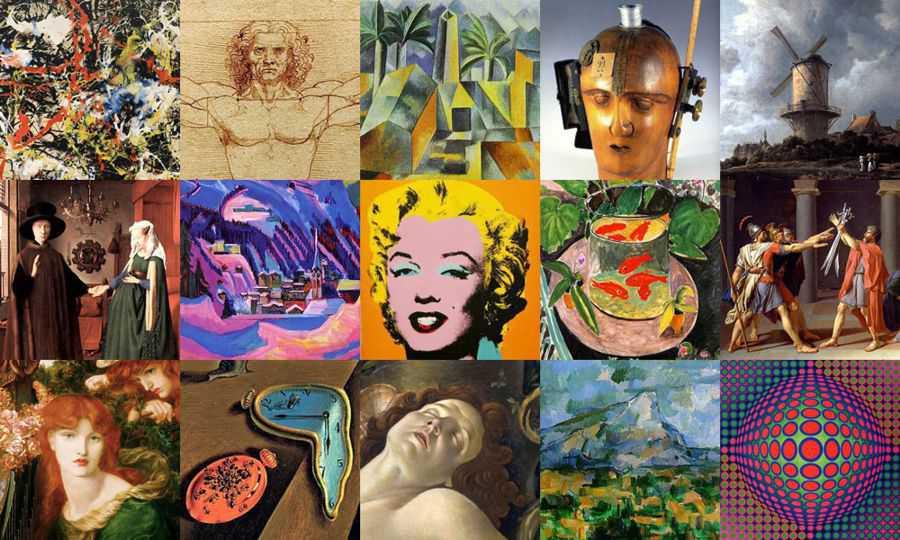
Famous Movements and Artistic Styles
Throughout history, artists have produced art in a variety of media and styles following different philosophies and ideals. Although the name of a style can often be reductive, different artistic trends or styles can be grouped under collective titles known as artistic movements.
Kuadros offers you the main terms of movements and artistic styles, from classicism to futurism, passing through baroque to avant-garde.
Abstract Expressionism

The designation 'Abstract Expressionism' encompasses a wide variety of American artistic movements of the 20th century in abstract art. Also known as the New York School, this movement includes large painted canvases, sculptures, and other media as well. The term 'action painting' is associated with abstract expressionism, and describes a highly dynamic and spontaneous application of vigorous brushstrokes and the effects of dripping and spilling paint onto the canvas.
Learn more about Abstract Expressionism
Art Deco

Emerging in France before World War I, Art Deco burst onto the scene in 1925 during the Exposition des Arts Décoratifs (Exhibition of Decorative Arts). Blurring the line between different media and fields, from architecture and furniture to clothing and jewelry, Art Deco fused modern aesthetics with skilled craftsmanship, advanced technology, and elegant materials.
Art Nouveau

A decorative style that flourished between 1890 and 1910 across Europe and the U.S. Art Nouveau, also called Jugendstil (Germany) and Sezessionstil (Austria), is characterized by sinuous and asymmetric lines based on organic forms. Although it influenced painting and sculpture, its main manifestations were architecture and the decorative and graphic arts, aiming to create a new style, free from the imitative historicism that dominated much of the artistic movements and design of the 19th century.
Avant-garde

Mazoni, Merda d'Artista. Example of avant-garde
In French, avant-garde means "advanced guard" and refers to concepts, works, or the group or people who produce them, innovative or experimental, particularly in the realms of culture, politics, and the arts.
Learn more about the Avant Garde Movement
Baroque

The term Baroque, derived from the Portuguese 'barocco' meaning 'irregular pearl or stone', is a movement in art and architecture that developed in Europe from the early 17th century to the mid-18th century. Baroque emphasizes dramatic and exaggerated movement and clear, easily interpretable details, which is far from surrealism, to produce drama, tension, exuberance, and grandeur.
Bauhaus

The art and design school was founded in Germany by Walter Gropius in 1919 and closed by the Nazis in 1933. The faculty brought together artists, architects, and designers, and developed an experimental pedagogy that focused on materials and functions rather than traditional methodologies of art schools. In its successive incarnations in Weimar, Dessau, and Berlin, it became the site of influential conversations about the role of modern art and design in society.
Learn more about the Bauhaus movement
Classicism

The principles embodied in the styles, theories, or philosophies of the different types of art from ancient Greece and Rome, focusing on traditional forms with emphasis on elegance and symmetry.
CoBrA

CoBrA, an ephemeral but innovative international artistic movement
Founded in 1948 in Paris, CoBrA was an ephemeral but innovative post-war group that brought together international artists who advocated for spontaneity as a means to create a new society. The name 'CoBrA' is an acronym of the cities of origin of its founders, Copenhagen, Brussels, and Amsterdam, respectively.
Color Field Painting

Often associated with abstract expressionism, Color Field painters were concerned with the use of pure abstraction but rejected the typical active gestures of action painting in favor of expressing the sublime through large, flat surfaces of contemplative color and open compositions.
Conceptual Art

Conceptual art, sometimes simply called conceptualism, was one of several artistic movements of the 20th century that emerged during the 1960s, emphasizing ideas and theoretical practices rather than the creation of visual forms. The term was coined in 1967 by artist Sol LeWitt, who named the new genre in his essay “Paragraphs on Conceptual Art,” in which he wrote: “The idea itself, even if not visual, is as much a work of art as any finished product.”
Constructivism

Developed by the Russian avant-garde around 1915, constructivism is a branch of abstract art, rejecting the idea of “art for art’s sake” in favor of art as a practice directed towards social purposes. The work of the movement was primarily geometric and composed with precision, sometimes through mathematical tools and measurements.
Cubism

An artistic movement initiated in 1907 by artists Pablo Picasso and Georges Braque, who developed a visual language whose geometric planes challenged the conventions of representation in different types of art, reinventing traditional themes such as nudes, landscapes, and still lifes in increasingly fragmented compositions.
Dadaism

Dada / Dadaism
Artistic and literary movement in art formed during World War I as a negative response to traditional social values and the conventional artistic practices of the different types of art of the time. Dadaist artists represented a protest movement with an anti-system manifesto, seeking to expose the accepted conventions of order and logic, which were often repressive, by shocking people into self-awareness.
Expressionism

Expressionism is an international artistic movement in art, architecture, literature, and performance that flourished between 1905 and 1920, especially in Germany and Austria, which sought to express the meaning of emotional experience rather than physical reality. The conventions of the expressionist style include distortion, exaggeration, fantasy, and the vivid, discordant, violent, or dynamic application of color to express the artist's inner feelings or ideas.
Fauvism

Coined by critic Louis Vauxcelles, fauvism (in French, “wild beasts”) is one of the artistic movements of the early 20th century. Fauvism is especially associated with Henri Matisse and André Derain, whose works are characterized by strong, vibrant colors and bold brushstrokes over realistic or figurative qualities.
Futurism

Quite unique among the different types of artistic movements, it is an Italian development in abstract art and literature, founded in 1909 by Filippo Tommaso Marinetti, with the aim of capturing the dynamism, speed, and energy of the modern mechanical world.
Harlem Renaissance

Emerging after World War I in the predominantly African American neighborhood of Harlem in New York, the Harlem Renaissance was an influential movement of African American art that encompassed visual arts, literature, music, and theater. Artists associated with the movement rejected stereotypical representations and expressed pride in black life and identity.
Impressionism

Impressionism is an artistic movement of the 19th century, especially associated with French artists such as Claude Monet, Pierre Auguste Renoir, Camille Pissarro, and Alfred Sisley, who tried to accurately and objectively capture visual "impressions" through the use of small, thin, and visible brushstrokes that come together to form a single scene and emphasize movement and the changing qualities of light.
Installation Art

Installation art is a movement developed at the same time as pop art in the late 1950s, characterized by large-scale mixed media constructions, often designed for a specific location or for a temporary period of time. Often, installation art involves creating an immersive sensory or aesthetic experience in a particular environment, which often invites the viewer to actively participate or immerse themselves.
Land Art

Land Art, also known as Earth art, Environmental art, and Earthworks, is a simple art movement that emerged in the 1960s and 1970s, characterized by works made directly in the landscape, sculpting the land itself in earthworks or creating structures in the landscape using natural materials like rocks or twigs. It could be seen as a natural version of installation art. Land Art is largely associated with Great Britain and the United States, but includes examples from many countries.
Minimalism

Another of the artistic movements of the 1960s, typified by works composed of simple art, such as geometric shapes devoid of figurative content. The minimal vocabulary of forms made from humble industrial materials challenged traditional notions of craftsmanship, the illusion of spatial depth in painting, and the idea that an abstract work of art must be unique.
Neo-Impressionism

Neo-Impressionism is a term applied to an avant-garde art movement that flourished mainly in France from 1886 to 1906. Led by the example of Georges Seurat and Paul Signac, Neo-Impressionists renounced the spontaneity of Impressionism in favor of a systematic painting technique known as pointillism, based on science and the study of optics.
Neoclassicism

Almost the opposite of pop art in terms of inspiration, this style emerged in the second half of the 18th century in Europe, drawing from the art and culture of Ancient Greece and Ancient Rome, which is not uncommon for artistic movements.
Neon Art

In the 1960s, Neon Art transformed a commercial medium used for advertising into an innovative artistic medium. Neon lighting allowed artists to explore the relationship between light, color, and space while leveraging images from pop culture and the mechanisms of consumerism.
Optical Art or Op Art

Op Art, a famous artistic movement of the late 20th century.
Op Art is short for optical art, a form of geometric abstract art that explores optical sensations through the use of visual effects such as the repetition of simple shapes, combinations of vibrant colors, moiré patterns, confusion of foreground and background, and an exaggerated sense of depth. The paintings and Op Art works employ visual perception tricks such as manipulating perspective rules to create the illusion of three-dimensional space.
Performance Art

A term that emerged in the 1960s to describe different types of art created through actions performed by the artist or other participants, which can be live or recorded, spontaneous or scripted. Performance challenges the conventions of traditional visual art forms, such as painting and sculpture, by adopting a variety of styles, such as events, body art, actions, and happenings.
Pop Art

Pop art emerged in the 1950s and was composed of British and American artists who drew inspiration from "popular" images and products from commercial culture in opposition to "elitist" fine arts. Pop art reached its peak activity in the 1960s, emphasizing the banal or kitsch elements of everyday life in forms such as mechanically reproduced screen prints, large-scale facsimiles, and soft pop art sculptures.
Post-Impressionism

'Post-Impressionism' is a term coined in 1910 by the English art critic and painter Roger Fry to describe the reaction against the naturalistic representation of light and color in Impressionism. Artists like Paul Cézanne, Paul Gauguin, and Vincent van Gogh developed a personal style, although unified by their interest in expressing their emotional and psychological responses to the world through vibrant colors and often symbolic images.
Precisionism

Precisionism was the first real indigenous modern art movement in the United States and contributed to the rise of American modernism. Inspired by Cubism and Futurism, Precisionism was driven by the desire to restore structure to art and celebrated the new American landscape of skyscrapers, bridges, and factories.
Rococo

Rococo is a movement in art, particularly in architecture and decorative art, that originated in France in the early 18th century. The characteristics of Rococo art consist of elaborate ornamentation and a light, sensual style, which includes scrolls, foliage, and animal forms.
Surrealism

Founded by the poet André Breton in Paris in 1924, Surrealism was an artistic and literary movement that was active during World War II. The main goal of surrealist painting and the surrealists was to free thought, language, and human experience from the oppressive limits of rationalism by advocating the irrational, the poetic, and the revolutionary.
Suprematism

It is found to be a relatively unknown member of the various types of abstract art movements outside the art world. The term was coined by Russian artist Kazimir Malevich in 1915 to describe an abstract style of painting that aligns with his belief that art expressed in the simplest geometric forms and dynamic compositions was superior to previous forms of figurative art, leading to the “supremacy of pure feeling” or perception in the pictorial arts.
Symbolism

Symbolism emerged in the second half of the 19th century, mainly in Catholic European countries where industrialization had largely developed. Starting as a literary movement, symbolism soon became associated with a young generation of painters who wanted art to reflect emotions and ideas rather than represent the natural world in an objective way, united by a shared pessimism and fatigue from the decay in modern society.
Zero Group

Iconic illustration of Zero Group
Emerging in Germany and spreading to other countries in the 1950s, the Zero Group was a group of artists united by the desire to move away from the subjectivity of post-war movements, focusing instead on the materiality, color, vibration, light, and movement of pure abstract art. The main protagonists of the group were Heinz Mack, Otto Piene, and Günther Uecker.
KUADROS ©, a famous painting on your wall.

4 comments
jumechi93
gracias
Paula
Que información tan útil e interesante y al alcance de muchos. Muchas gracias!
Alle
Secundo el comentario anterior. Gracias ,excelente para empezar a conocer y profundizar.
Rodrigo López
No sé como nadie ha dejado un comentario.
Te agradezco profundamente. Es un resumen básico, justo lo que buscaba para empezar a profundizar en cada uno de ellos.
Un abrazo.