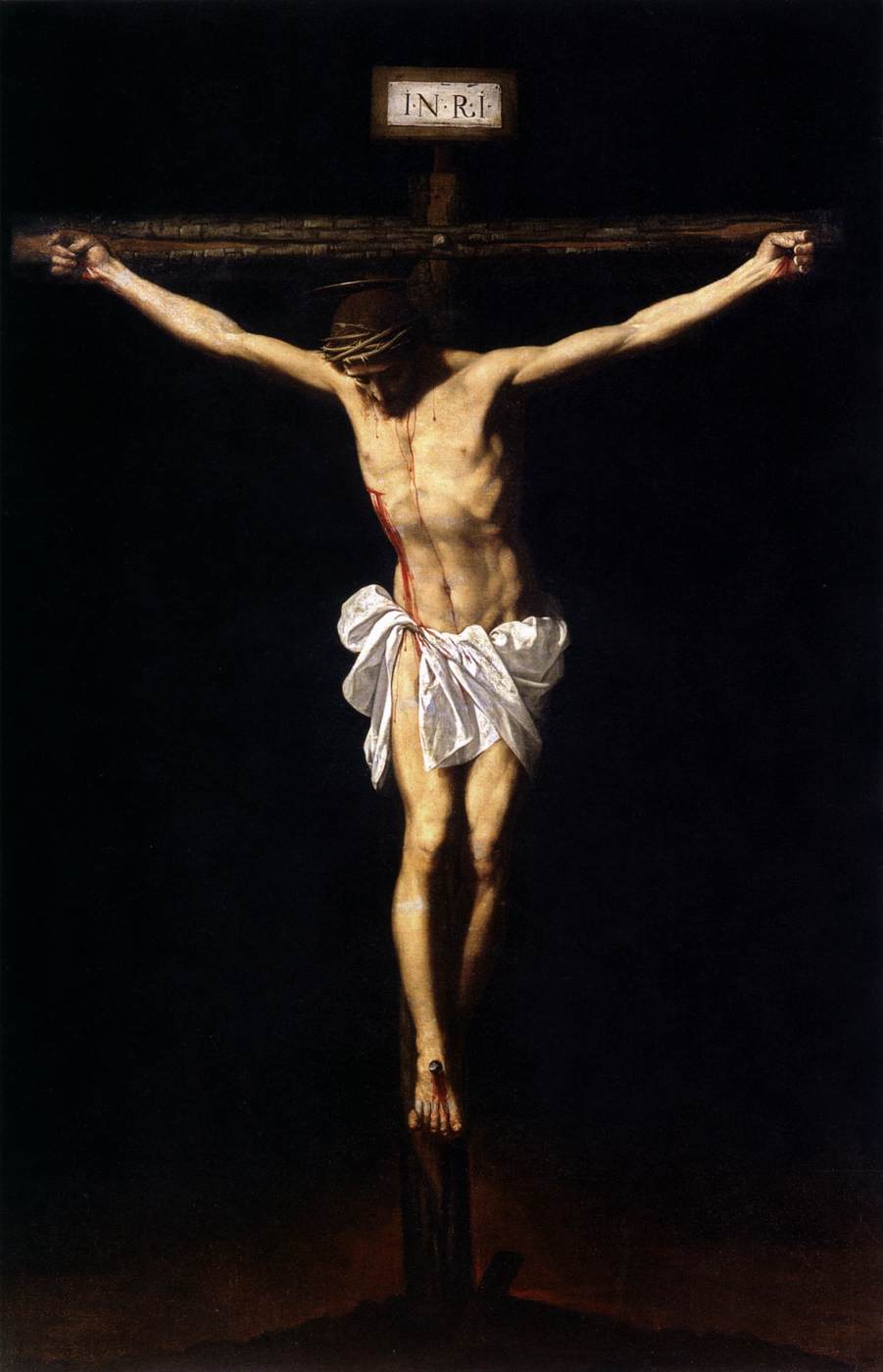
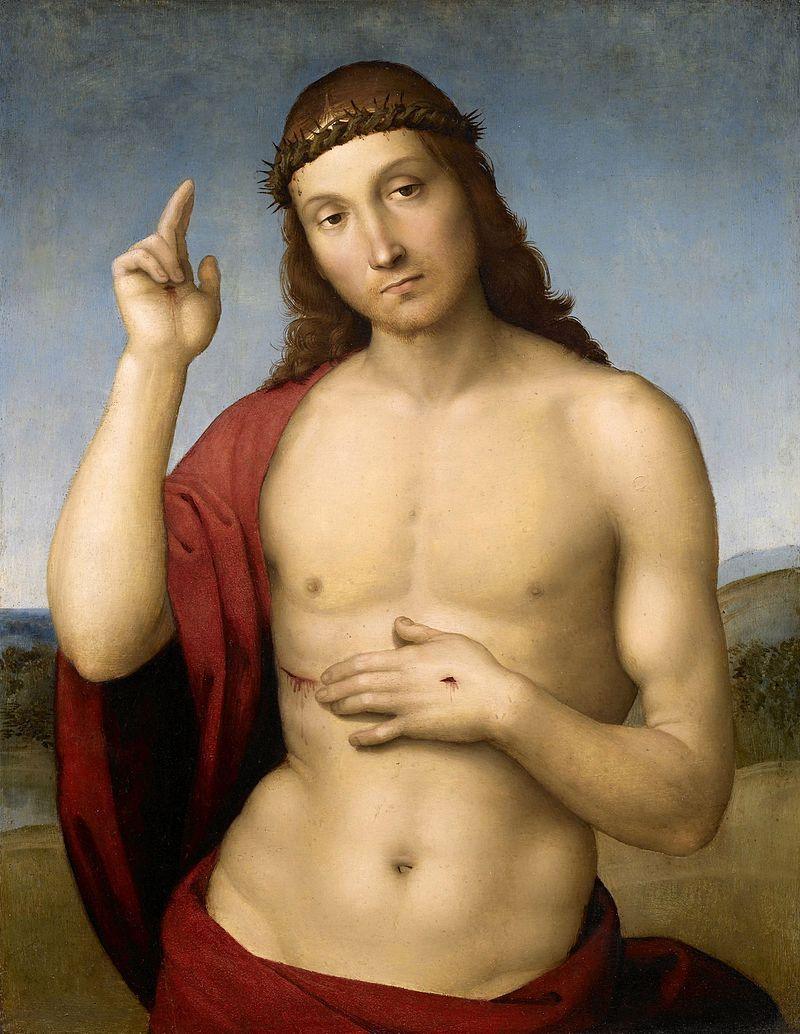
Spanish Romanesque art, a treasure that unfolds across the peninsula, is much more than a collection of stone churches and monasteries. It is a powerful testament to a tumultuous and deeply spiritual era, a visual language that conveyed a clear and forceful message to a predominantly illiterate population. From the Pyrenees to the Plateau, Romanesque speaks to us of faith, power, and the fusion of cultures in medieval Spain.
On this journey through Spanish Romanesque, we will discover the keys to understanding its robust architecture, expressive sculpture, and vibrant painting. We will explore the hidden meanings in its forms and colors, and unravel the history that lies behind each stone. A journey to appreciate not only the aesthetic beauty but also the profound cultural and religious significance of this artistic movement.
Beyond the stone: a journey to the heart of Spanish Romanesque
The Romanesque: a universal language in the Middle Ages
The Romanesque, which flourished between the 11th and 13th centuries, was the first artistic style to spread throughout Europe, from Spain to Italy, passing through France and Germany. It was not simply an aesthetic style; it was a common visual language that allowed for the communication of religious and social ideas in a politically fragmented continent. Pilgrimages to Santiago de Compostela, for example, served as important channels for the dissemination of Romanesque art, bringing with them new ideas and construction techniques.
Spain, a melting pot of cultures: the Muslim and Christian imprint on art
The peculiarity of Spanish Romanesque lies in its ability to integrate diverse influences. The prolonged Muslim presence in the Iberian Peninsula left an indelible mark, which is appreciated in architectural elements such as the use of the horseshoe arch, although reinterpreted in a Christian key. Likewise, the coexistence (sometimes conflictual) between different Christian kingdoms contributed to the diversity of styles within Spanish Romanesque. This cultural fusion makes Spanish Romanesque something unique and fascinating. An excellent way to observe the influence of various cultures can be found at the Prado Museum where works reflecting this exchange are exhibited.
A geographical tour: main centers of Spanish Romanesque
Spanish Romanesque is not a monolithic phenomenon, but presents different geographical centers with their own characteristics. In Catalonia, the monasteries of Ripoll and Sant Pere de Rodes stand out, with a strong Lombard influence. In Castile and León, Romanesque manifests in the monumentality of churches such as San Martín de Frómista and the Cathedral of Jaca, reflecting the power of the Christian kingdoms in the struggle against Islam. In Galicia, the Camino de Santiago spurred the construction of numerous churches and hospitals, while in Navarra, a greater French influence is appreciated. Each region offers a different perspective on this universal art.
Romanesque Architecture: the strength of simplicity
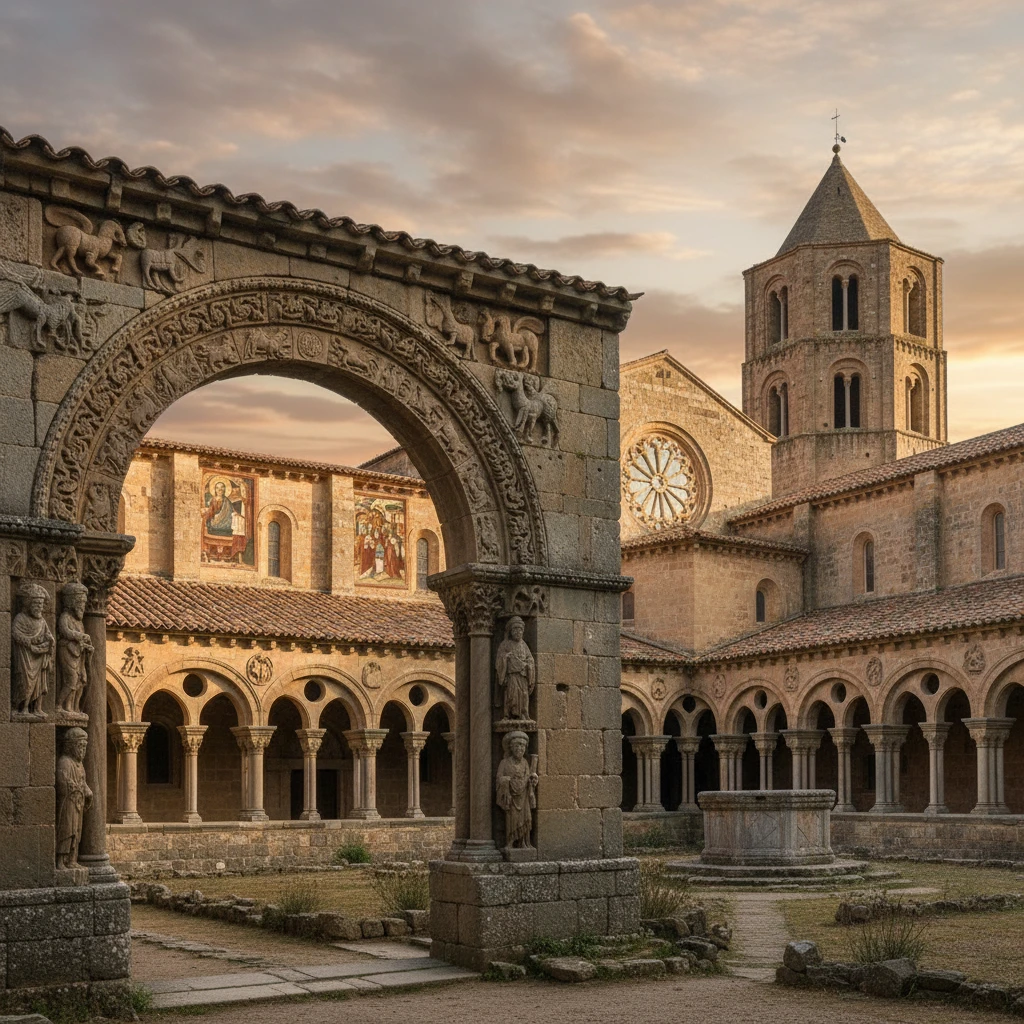
Essential features: thick walls, semicircular arches, and barrel vaults
Romanesque architecture is characterized by its solidity and sobriety. The walls are thick and sturdy, designed to support the weight of the stone vaults. The semicircular arch is a fundamental element, used both in doors and windows as well as in the internal structure of buildings. The barrel vault, formed by the extension of a semicircular arch, is the most common solution for covering the naves of churches. These features give Romanesque buildings a solid and austere appearance, conveying a sense of strength and permanence. A key decision when building a Romanesque church was the choice of stone, seeking durable materials that were locally available. A common mistake was underestimating the weight of the vault, which could lead to structural collapse.
The function of light: dim lighting and religious symbolism
Light plays a fundamental role in Romanesque architecture, although often subtly. The windows are usually small and sparse, creating dim and mysterious lighting inside the buildings. This twilight favors an atmosphere of contemplation and prayer, contributing to a sense of transcendence. Light serves not only a practical function but also a symbolic one: it represents divine presence, spiritual illumination. The orientation of the churches, generally with the apse facing east, allows the first rays of sunlight to illuminate the altar at dawn, symbolizing the resurrection of Christ. Ignoring solar orientation in construction could result in cold and dark buildings, affecting the religious experience.
The symbolism of the plan: the Latin cross and its meaning
The majority of Romanesque churches adopt the Latin cross plan, which symbolizes the body of Christ crucified. This plan consists of a main nave, a transept (cross arm), and an apse (semicircular end). The main nave represents the path of the faithful towards God, while the transept symbolizes Christ's outstretched arms on the cross. The apse, located at the head of the church, houses the altar and represents the holiest place, the dwelling of God. The choice of the Latin cross plan is not casual, but rather responds to a clear intention to convey a religious message through architecture. Other variants, such as the basilica plan, were less common but also present, especially in older buildings. A paradigmatic example is the church of San Clemente de Tahull, in Catalonia.
Romanesque Sculpture: narrating the Bible in stone
The tympanum: the gateway to the divine message
The tympanum, the semicircular space situated above the entrance door of Romanesque churches, is one of the most important sculptural elements. Generally, the tympanum is decorated with reliefs that represent biblical scenes, such as the Last Judgment, the Epiphany, or the Maiestas Domini (Christ in Majesty). These images had an educational function: to convey the Christian message to an illiterate population. The tympanum thus becomes a "Bible in stone," a visual narrative that allows the faithful to understand the main episodes of sacred history. The choice of the scene represented in the tympanum was crucial, as it had to reflect the church's patronage and convey a specific message to the community.
Hieratic and expressive figures: the representation of saints and biblical characters
Romanesque sculpture is characterized by its hieratic and somewhat unnaturalistic style. The figures tend to be rigid and frontal, with contained expressiveness. However, this apparent rigidity does not prevent them from conveying great emotional intensity. The faces of the saints and biblical characters, although schematic, reflect their faith, their suffering, or their divine power. The lack of anatomical realism is compensated by the symbolic strength of the images. The function of Romanesque sculpture is not to imitate reality but to convey a spiritual message. The polychromy, often faded today, intensified the expressiveness of the sculptures. Artists had to balance expressiveness with the need to convey a clear and understandable message.
The importance of iconography: a visual language for the faithful
Iconography, the study of the symbols and attributes represented in art, is fundamental to understanding Romanesque sculpture. Each figure, each object, each gesture has a specific meaning that was known to the faithful of the time. For example, Saint Peter is represented with the keys to the Kingdom of Heaven, Saint Paul with a sword, and the Virgin Mary with a blue mantle. Knowledge of iconography allows one to decipher the hidden message in the images and understand the profound meaning of Romanesque sculpture. Ignorance of iconography can lead to erroneous or superficial interpretations. Medieval bestiaries, such as that of Pierre de Beauvais, provide valuable information about the symbolism of the animals represented in Romanesque sculpture. More information about symbols in art can be found here.
Romanesque Painting: an explosion of color in the apses
The fresco technique: natural pigments and the wall as canvas
Romanesque painting, which is generally found inside churches, is characterized by its vividness and colorfulness. The most commonly used technique is fresco, which involves applying natural pigments mixed with water onto a wall covered with a fine layer of fresh plaster. As the plaster dries, the pigments become integrated into the wall, creating a lasting image. The choice of pigments was crucial to achieve intense and durable colors. Artists used pigments of mineral, vegetable, or animal origin, such as ochre, lapis lazuli, or cinnabar. The preparation of the wall and the application of the pigments required great skill and experience. Poor execution could lead to premature deterioration of the painting.
The Pantocrator: the image of Christ as the supreme judge
One of the most recurring images in Romanesque painting is the Pantocrator, which represents Christ in Majesty as the supreme judge. The Pantocrator usually appears in the central apse of churches, presiding over the sacred space. Christ is depicted with a severe and authoritative expression, blessing with his right hand and holding a book in his left, which symbolizes divine law. Surrounding him are usually the symbols of the four evangelists: the lion (Mark), the bull (Luke), the eagle (John), and the angel (Matthew). The Pantocrator conveys a sense of power and transcendence, reminding the faithful of the imminence of the Last Judgment. The figure of the Pantocrator reinforces the authority of the Church and its role as an intermediary between God and men.
Vibrant colors: ultramarine blue, red, and ochre yellow
Romanesque painting is characterized by the use of vibrant and contrasting colors. Ultramarine blue, obtained from lapis lazuli, was a very valuable pigment and was reserved for the most important figures, such as the Virgin Mary. Red, obtained from cinnabar or red ochre, symbolizes the blood of Christ and the martyrdom of the saints. Ochre yellow, obtained from clay, was used to represent divine light and celestial glory. The combination of these colors creates a rich and expressive palette that contributes to the visual strength of Romanesque painting. The colors not only serve an aesthetic function but also a symbolic one, conveying a religious message to the faithful. The availability of natural pigments influenced the color palette used in each region. Experimentation with other styles, such as those of Matisse or even the movement of The Fauves, can offer new perspectives on the use of color in art.
KUADROS ©, a famous painting on your wall. Hand-made oil painting reproductions, with the quality of professional artists and the distinctive seal of KUADROS ©. Reproduction service of paintings with a satisfaction guarantee. If you are not completely satisfied with the replica of your painting, we will refund 100% of your money.
Catalan Romanesque: a unique style with Italian influences
The churches of the Boí Valley: a group declared World Heritage
The Catalan Romanesque, particularly visible in the Boí Valley, is characterized by its remarkable Italian influence, specifically from the early Lombard Romanesque. These churches, declared World Heritage Sites by UNESCO, are exceptional examples of the adaptation of the Romanesque style to the geographical and cultural particularities of Catalonia. Local stone, the use of blind arches and Lombard bands, and slender bell towers are distinctive elements. An emblematic example is the church of Sant Climent de Taüll, famous for its impressive Pantocrator, originally a mural painting that dominated the central apse. When planning a visit, it is crucial to consider the time of year, as access to the valley may be affected by weather conditions. The careful restoration of these churches has allowed for the appreciation of the original polychromy of many of their paintings, offering a more complete vision of medieval Romanesque aesthetics.
The masters of the workshop: the diffusion of the Catalan Romanesque style
The diffusion of the Catalan Romanesque would not have been possible without the itinerant work of the masters of the workshop. These artisans, often anonymous, traveled from village to village, adapting the techniques and designs learned in Lombardy to local materials and needs. Their knowledge was passed down from master to apprentice, ensuring the continuity of the style over time. These workshops not only built churches but also took care of the sculptural and pictorial decoration, creating a coherent and distinctive style. When studying Catalan Romanesque architecture, one can identify the hands of different workshops in the subtle variations of construction and decorative details. The church of Santa Maria de Cardet, for example, shows a clear influence from various masters, evidenced by the diversity of styles in its capitals and paintings murals.
Influence of the early Lombard Romanesque
The influence of the early Lombard Romanesque is undeniable in the Catalan architecture of the time. This style, originating from northern Italy, is characterized by its simplicity, the use of unhewn stone, semicircular arches, Lombard bands (decorative vertical stripes), and blind arches. These characteristics were perfectly adapted to the Catalan landscape, resulting in a unique and distinctive Romanesque style. One possible explanation for the rapid diffusion of this style is the geographical proximity and trade links between Catalonia and Lombardy during the Middle Ages. Furthermore, the Catalan counts actively promoted the construction of churches and monasteries, attracting Lombard masters to work in their territories. The church of Sant Joan de Boí is a clear example of this influence, with its slender bell tower and Lombard bands adorning its walls.
The Castilian-Leonese Romanesque: sobriety and grandeur
The route of the Palentine Romanesque: churches and monasteries in a rural setting
The Castilian-Leonese Romanesque is distinguished by its sobriety and grandeur, reflecting the power and austerity of the kingdoms of Castilla and León during the Middle Ages. Unlike the Catalan Romanesque, with its Italian influence, the Castilian-Leonese Romanesque shows a greater French influence, due to the Camino de Santiago and the Cluniac monastic orders. The Palentino Romanesque Route offers a fascinating journey through churches and monasteries located in a rural setting, where the sandstone takes on golden hues under the sunlight. When planning a visit to this region, it is advisable to consult local tourist offices for updated information on opening hours and access to the monuments. The churches of San Martín de Frómista and Santa María la Real de Aguilar de Campoo are outstanding examples of this style, with their imposing towers and richly sculpted façades.
The Monastery of Silos: an example of high-quality Romanesque sculpture
The Monastery of Santo Domingo de Silos is a treasure of the Castilian-Leonese Romanesque, primarily known for its Romanesque cloister, whose sculpture is considered one of the most important in Europe. The capitals of the cloister narrate biblical scenes and vegetal and animal motifs, with unique technical mastery and expressiveness. The representation of the Annunciation and the Tree of Jesse are particularly notable. However, it is important to note that the monastery has undergone modifications over the centuries, so not all of the architectural ensemble belongs to the original Romanesque period. In addition to the cloister, the monastery's library houses a valuable collection of medieval manuscripts, including the famous Beatos, richly illustrated books of commentary on the Apocalypse. The atmosphere of peace and contemplation that pervades the monastery invites reflection and meditation.
The Romanesque in Segovia: the medieval legacy of a historic city
Segovia, a city declared a UNESCO World Heritage Site, houses an important Romanesque legacy, which harmoniously integrates with its famous Roman aqueduct and its imposing Gothic cathedral. The Romanesque churches of Segovia, such as San Esteban, San Millán, and San Clemente, are characterized by their sobriety and elegance, with their semicircular apses, simple façades, and slender bell towers. A common mistake when visiting Segovia is to focus solely on the aqueduct and the cathedral, neglecting the rich Romanesque heritage of the city. These churches, often located in quiet neighborhoods away from the historic center, offer a fascinating glimpse into the religious and social life of medieval Segovia. The church of San Juan de los Caballeros, currently home to the Zuloaga ceramic collection, is a notable example of the adaptation of a Romanesque building to new uses.
Anonymous Masters: the soul of the Romanesque
Teamwork: the collaboration between architects, sculptors, and painters
The soul of Romanesque art resides in the anonymous and collaborative work of the masters builders, sculptors, and painters. In Romanesque art, the individual dissolves into the collective, prioritizing the work itself over personal fame. The construction of a church or monastery was a community project involving numerous artisans, each contributing their skills and knowledge. Architects, sculptors, and painters worked closely together, creating a coherent and harmonious sacred space. The planning of a work required precise coordination, from the selection of materials to the distribution of spaces and the iconography of the images. The church of San Isidoro de León is a clear example of this collaboration, with its solid and functional architecture, expressive sculptures, and paintings vibrant murals.
The transmission of knowledge: from generation to generation
Technical and artistic knowledge was transmitted from generation to generation through the apprenticeship system in workshops. Young apprentices worked alongside the masters, learning the techniques and secrets of the trade. This process of oral and practical transmission ensured the continuity of style and quality of the works. The masters shared their knowledge not only about construction and sculpture but also about religious iconography and the symbolism of images. This apprenticeship system allowed young artisans to develop their skills and creativity, contributing to the enrichment of Romanesque art. An example of this knowledge transmission can be observed in the subtle differences between the works of different Romanesque workshops, each with its own style and techniques.
Anonymity as an expression of humility and devotion
The anonymity of Romanesque artists was not a sign of lack of talent or recognition, but rather an expression of humility and devotion. The artists believed that their work was an offering to God and that their name was not important. Their goal was to glorify God through the beauty and expressiveness of their works. This attitude of humility and anonymity is reflected in the lack of signatures or inscriptions on the majority of Romanesque works. The church of Santiago de Compostela, an important pilgrimage center, is an example of this devotion, with its Obradoiro facade, a symbol of faith and hope. This approach contrasts with the individualistic and fame-centered mentality of the Renaissance, where artists actively sought recognition and immortality through their works.
The Romanesque and music: Gregorian chants and the spirit of the era
The acoustics of churches: a conducive environment for prayer and contemplation
Music, especially Gregorian chant, played a fundamental role in the liturgy and religious experience of the Romanesque period. Romanesque churches were designed with a particular acoustics, creating an environment conducive to prayer and contemplation. The barrel vaults and stone walls reverberated the sound of the chant, creating a mystical and enveloping atmosphere. The dim light that entered through the small windows contributed to a sense of introspection and transcendence. Silence was also an important part of the musical experience, allowing the faithful to reflect on the words and melodies of the Gregorian chant. A clear example of this special acoustics can be experienced in the Abbey of Fontenay, where Gregorian chants still resonate strongly within its stone walls. Marketing strategies for events related to sacred music should consider the importance of highlighting the unique atmosphere of these spaces.
Gregorian chant: a fundamental element of Romanesque liturgy
Gregorian chant, a type of plainchant monophonic, was the main type of music used in Romanesque liturgy. It was characterized by its simplicity, free rhythm, and soft, melancholic melody. Gregorian chant had no instrumental accompaniment and was sung in Latin. Its function was to elevate the spirit of the faithful and create an atmosphere of prayer and devotion. Monks and clergy devoted many hours to the study and practice of Gregorian chant, ensuring its correct interpretation and transmission to future generations. Medieval manuscripts, such as antiphonaries and graduals, preserve numerous examples of Gregorian chant, showcasing the richness and variety of this musical repertoire. The interpretation of Gregorian chant requires a deep understanding of its historical and religious context, as well as precise vocal technique and artistic sensitivity.
The influence of music on the perception of sacred space
Music, particularly Gregorian chant, profoundly influenced the perception of sacred space in Romanesque churches. The sound of the chant resonated in the stone walls, creating a sense of immensity and transcendence. The soft and melancholic melodies invited reflection and contemplation, elevating the spirit of the faithful. Music also contributed to creating an atmosphere of mystery and solemnity, reinforcing the sacred character of the place. Gregorian chant was not merely an accompaniment to the liturgy but an integral part of the religious experience, transforming the physical space into a meeting place with the divine. It is interesting to note that the art of Paul Klee, although much later, shares a similar quest for the spiritual through form and color, albeit in a secular context.
KUADROS ©, a famous painting on your wall. Hand-made oil painting reproductions, with the quality of professional artists and the distinctive seal of KUADROS ©. Reproduction service of paintings with satisfaction guarantee. If you are not completely satisfied with the replica of your painting, we will refund 100% of your money.
Romanesque in the 21st Century: reinterpretations and new perspectives
The influence of Romanesque art on contemporary art
Romanesque art, with its robustness and symbolism, continues to exert a notable influence on contemporary art. Artists from various disciplines find in its forms, narratives, and techniques an inexhaustible source of inspiration. This influence is not limited to a mere copying of stylistic elements, but involves a deep reinterpretation and adaptation to current artistic languages. For example, the monumentality of Romanesque sculptures is reflected in contemporary large-format works, while the expressiveness of faces and figures, often characterized by a certain rigidity, is reinterpreted in sculptures and paintings that explore the human condition with a similar intensity. The abstraction present in many Romanesque decorative elements, such as geometric and vegetal motifs, also resonates in the work of artists who seek to reduce reality to its essential forms. Often, the choice of materials, such as stone and wood, evokes the durability and connection to the earth that characterize the Romanesque. Moreover, the religious iconography and biblical narratives that permeate Romanesque art provide a symbolic framework to explore themes such as faith, morality, and transcendence, albeit from a contemporary and often critical perspective.
The conservation and restoration of Romanesque heritage
The conservation and restoration of Romanesque heritage presents unique challenges. The antiquity of the structures, the materials used (mainly stone and wood), and the effects of time require careful and respectful interventions. One of the main challenges is the reintegration of lost or damaged elements, seeking a balance between historical fidelity and the legibility of the work for the current viewer. Both structural aspects, such as the consolidation of walls and roofs, and aesthetic aspects, such as the cleaning of paintings murals and sculptures, must be considered. The choice of materials and restoration techniques is crucial to ensure compatibility with the originals and avoid irreversible damage. It is important to conduct thorough studies prior to any intervention, including historical, archaeological, and scientific analyses. Detailed documentation of each phase of the restoration process is essential for future interventions and for the understanding of heritage. An example of successful restoration can be found in the church of San Clemente de Tahull, where the recovery of the paintings murals allowed for the appreciation once again of the richness and expressiveness of Catalan Romanesque art. The fundamental criterion is always to prioritize the preservation of the authenticity and integrity of the cultural asset.
The Romanesque as a source of inspiration for contemporary artists
Romanesque art is not just a legacy of the past but also a constant source of inspiration for contemporary artists. The simplicity and strength of its forms, the expressiveness of its figures, and the richness of its symbolism offer a wide range of creative possibilities. Some artists draw direct inspiration from Romanesque motifs and characters, reinterpreting them in a modern key, while others focus on the atmosphere and spirituality that emanate from this art. The monumentality of Romanesque churches can inspire large-scale artistic installations, while the rusticity of the materials may influence the choice of techniques and textures. The visual narrative of the Romanesque, with its biblical scenes and representations of saints and angels, can be used to explore contemporary themes such as faith, justice, and hope. The influence of the Romanesque is manifested in painting and sculpture as well as in architecture, design, and performing arts. For example, contemporary sculptors employ techniques similar to those used in Romanesque workshops, albeit with current materials and tools, to create works that evoke the solidity and spirituality of medieval sculpture. The key to a successful reinterpretation of the Romanesque lies in a deep understanding of its historical and cultural context, as well as the ability to adapt it to the sensitivities and concerns of the present.
Discovering hidden gems: rural Spanish Romanesque
Charming small churches and hermitages
The rural Spanish Romanesque houses a treasure of small churches and hermitages that often remain hidden from the most conventional tourist circuits. These architectural gems, scattered across valleys and mountains, offer an authentic vision of Romanesque art in its most intimate and simple expression. Unlike large cathedrals and monasteries, these small constructions stand out for their modesty and their integration into the natural environment. They are usually single-nave churches, with semicircular apses and simple facades, but they are not lacking in charm and artistic value. Inside, paintings murals, sculptures, and other decorative elements that reflect the devotion and creativity of local communities are often preserved. These churches and hermitages are witnesses to the history and culture of the towns that built them, and visiting them allows for a more personal and meaningful connection with the past. A notable example is the church of Santa María de Eunate in Navarra, an octagonal temple surrounded by a mysterious halo of legend. The decision to explore these small gems involves venturing into landscapes of great beauty, where time seems to stand still.
Alternative routes for art and nature lovers
For art and nature lovers, Spanish rural Romanesque offers the opportunity to discover alternative routes that combine visits to historical monuments with the exploration of stunning landscapes. These routes, often marked as "Romanesque paths", allow you to traverse charming villages, discover hidden churches and hermitages, and enjoy the tranquility of the countryside. Some routes focus on a specific region, such as Palentine Romanesque or Catalan Romanesque, while others cross several provinces, offering a broader view of the diversity of Spanish Romanesque art. When planning one of these routes, it is important to consider the condition of the roads and trails, as well as the availability of accommodation and services in the villages being visited. Comfortable footwear, appropriate clothing for the weather, and a Romanesque art guide to identify the main architectural and decorative elements of the monuments are recommended. In addition to visiting churches and hermitages, these routes offer the possibility to enjoy other activities, such as hiking, cycling, bird watching, and tasting local products. It is a form of sustainable tourism that contributes to the conservation of the cultural and natural heritage of rural areas.
The importance of conserving rural heritage
The conservation of rural heritage, including Romanesque churches and hermitages, is essential for preserving the cultural identity and historical legacy of local communities. This heritage not only has artistic and historical value but also social and economic value, as it can be a driver of sustainable tourism development. Conservation involves the protection, restoration, and enhancement of monuments, as well as promoting their knowledge and enjoyment by society. It is necessary to involve local communities in the management of heritage, encouraging their participation in decision-making and their commitment to conservation. The lack of economic resources and the depopulation of rural areas are some of the main challenges facing heritage conservation. It is necessary to seek alternative funding sources, such as public grants, private sponsorships, and international cooperation programs. Awareness and education are also key tools for promoting respect and care for heritage. Guided tours, educational workshops, and exhibitions are some of the activities that can be carried out to bring heritage closer to society and foster its appreciation. An integrated management of rural heritage, combining conservation, tourism, and economic development, is essential to ensure its long-term sustainability.
The Romanesque: a lasting legacy over time
The Romanesque as an expression of faith and medieval culture
Romanesque art is much more than an architectural or artistic style; it is a profound expression of faith and culture from the Middle Ages. Emerging during a period of great social, political, and religious transformations, Romanesque reflects the worldview of a deeply religious society, where the Church played a central role in all aspects of life. Romanesque churches and monasteries were not only places of worship but also centers of learning, refuges for pilgrims, and symbols of power. Romanesque architecture, with its thick walls, semicircular arches, and barrel vaults, conveys a sense of solidity and permanence, reflecting the quest for stability and security in an uncertain world. Romanesque sculpture, with its hieratic and expressive figures, narrates biblical stories and represents saints and angels, conveying religious and moral messages to a predominantly illiterate population. Romanesque painting, with its vivid colors and schematic forms, decorates the walls of churches, creating an atmosphere of solemnity and mystery. Romanesque art, as a whole, is a testament to the profound religiosity and rich culture of the Middle Ages. Studying Romanesque art is to delve into the mindset and beliefs of a fascinating era.
Its influence on later architecture and art
The influence of Romanesque extends far beyond its own historical period, leaving a lasting mark on later architecture and art. Although the Gothic style, with its verticality and luminosity, represented a break from Romanesque, many Romanesque elements continued to be present in medieval architecture and sculpture. In religious architecture, the basilica plan, the use of the semicircular arch, and the sculptural decoration of the portals are examples of Romanesque elements that remained in Gothic. In sculpture, the expressiveness and monumentality of Romanesque figures influenced the representation of characters and scenes in Gothic. Furthermore, Romanesque served as inspiration for later artistic movements, such as the 19th-century Neo-Romanesque, which sought to recover the values and aesthetics of medieval art. Even in contemporary art, echoes of Romanesque can be found, both in form and content. The solidity, simplicity, and spirituality of Romanesque remain relevant for artists and architects seeking to create works that convey a sense of permanence and transcendence. For more information on the stylistic influences between different artistic movements, you can consult specialized academic sources like this one.
A journey through time: the experience of visiting a Romanesque monument
Visiting a Romanesque monument is like taking a journey through time, an opportunity to connect with the past and understand the life and culture of the Middle Ages. Upon entering a Romanesque church, one feels transported to a different world, where faith and devotion were the center of life. The solidity of the walls, the dimness of the interior, and the silence of the place invite reflection and contemplation. Observing the paintings murals, sculptures, and capitals is like reading a history book, where biblical stories are narrated, saints and angels are represented, and the beliefs and values of the time are reflected. Climbing a Romanesque tower offers a panoramic view of the surrounding landscape, allowing one to understand the relationship between the monument and its natural environment. Walking through a Romanesque cloister invites meditation and introspection. Visiting a Romanesque monument is not only an aesthetic experience but also a spiritual and intellectual one. It is an opportunity to learn about history, art, and culture, but also to reflect on the human condition and the meaning of life. It should be noted that the visit may require prior planning, such as checking opening hours and the accessibility of the site.
The Romanesque, yesterday and today: a style that endures in time and art
How to bring a piece of Romanesque art into your home
Although we cannot literally take a stone from a Romanesque temple, there are ways to incorporate the essence of this art into our home. One option is to acquire reproductions of Romanesque sculptures, such as capitals or reliefs, which can decorate a shelf or a garden. Another possibility is to use Romanesque motifs and designs in interior decoration, such as semicircular arches, friezes with geometric patterns, or textiles with prints inspired by the paintings murals. For craft lovers, DIY projects inspired by Romanesque art can be made, such as creating mosaics with colored tiles or making lamps with geometric shapes. It is also possible to find furniture and decorative objects that reinterpret the Romanesque style in a modern key, using materials like wood, stone, and iron. The key to bringing a piece of Romanesque art into your home is to look for elements that convey the solidity, simplicity, and spirituality of this art, creating an environment that invites reflection and contemplation. A good option is to search online for paintings that evoke that style at kuadros.com, which can be adapted to your decor.
Oil painting replicas for art lovers
For those who wish to have a Romanesque artwork in their home but do not have access to the original works, oil painting replicas are an excellent option. These replicas, created by professional artists, faithfully reproduce the colors, textures, and details of the paintings Romanesque murals, allowing you to enjoy the beauty and expressiveness of this art in an accessible format. Oil painting replicas can be made on canvas, board, or other supports, and can be framed to protect and enhance them. It is important to choose high-quality replicas made by artists who have a deep understanding of Romanesque art and who use appropriate materials and techniques. Some specialized companies, such as kuadros.com, offer custom oil reproduction services of paintings, allowing you to order replicas of specific works or adapt Romanesque designs to the client's preferences. Before ordering a replica, it is advisable to research the company or artist creating it, read reviews from other customers, and request samples of previous work. An oil painting replica can be a centerpiece in the decoration of a living room, bedroom, or studio, creating a unique and personal atmosphere.
Romanesque Art as an Investment: paintings and Sculptures
Although Romanesque art is primarily a historical and cultural heritage, it can also be considered an investment. The paintings and sculptures of Romanesque art, especially the original works of recognized artists, can reach high prices in the art market. However, it is important to keep in mind that investing in Romanesque art requires a deep understanding of the market, as well as the advice of experts and appraisers. Before acquiring a Romanesque artwork, it is essential to verify its authenticity, provenance, and condition. It is recommended to visit specialized art galleries, participate in auctions, and consult experts in medieval art. Investing in Romanesque art can not only generate economic benefits but also provide the satisfaction of owning a unique and valuable piece of art. Furthermore, owning a Romanesque artwork can be a way to support the conservation of cultural heritage and contribute to the dissemination of knowledge about this art. It is crucial to thoroughly research before making any investment decision and to understand the risks and opportunities involved. Acquiring a reproduction from kuadros.com allows for lower risk and also represents a smart investment for decorating your home, as well as an original gift for someone who loves Romanesque art.
Romanesque art, with its rich history and lasting influence, continues to fascinate and inspire today. From contemporary reinterpretations to the preservation of rural gems, its legacy remains alive. Through replicas and the incorporation of Romanesque elements into our homes, we can keep the connection with this important chapter of art history alive.
KUADROS ©, a famous painting on your wall. Hand-made oil painting reproductions, with the quality of professional artists and the distinctive seal of KUADROS ©. Reproduction service of paintings with a satisfaction guarantee. If you are not completely satisfied with your painting replica, we will refund 100% of your money.