Chaim Soutine, a name that evokes images of throbbing flesh and incandescent colors, remains surprisingly on the margins of the Expressionist canon, overshadowed by figures such as Kirchner or Nolde. However, his art, visceral and deeply personal, offers a unique window into the anguish of the twentieth century. His canvases, often unsettling, challenge complacency and confront us with the fragility of existence.
This article seeks to rescue Soutine’s figure from obscurity, exploring his humble origins, his tormented life in Paris, and his unmistakable style, marked by distortion and a bold, provocative color palette. Through an analysis of his most emblematic works, we will unravel the obsessions and demons that drove this singular artist to create a pictorial universe as unsettling as it is fascinating.

Soutine’s work often provokes an initial reaction of repulsion. His distorted faces, his convulsed landscapes, and his still lifes of slaughtered animals challenge our traditional conception of beauty. However, this repulsion can be the gateway to a deeper understanding of his art. Soutine was not seeking aesthetic complacency, but rather the visceral expression of anguish and human vulnerability. The viewer is forced to confront the grotesque, the ugly, what is normally avoided, and in that act of confrontation a form of empathy can emerge. Conventional beauty numbs, while ugliness, as Soutine understood it, awakens consciousness.
Soutine is part of the Expressionist movement, but his expression is deeply personal and visceral. Unlike other Expressionists who sought to reflect the social and political crisis of their time, Soutine focused on his own inner experience, on his fears and obsessions. His painting is a reflection of his tormented soul, a manifestation of his struggle against poverty, illness, and isolation. Expressionism in Soutine is not merely a technique, but a vital need to externalize a chaotic and painful inner world. This brutal, uncompromising honesty is what gives his work such moving force.
Despite his talent and originality, Soutine never achieved the fame and recognition of some of his Expressionist contemporaries. Several reasons may explain this relative obscurity. First, his singular and uncompromising style did not fit easily into the established categories of criticism. His work was too visceral and personal to be considered simply Expressionist. Second, his introverted personality and refusal of self-promotion prevented him from building a network of influential contacts in the art world. Finally, World War II and the Holocaust, which cut his life short and scattered his work, contributed to his obscurity. However, in recent years, his work has been increasingly reevaluated, and his legacy as one of the most original and moving artists of the twentieth century is finally being recognized.
Chaim Soutine was born in 1893 in Smilovichi, a small shtetl
(Jewish village) in present-day Belarus, born into an extremely poor and religious family. His childhood was marked by deprivation and the limitations imposed by Orthodox traditions that prohibited the depiction of the human figure. However, from a very early age, Soutine felt an irresistible attraction to art and began drawing in secret, using charcoal and pieces of brick as materials. His talent was evident, but his passion for art was viewed disapprovingly by his family, who considered painting a frivolous and sinful activity. Despite family opposition, Soutine persevered in his calling, fueled by an insatiable thirst for knowledge and a deep need to express himself through art.In 1913, at the age of twenty, Soutine finally managed to escape the poverty and oppression of his shtetl and traveled to Paris, the world capital of art. He enrolled at the École des Beaux-Arts, but soon became disillusioned with academic teaching and preferred to explore the Louvre and immerse himself in the work of the great masters. He settled in La Ruche ("The Beehive"), a community of poor artists where he met other young creators, including Amedeo Modigliani and Ossip Zadkine. Modigliani became his friend and mentor, and encouraged him to follow his own path, despite the difficulties and misunderstanding. La Ruche was a melting pot of ideas and experimentation, a place where Soutine could develop his unique style in an atmosphere of freedom and camaraderie. The influence of these artists, as can be seen in The Fauves, is evident in the boldness and use of color.
Soutine's life in Paris was hard and precarious. He suffered from hunger, illness, and deep personal insecurity. His tortured personality, marked by anxiety and paranoia, made it difficult for him to form stable relationships and prevented him from enjoying the success that, despite everything, he was beginning to achieve. He often destroyed his own works, dissatisfied with the result and tormented by doubt. His fragile health, worsened by a bleeding ulcer that was never properly treated, stayed with him throughout his life and contributed to his pessimistic and often dark view of the world. Ironically, it was his own misery and suffering that fueled his creative genius, driving him to create such visceral and moving art.
Although Soutine developed a unique and unmistakable style, his work reveals the influence of some of the great masters of the past, particularly El Greco and Rembrandt. From El Greco, he admired his expressive style and his use of distortion to convey intense emotions. As can be appreciated in the article about El Greco, his use of light and shadow, his dramatic brushwork, and his ability to capture the spiritual essence of his characters were a constant source of inspiration for Soutine. From Rembrandt, he admired his mastery of chiaroscuro and his ability to reveal humanity even in the most worn and suffering faces. Soutine adopted the tenebrism technique, using strong contrasts of light and shadow to create a dramatic atmosphere and highlight the vulnerability of his characters.
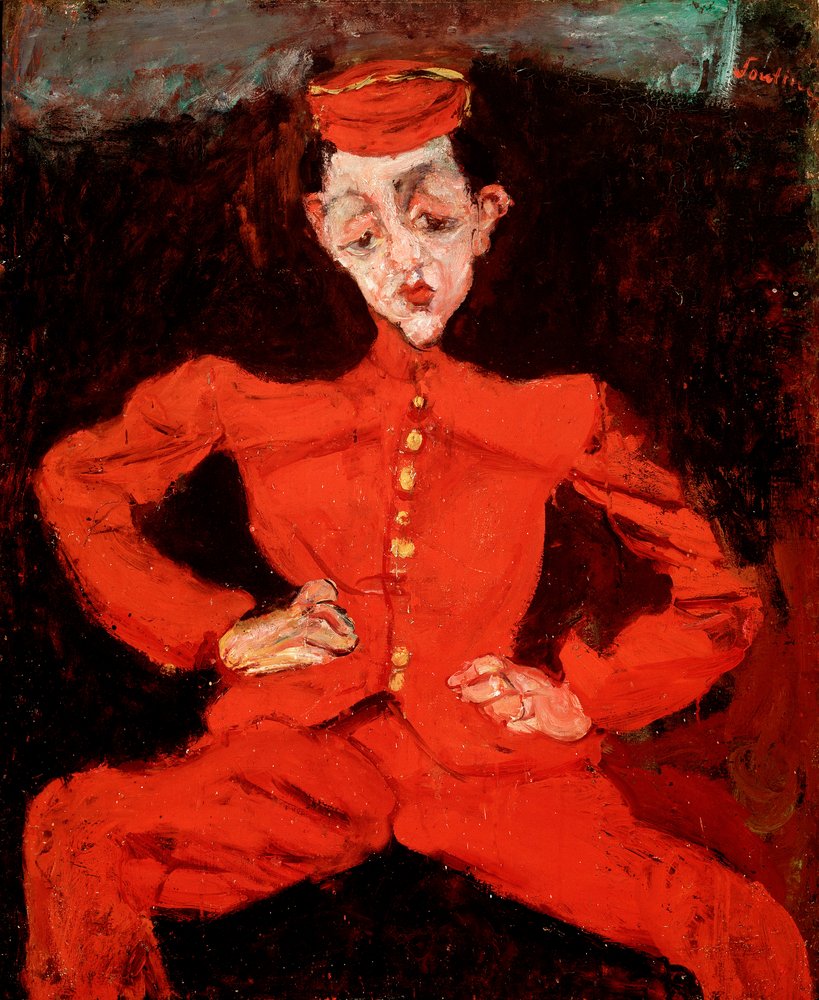
Color plays a fundamental role in Soutine’s work. Far from seeking harmony and conventional beauty, Soutine used color in a bold and provocative way, creating jarring and often disturbing combinations. His color palettes are dominated by crimson reds, which evoke blood and flesh; sulfurous yellows, which suggest illness and decay; and rotten greens, which allude to death and decomposition. Yet in these seemingly chaotic and discordant combinations, Soutine achieved unmatched expressive intensity. Color is not simply a decorative element, but a means of conveying emotions and sensations, of expressing the visceral nature of life and the inevitability of death.
One of the most distinctive features of Soutine’s style is his use of distortion. His faces are elongated and distorted, his landscapes are convulsed, and his objects are disfigured, creating a sense of chaos and disorder. However, this distortion is neither arbitrary nor gratuitous, but rather responds to a deep expressive need. Soutine used distortion as a language to convey intense emotions and to reveal the visceral reality hidden beneath the surface appearance. By distorting reality, Soutine intensified it, making it more palpable, more moving. His works confront us with the fragility of existence, with the imperfection and vulnerability inherent in the human condition.
Soutine is known for his still lifes, but these are not simple representations of inanimate objects. His still lifes, especially those depicting slaughtered animals, are deeply symbolic and charged with anguish. These animals, often skinned and mutilated, become metaphors for human fragility, for the vulnerability of the body to illness and death. Soutine channeled his own anguish and fears through these images, creating works that are at once disturbing and moving. The slaughtered animals are not simply objects to observe, but beings that suffer and remind us of our own mortality.

Skinned Ox
Within Soutine’s output, the series of skinned oxen stands out, a series of paintings that depict ox carcasses hanging and mutilated. This theme, which can be macabre and repulsive, reveals a deep obsession with flesh, death, and decay. Soutine did not limit himself to representing the physical appearance of the animals, but sought to capture their essence, their suffering, their vulnerability in the face of death. It is said that he spent hours contemplating carcasses in slaughterhouses, studying their shapes, their colors, and their textures. For Soutine, flesh was not simply an object, but a symbol of life and death, of beauty and ugliness, of attraction and repulsion.
The work 'Flayed Ox' (circa 1925) is a paradigmatic example of Soutine's style and obsessions. In this painting, a bovine carcass hangs from a hook, its red, shining flesh contrasting with the dark, somber background. The composition is unbalanced and chaotic, reflecting the visceral nature and horror of the scene. Color plays a fundamental role: the intense reds evoke blood and flesh, while the yellows and greens suggest decomposition. The brushwork is thick and impastoed, creating a rough, palpable texture. The symbolism of the work is complex and ambiguous. The flayed ox can be interpreted as a metaphor for human fragility, for the vulnerability of the body in the face of death. It can also be seen as a critique of the violence and brutality inherent in existence. Ultimately, the meaning of the work is left open to the viewer's interpretation.
Despite his short and tragic life, Soutine left a lasting impact on the art world. His expressionist style and disturbing subject matter influenced many later artists, such as Francis Bacon and Willem de Kooning. Soutine showed that art can be both beautiful and repulsive, that it can explore the darkest aspects of the human condition. His work remains relevant today, inviting us to reflect on life, death, and our own mortality. His legacy lives on through his paintings, which are exhibited in the world's most important museums and continue to fascinate critics and art lovers alike.
After his formative years in Minsk and Paris, Soutine found in the landscape a new path of expression. He desperately sought the light that had been scarce in his youth, and he found it, though in a tumultuous way, in places like Céret and Cagnes-sur-Mer. These regions, located in the south of France, offered him a natural canvas of intense colors and capricious forms. However, his connection with nature was never idyllic. Soutine did not paint postcards; he conveyed his existential anguish by projecting it onto the landscape, distorting it until it became a reflection of his own emotional state. The decision to paint landscapes was driven by his need to experiment with color and form in a context different from portraiture, seeking an emotional connection with nature, though always tinted by his own inner world. The challenge lay in not falling into mere reproduction, but in the visceral interpretation of the surroundings.

Soutine landscape painting
Soutine’s landscapes are characterized by a haunting atmosphere and a sense of instability. The trees twist and contort like tormented figures, the paths wind aimlessly, and the skies are heavy with threatening clouds. The brushwork is gestural and energetic, applying paint with an almost wild intensity. The colors, although bright, are used to create dramatic contrasts and effects of tension. There is no serenity or harmony in these works; only a chaotic and visceral representation of nature, filtered through the lens of anguish and unease. Soutine sought to convey the brute force of nature, but also its dark and threatening side, representing reality not as it is, but as he felt it. His vision of nature is far removed from the idealized one of other artists, such as those featured in The Spanish Impressionists.

Soutine painting Landscape of Céret
A paradigmatic example of this style is 'Landscape of Céret' (circa 1920). In this work, the trees seem to struggle against the wind, their twisted branches like desperate arms. The color palette is vibrant, but dominated by earthy and reddish tones that intensify the sense of emotional turbulence. The path winding through the landscape seems to lead nowhere, symbolizing a lack of direction and uncertainty. The brushwork is thick and impastoed, creating a textured surface that emphasizes the emotional weight of the work. This painting is not simply a representation of a place; it is a projection of the artist’s mood, a window into his inner world. One can perceive his inner struggle through the way he manipulates the paint and composition. The goal was not conventional beauty, but the raw expression of truth.

Soutine portrait painting
Soutine’s portraits, like his landscapes, are not limited to mere physical representation. He sought to capture the inner essence of his subjects, their personality and their emotions, even if that meant distorting their features and exaggerating their characteristics. His portraits are intense and moving, revealing the vulnerability and fragility of the human condition. Soutine was not interested in superficial beauty; his goal was truth, even if it was painful or uncomfortable. The decision to distort his subjects was not arbitrary, but rather a way to intensify their expressiveness and reveal hidden aspects of their character. For him, outward appearance was only a starting point, a pretext for exploring the complexity of the human soul. The challenge lay in finding the balance between fidelity to the model and creative freedom.
The influence of Modigliani is evident in Soutine's portraits, especially in the elongation of the faces and the atmosphere of melancholy that permeates many of his works. However, Soutine took this technique to an even greater extreme, deforming and distorting the features of his models in a much more radical way. While Modigliani sought a certain elegance and sophistication, Soutine focused on pure expression and emotional intensity. Both artists shared a tragic view of existence and a special sensitivity toward human suffering. The choice of elongated faces was not only an aesthetic matter, but also a way of expressing the fragility and vulnerability of his models, conveying a sense of unease and alienation. The atmosphere of melancholy, palpable in their works, reflected the artists' own existential anguish.

Young Pastry Chef, Soutine
'Young Pastry Chef' (1927) is one of Soutine's most emblematic portraits. The figure of the young man, with his elongated face and large, expressive eyes, conveys a sense of innocence and vulnerability. The brushwork is loose and vibrant, creating a textured surface that intensifies the emotional weight of the work. The colors are warm and rich, but there is also a certain sadness in the young man's gaze, a premonition of the challenges that await him in life. This portrait is not simply a representation of an individual; it is a symbol of lost youth and the fragility of human existence. The choice of the young pastry chef as a model can be interpreted as a metaphor for creativity and the need to nourish the spirit. The painting is a testament to Soutine's ability to capture the human essence in all its complexity.
World War II marked a turning point in Soutine's life. As a Jew, he was forced to flee Paris and live in hiding, taking refuge in small towns and farms to avoid being captured by the Nazis. The constant fear and uncertainty deeply affected his mental and physical health, exacerbating his already tormented nature. During this period, his artistic output decreased considerably, although he continued painting when circumstances allowed. The experience of war and persecution left a profound mark on his work, which became even darker and more desperate. The decision to flee and hide was not easy, but it was the only way to survive. Life in hiding meant giving up his identity and living in constant fear of being discovered. This period of his life reflects the brutality and inhumanity of war, and how it affected even those who were not directly involved in the conflict.
In 1943, Soutine died in Paris of a bleeding ulcer. Due to the war and his status as a fugitive, he did not receive proper medical care, which contributed to his premature death at the age of 50. His death was lonely and sad, far from the recognition and fame he deserved. Although in his final years he had begun to be appreciated by some collectors and critics, his true value would not be recognized until after his death. The irony of his passing lies in the fact that, despite having escaped Nazi persecution, he died as a result of the circumstances created by the war. His bleeding ulcer became a symbol of his physical and emotional suffering, a metaphor for his tormented life. The lack of proper medical care was a reflection of the desperate situation in which many lived during the war.
Soutine's legacy is that of a tormented but also deeply human artist. His work, characterized by visceral expressiveness and distortion, continues to resonate in the 21st century, confronting the viewer with its cry of anguish. His turbulent landscapes and intimate portraits reveal the complexity of the human condition, the struggle between beauty and ugliness, hope and despair. Soutine did not seek to please or decorate; his goal was truth, even if it was painful or uncomfortable. His influence can be felt in many contemporary artists who, like him, seek to explore the limits of artistic expression and convey intense emotions through painting. His work is a testament to art's ability to reflect reality and transform suffering into beauty.
Recognition of Soutine came belatedly, but forcefully. After his death, his work was the subject of numerous retrospective exhibitions in major museums around the world, which helped spread his legacy and consolidate his reputation as one of the great artists of the 20th century. The interest of collectors and museums in his work has grown exponentially in recent decades, causing a significant increase in the value of his paintings. This late recognition is a testament to the quality and originality of his work, as well as his ability to connect with audiences on a deeply emotional level. The retrospective exhibitions have allowed viewers to appreciate the evolution of his style and the complexity of his artistic vision. The growing demand for his works in the art market is a reflection of his increasing importance in the history of modern art.
Soutine's influence can be felt in numerous contemporary artists who share his interest in visceral expressionism and distortion as a language. His work has inspired painters, sculptors, and artists from various disciplines who seek to convey intense emotions and explore the limits of representation. The freedom with which Soutine distorted reality and the intensity with which he applied paint have served as a model for many artists seeking to break with convention and create a more authentic and personal art. His legacy lives on in the work of those who dare to challenge norms and express their existential anguish through art. Soutine's influence extends beyond painting, reaching other forms of artistic expression that seek to convey raw and authentic emotions.
Soutine’s work remains relevant in the 21st century because it addresses universal themes such as anguish, loneliness, death, and the search for meaning in a chaotic world. His visceral expressionism and his ability to convey intense emotions connect with viewers on a profound level, inviting them to reflect on the human condition. In an era marked by uncertainty and fragmentation, his work offers a testimony to the fragility of existence and the need to find beauty amid chaos. His legacy is a reminder that art can be a powerful tool for exploring the darkest aspects of the human condition and for finding hope amid despair. Soutine’s value lies in his ability to connect with the viewer on a deep emotional level, inviting them to reflect on the complexity of the human condition. Soutine reminds us that art can be a form of resistance and a tool for healing. And to continue exploring other artistic manifestations, you can visit the article on Ephemeral Architecture.
Soutine’s influence on Francis Bacon is undeniable, especially in the rawness and depiction of flesh. Bacon admired Soutine’s ability to capture the visceral nature of human existence, and this admiration is reflected in his own works, where the human figure is often shown distorted and in a state of suffering. Bacon’s decision to draw inspiration from Soutine was not merely aesthetic; it was an ideological choice, a way of exploring human fragility and vulnerability. A clear example of this influence is Bacon’s series of paintings inspired by Velázquez’s "Portrait of Innocent X," in which the figure of the Pope is transformed into an image of anguish and terror, evoking the emotional intensity of Soutine’s works. In fact, you can learn more about Velázquez and his work in this article.
Abstract expressionism, with its emphasis on gestural brushwork and emotional intensity, owes a great deal to Soutine. Although he was not an abstract expressionist in the strict sense of the word, Soutine anticipated many of the key characteristics of this movement, including freedom of expression and the exploration of subjectivity. His focus on form and color as carriers of emotion influenced artists such as Jackson Pollock and Willem de Kooning, who sought to convey their inner experiences through abstraction. The abstract expressionists’ decision to embrace gestural brushwork as a means of direct expression can be seen as an extension of Soutine’s focus on visceralness and spontaneity. It is important to remember that Soutine’s influence on abstract expressionism is not limited to technique; it also encompasses the search for authenticity and the exploration of the human condition.
Soutine can be considered a precursor of contemporary art for his deconstruction of form and his exploration of existential anguish. His focus on deformation and distortion anticipated many of the concerns of contemporary art, including criticism of traditional representation and the exploration of identity. His ability to convey anguish and alienation through his paintings resonated with later artists who sought to express the complexities of modern experience. Soutine's decision to challenge artistic conventions and explore difficult themes paved the way for a new generation of artists who sought to break with established norms. For example, his raw and visceral depiction of flesh can be seen as a critique of consumer society and a reflection on the fragility of life.
To fully understand Soutine's work, it is essential to explore his life through essential biographies. These works offer a deep look at his humble origins, his personal struggles, and his unwavering dedication to art. Through reading biographies, one can better understand the context in which Soutine created his paintings and the influences that shaped his vision. The decision to invest time in reading a biography makes it possible to appreciate the complexity of the artist and his work, avoiding simplifications and stereotypes. A good example would be to look for biographies based on thorough research and that offer new perspectives on Soutine's life and work. It is essential to remember that Soutine's life was marked by poverty, discrimination, and illness, and that these experiences profoundly influenced his art.
Chaïm Soutine's influence endures in contemporary art, inspiring generations of artists with his passionate and expressive approach. His work, characterized by emotional intensity and visceral distortion, has left an indelible mark on art history.
KUADROS ©, a famous painting on your wall. Hand-made oil painting reproductions, with the quality of professional artists and the distinctive seal of KUADROS ©. paintings reproduction service with satisfaction guarantee. If you are not completely satisfied with your painting replica, we will refund you 100% of your money.