Joseph Mallord William Turner, a name synonymous with light, color, and the sublime representation of nature, stands as one of the most influential painters in art history. His bold experimentation and innovative vision propelled him beyond the confines of traditional landscape painting, paving the way for later artistic movements such as Impressionism and Expressionism. Through his canvases, Turner not only captured the beauty of the world around him but also explored human emotions and the elemental forces that shape our existence.
This article delves into Turner's universe, exploring his fascinating life, his thematic obsessions, his revolutionary use of color and light, and the enduring legacy that continues to inspire artists and art lovers around the world. We will analyze his most emblematic masterpieces, unraveling the secrets behind his creative genius and understanding the depth of his artistic vision.
A Soul Trapped Between Sun and Storm: The Legacy of Turner
The Relentless Search for Light
Turner's obsession with light is perhaps the most distinctive feature of his work. He did not merely represent light as an atmospheric element but elevated it to the status of the main protagonist, blurring outlines, dissolving forms, and creating dreamlike atmospheres. For Turner, light was synonymous with emotion, spirituality, and the vital force that animates the universe. His constant search for light led him to experiment with new techniques and materials, challenging the conventions of his time and opening uncharted territory for future generations of artists. One of the key criteria in his work was the ability of light to evoke an emotional response in the viewer. The danger lay in falling into mere technical representation, losing sight of the emotional essence that light was meant to convey. An example of his mastery in this area is his work "The Fighting Temeraire Tugged to Her Last Berth to be Broken Up," where the light of the sunset envelops the scene in a melancholic and nostalgic atmosphere, evoking the decay of the naval era.
The Radical Romanticism of Turner
Turner was a key exponent of Romanticism, an artistic and intellectual movement that emphasized emotion, imagination, and individuality. However, his Romanticism was radical, transgressive, and often subversive. He did not limit himself to idealizing nature; he also explored its wildest, most turbulent, and terrifying aspects. His storms, shipwrecks, and representations of nature's untamed power reflect a vision of the world marked by uncertainty, human fragility, and the constant struggle between man and his environment. His connection to Romanticism can be observed in his choice of themes: the sublime in nature, the power of emotion, and the importance of individual experience. A constant risk was falling into excessive sentimentality, something Turner avoided through his technical rigor and ability to capture the rawness of reality. For example, his series on the paintings fire at the Houses of Parliament in 1834 not only documents the event but also conveys the sense of chaos and destruction experienced by witnesses.
From Watercolors to Oils: A Constant Evolution
Turner was both a watercolorist and an oil painter, and his artistic evolution was characterized by a constant experimentation with both techniques. He began his career as a watercolorist, producing detailed and precise landscapes that earned him early recognition. However, as he matured as an artist, he began to explore the possibilities of oil, using thick layers of paint, bold brushstrokes, and a vibrant color palette to create works of unprecedented emotional intensity. His transition from traditional landscape painting to experimentation with new techniques was based on his desire to capture the essence of light and atmosphere. A potential pitfall was losing the precision and detail that characterized his early work. However, Turner managed to integrate his mastery of watercolor into his oil work, creating pieces that combined precision with expressiveness. An example of this evolution is his series of paintings on Venice, where he uses oil to capture the misty and luminous atmosphere of the city.
The Storm in the Heart: Exploring Turner's Thematic Obsessions
The Sea as a Metaphor for Life
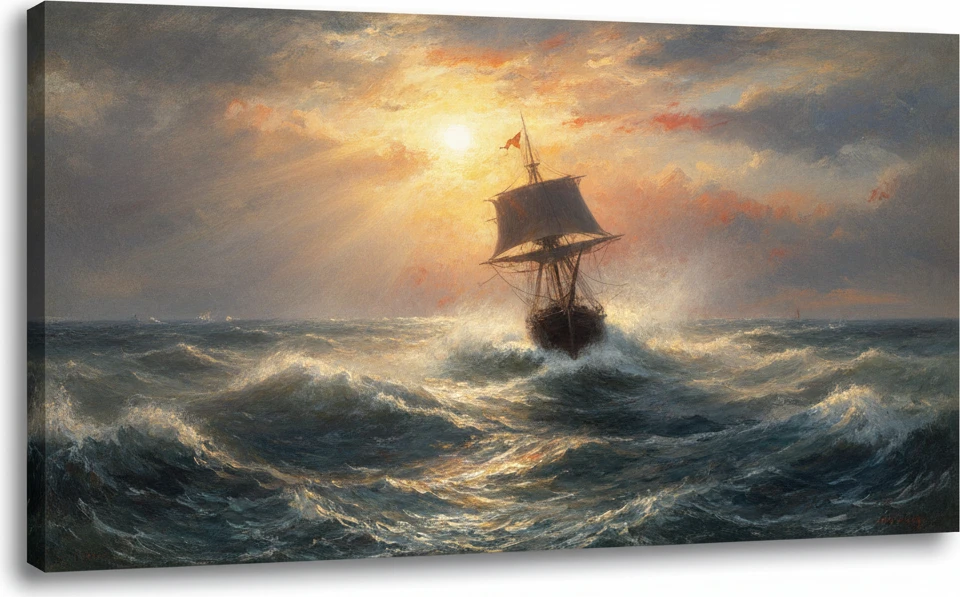
The sea occupied a central place in Turner's work, becoming a recurring metaphor for life, death, and fate. His raging waves, relentless storms, and tragic shipwrecks reflect human fragility in the face of nature's uncontrollable forces. But the sea also represents hope, adventure, and the possibility of new horizons. Turner understood the sea not only as a physical element but as a powerful and multifaceted symbol. His decision to include the sea in so many of his works was based on its ability to evoke a wide range of emotions and meanings. A potential complication was falling into the repetition of images and clichés. Turner avoided this through his constant experimentation with technique and his ability to capture the uniqueness of each moment. For example, in his work "Slavers Throwing Overboard the Dead and Dying - A Typhoon is Coming," the sea becomes a stage of horror and suffering, but also of resilience and survival.
Untamed Nature Against Human Fragility
Turner's work is imbued with a profound awareness of human fragility in the face of the vastness and power of nature. His imposing landscapes, steep mountains, and apocalyptic storms serve as a constant reminder of man's insignificance in the context of the universe. However, he also celebrates human resilience, adaptation, and overcoming in the face of adversity. Turner does not idealize nature; instead, he represents it in all its complexity and ambivalence. His selection of themes, such as avalanches, fires, and storms, reflected his interest in nature as both a destructive and sublime force. The challenge was to avoid excessive simplification and demonization of nature. Turner achieved this by recognizing the beauty and harmony inherent in the natural world, even in its most violent manifestations. For example, in his work "Avalanche in the Aosta Valley," the magnitude of the avalanche underscores human vulnerability, but also the beauty and grandeur of the alpine landscape.
Painting Chaos: Turner's Technique for Capturing the Tempest
Capturing the essence of a storm on canvas requires exceptional technical mastery and a deep understanding of the dynamics of nature. Turner developed an innovative technique that allowed him to convey the sensation of chaos, movement, and unleashed energy that characterizes storms. He used rapid, bold brushstrokes, thick layers of paint, and a palette of vibrant colors to create turbulent and immersive atmospheres. His approach was not simply to represent the visual appearance of the storm but also to convey its emotional and sensory impact. Turner's technique was based on his meticulous observation of nature and his ability to translate that observation into a pictorial language. One difficulty was maintaining visual coherence amidst the chaos. Turner overcame this by using light and color as unifying elements, creating a sense of harmony even in the most turbulent scenes. For example, in his work "Snow Storm: Steam-Boat off a Harbour's Mouth," the swirling brushstrokes and the palette of dark and luminous colors convey the intensity of the storm and the despair of the sailors.
Light and Color: The Secret Language of Turner's Painting
The Revolutionary Use of Color as Emotion
Turner did not consider color as a mere decorative element, but as a powerful means of emotional expression. He used colors to convey feelings, evoke atmospheres, and create dramatic effects. His palette was rich and varied, from the warm and bright tones of the sun to the cold and dark colors of the storm. He experimented with unusual combinations and bold contrasts, challenging the conventions of his time and paving a new way for modern painting. The choice of colors in Turner’s work was not arbitrary, but based on a deep understanding of color psychology. A mistake would be to use color superficially, without considering its emotional significance. Turner avoided this by studying the color theories of his time and developing his own personal palette, based on his observation of nature. For example, in his work "Rain, Steam and Speed - The Great Western Railway", he uses a combination of warm and cool colors to convey the sensation of movement, energy, and the arrival of the industrial age.
Brushstroke Techniques: From the Detailed to the Abstract
Turner's brushstroke technique evolved throughout his career, from a detailed and precise style in his early works to a more free and abstract approach in his later pieces. In his early watercolors, he used fine and delicate brushstrokes to capture the details of nature with precision. In his later oils, he adopted a bolder and more expressive brushstroke, using thick layers of paint and quick, gestural strokes to create turbulent atmospheres and impressionistic landscapes. Turner adapted his brushstroke technique to the subject and the effect he wished to achieve. A potential pitfall was losing control over the brushstroke, resulting in chaotic works that lacked structure. Turner avoided this by maintaining a balance between spontaneity and precision, creating works that combined expressive freedom with visual clarity. For example, when comparing his early watercolors of castles with his paintings later seascapes, one can appreciate the evolution of his brushstroke technique towards greater abstraction and expressiveness.
Influence of Color Theory on His Work
Turner was deeply influenced by the color theories of his time, particularly by the works of Johann Wolfgang von Goethe and Michel Eugène Chevreul. He studied the relationship between colors, their psychological effects, and their ability to create harmony and contrast. He applied this knowledge to his painting, experimenting with unusual combinations and bold contrasts to create dramatic effects and convey intense emotions. The application of color theory in Turner’s work was not merely theoretical, but based on his observation of nature and his experimentation with different materials and techniques. A risk was to follow color theory rigidly, stifling creativity and spontaneity. Turner avoided this by adapting color theory to his own artistic vision, creating works that were both scientifically informed and emotionally expressive. For example, his use of complementary colors, such as blue and orange, in his seascapes creates a sense of dynamism and visual tension.
Masterpieces Under the Microscope: Unraveling 'Snow Storm: Hannibal Crossing the Alps'
The Historical Context and Inspiration of the Work
'Snow Storm: Hannibal Crossing the Alps' is a monumental work that reflects the historical context and concerns of Turner's time. Painted in 1812, during the Napoleonic Wars, the work represents the epic crossing of Hannibal and his army through the Alps during the Second Punic War. However, the painting is not merely a historical representation, but an allegory of the power of nature and the insignificance of man in the face of elemental forces. Turner was inspired by classical descriptions of Hannibal's crossing, as well as his own experiences of mountains and storms. His decision to depict this historical event was based on his desire to explore universal themes such as ambition, power, and the fragility of the human condition. A possible limitation was falling into a literal and superficial interpretation of the historical event. Turner avoided this by using the figure of Hannibal as a symbol of human ambition, contrasting it with the immensity and power of nature. The work reflects the political and social concerns of the time, as well as Turner's fascination with history and mythology.
Analysis of the Composition and Use of Light
The composition of 'Snow Storm: Hannibal Crossing the Alps' is complex and dynamic, reflecting the turbulence of the storm and the confusion of Hannibal's army. The work is organized around a spiral of light and darkness, with the sun shining through the stormy clouds and casting dramatic shadows over the landscape. Turner uses light and color to create a sense of depth and movement, guiding the viewer's gaze through the scene. The figure of Hannibal and his army are tiny and barely visible in the distance, emphasizing their insignificance against the magnitude of nature. The use of light in the work is particularly notable, as Turner employs it not only to illuminate the scene, but also to create an emotional atmosphere and convey a sense of danger and uncertainty. The main challenge was to achieve a balance between detail and abstraction, creating a work that was both visually striking and emotionally resonant. Turner accomplished this by using a loose and expressive brushstroke, which allowed him to capture the essence of the storm without sacrificing visual clarity. The composition and use of light in the work contribute to its emotional impact and allegorical meaning.
The Impact of the Work on Critics and the Public
'Snow Storm: Hannibal Crossing the Alps' generated controversy and admiration when it was first exhibited in 1812. Some critics praised the boldness of the work, its originality, and its ability to convey the sensation of nature. Others criticized its lack of detail, its abstraction, and its apparent chaos. However, over time, the work has been recognized as one of Turner's masterpieces and a landmark in the history of art. Its impact on critics and the public is due to its ability to evoke intense emotions, its innovative use of light and color, and its deep reflection on the human condition. The work influenced later generations of artists, particularly the Impressionists and Expressionists, who admired its expressive freedom and innovative approach to color and light. Its ability to generate both positive and negative reactions demonstrates its power as a work of art. A potential limitation was that the work could be misinterpreted or misunderstood by the public. Turner overcame this by creating a piece that was both visually striking and intellectually stimulating, inviting the viewer to reflect on the themes it raises. The work continues to inspire artists and art lovers around the world, and its legacy endures as a testament to Turner's creative genius. Turner's art remains relevant in the 21st century, as seen in the works of Frida Kahlo, where raw emotion and personal representation intertwine in a similar way.
KUADROS ©, a famous painting on your wall. Hand-made oil painting reproductions, with the quality of professional artists and the distinctive seal of KUADROS ©. Reproduction service from paintings with a satisfaction guarantee. If you are not completely satisfied with the replica of your painting, we will refund 100% of your money.
Venice in the Fog: Turner's Venetian Series and His Fascination with the Floating City
The Enigmatic Atmosphere of Venice Captured by Turner
J.M.W. Turner visited Venice on several occasions, and these visits resulted in a series of works that capture the essence of the city in a unique way. Instead of simply representing the famous monuments, Turner focused on the atmosphere, light, and water that define the Venetian experience. His paintings often show Venice shrouded in fog, creating a sense of mystery and melancholy. The mist blurs the outlines of buildings and boats, making them seem to emerge from nothing. The artist sought to capture the fleeting impression and the emotion that the city evoked in him, setting aside precise detail to capture the atmosphere in its entirety. By choosing this approach, Turner avoided mere visual reproduction, prioritizing the transmission of a sensory and emotional experience of the environment.
Influence of Venice on the Artist's Color Palette
Venice had a profound impact on Turner's color palette. The bright and saturated colors often associated with the city, such as red, gold, and blue, are combined with more subtle tones of gray, white, and ochre to reflect the changing light and watery atmosphere. Turner experimented with different techniques to achieve these effects, including the use of transparent washes and loose brushstrokes. The choice of these colors was not random, but a conscious decision to evoke the sensations of warmth, luxury, and decadence that he associated with the city. The artist used these colors to convey a sense of opulence and splendor, reflecting the rich history and culture of Venice.
The Sense of the Ephemeral and the Sublime in Venetian Works
In Turner's Venetian works, there is a strong sense of the ephemeral and the sublime. The city, with its decadent beauty and constant struggle against water, embodies the transience of existence. Turner captures this sensation through the representation of changing light, swirling clouds, and distorted reflections in the water. His paintings not only represent a place but also explore the transient nature of beauty and the inevitability of change. The grandeur of the Venetian landscapes, combined with the city's vulnerability to water, creates a sense of the sublime, a mixture of awe and fear in the face of the immensity and power of nature. These works invite reflection on the human condition and the relationship between man and his environment. Such masterpieces can be found at kuadros.com as reproductions of paintings in oil.
Turner and the Industrial Revolution: A Pictorial Witness of His Time
The Railroad and Steam as New Elements in His Painting
Turner lived during the Industrial Revolution, a period of rapid technological and social change. Unlike many artists of his time, Turner did not ignore these changes but incorporated them into his work. The railroad and steam, symbols of the new era, became recurring elements in his paintings. These representations were not simply documentary but reflected Turner's fascination and ambivalence towards progress. Often, these machines appear enveloped in steam and smoke, almost as if they were mythical creatures, merging modernity with the grandeur of nature. This fusion creates a visual tension that reflects the complexity of the human experience during the Industrial Revolution.
The Duality between Progress and Destruction in His Artistic Vision
Turner's vision of the Industrial Revolution was ambivalent. On one hand, he celebrated the power and innovation of new technology. On the other hand, he recognized the environmental and social costs of progress. His paintings often show the juxtaposition between natural beauty and industrial pollution, creating a sense of conflict and tension. The choice to represent both aspects was neither a direct critique nor an unconditional praise, but rather an exploration of the inherent complexities of change. Turner sought to provoke reflection on the impact of industrialization on society and the environment, leaving it to the viewer to draw their own conclusions.
Examples of Works Reflecting the Industrial Era
A notable example is "Rain, Steam and Speed - The Great Western Railway" (1844), which shows a train speeding across a bridge, enveloped in a cloud of steam and rain. The painting captures the energy and dynamism of new technology, but also suggests the dangers and uncertainties of the future. Another example is "The Fighting Temeraire Tugged to Her Last Berth to Be Broken Up" (1838), which depicts an old warship being towed by a steam tug, symbolizing the decline of the sailing era and the rise of the industrial age. These works are not only visual representations of the time but also deep reflections on the meaning of progress and its impact on humanity. The choice of these themes demonstrates Turner's ability to connect with the concerns of his time and turn them into lasting art. These great works are an example of the artistic level that can be achieved by capturing history in art. You can find similar styles in the paintings of Tamara de Lempicka.
The Legacy of Turner: Influence on Subsequent Generations
The Influence on Impressionism and Expressionism
Turner's work had a significant impact on subsequent generations of artists, especially in the Impressionist and Expressionist movements. His focus on light, color, and atmosphere inspired Impressionists to break away from academic conventions and capture the fleeting impression of a moment. Artists like Claude Monet admired Turner's ability to represent light and water, and experimented with similar techniques in their own works. Expressionists, for their part, were drawn to Turner's emotional intensity and loose brushwork, which they used to express their own subjective experiences of the world. The freedom with which Turner handled form and color paved the way for greater experimentation and abstraction in modern art. This legacy endures to this day, and his influence can be seen in many different forms of contemporary art. In fact, painters like Monet based their style on Turner's work.
Modern Artists Inspired by Turner
Beyond Impressionism and Expressionism, many modern artists have found inspiration in Turner's work. His focus on abstraction, experimentation with materials, and exploration of themes such as nature and technology have resonated with artists from various disciplines and styles. Some artists have directly reinterpreted his works, while others have taken his approach as a starting point for new explorations. For example, some contemporary artists use digital techniques to create abstract landscapes reminiscent of Turner's paintings, while others explore similar themes related to climate change and environmental degradation. Turner's ability to connect with human emotions and concerns remains relevant in the 21st century, and his influence can be seen in a wide range of artistic practices.
The Relevance of Turner in Contemporary Art
The relevance of Turner in contemporary art lies in his ability to transcend the conventions of his time and address universal themes in an innovative and emotive way. His focus on light, atmosphere, and the subjective experience of the world remains relevant in an increasingly complex and fragmented world. His works invite us to reflect on our relationship with nature, technology, and the human condition, reminding us of the importance of creativity and imagination. Additionally, his experimentation with materials and techniques has opened new possibilities for contemporary artists, who continue to explore the limits of art and expression. In a world where information and images constantly bombard us, Turner's ability to capture the essence of a moment and convey deep emotion remains a valuable reminder of the power of art. A good example of contemporary marketing is what the company Over Horizon Media does in the media field.
Alternatives to Turner's paintings (and when to choose them)
Other Romantic Landscapists: Constable, Friedrich
Although Turner is considered one of the greatest landscapists of Romanticism, other artists of the time also explored similar themes with distinct styles. John Constable, for example, focused on the detailed and realistic representation of the English landscape, capturing the calm and serene beauty of the countryside. Caspar David Friedrich, on the other hand, focused on depicting nature as a reflection of spiritual experience, creating melancholic and evocative landscapes that invite contemplation. The choice between Turner and these other artists depends on personal taste and the type of emotion or atmosphere one wishes to create. If a realistic and detailed representation of the landscape is sought, Constable may be a good option. If a more transcendental and spiritual experience is desired, Friedrich may be more suitable. However, if one seeks the emotional intensity and visual experimentation characteristic of Turner, his works remain an unmatched choice.
Artists with a similar focus on light: Monet, Rembrandt
Turner was not the only artist obsessed with light. Claude Monet, the father of Impressionism, dedicated his life to capturing the effects of light on the landscape, creating works that celebrate the ephemeral beauty of the moment. Rembrandt, for his part, masterfully used light and shadow to create drama and emotional depth in his portraits and biblical scenes. While these artists have different styles, they share a common approach in representing light as a key element to create atmosphere and meaning. If a more subtle and delicate representation of light is sought, Monet may be a good option. If a more dramatic and emotional approach is desired, Rembrandt may be more suitable. However, if one seeks the intensity and visual experimentation characteristic of Turner, his works remain a unique choice.
When to consider a reproduction of another artist
The decision to opt for a reproduction of another artist instead of Turner depends on several factors. Firstly, personal taste plays a fundamental role. While Turner is widely admired, his style is not for everyone. Some may prefer the precision of Constable, the spirituality of Friedrich, or the delicacy of Monet. Secondly, the context in which the artwork will be displayed is also important. A reproduction of Turner may be ideal for a space looking to evoke emotion and grandeur, while a reproduction of Constable may be more suitable for a calm and relaxed environment. Thirdly, the available budget can also be a determining factor. High-quality reproductions of Turner can be expensive, while reproductions of other artists may be more affordable. Finally, it is important to consider the message you want to convey. Each artist has their own voice and perspective, and the choice of a reproduction should reflect the values and ideas you want to communicate.
KUADROS ©, a famous painting on your wall. Hand-made oil painting reproductions, with the quality of professional artists and the distinctive seal of KUADROS ©. Reproduction service from paintings with a satisfaction guarantee. If you are not completely satisfied with the replica of your painting, we refund 100% of your money.
The Turner Experience Today: Museums and Exhibitions Dedicated to His Work
Tate Britain: The Largest Collection of Turner Works
Tate Britain in London houses the most extensive and significant collection of works by J.M.W. Turner in the world. This museum, dedicated to British art from the 16th century to the present, devotes considerable space to the permanent exhibition of Turner’s work, allowing visitors to trace the evolution of his style throughout his prolific career. From his early topographical watercolors to his late, almost abstract canvases, Tate Britain offers a comprehensive view of Turner’s genius. The collection includes masterpieces such as "The Fighting Temeraire", "Rain, Steam and Speed – The Great Western Railway", and numerous other paintings, drawings and sketches that reveal his technical mastery and deep connection with nature and history. Deciding which works to exhibit requires careful analysis of the available space, the themes of temporary exhibitions, and the need to rotate light-sensitive works for their preservation. Tate Britain is undoubtedly a must-visit pilgrimage for any art lover wishing to understand the magnitude of Turner’s legacy.
Other Museums with Important Works by Turner
While the Tate Britain is the main repository of Turner’s art, other institutions around the world also house significant collections. The Metropolitan Museum of Art in New York has a notable selection of his works, including "The Fifth Plague of Egypt". The National Gallery in London also displays several important paintings by Turner, often in dialogue with works by his contemporaries and predecessors. Museums like the Louvre in Paris (though with a smaller collection) and the Yale Center for British Art in New Haven, Connecticut, also contribute to the global appreciation of his art. The geographical dispersion of his works means that fully experiencing the breadth of his talent requires international exploration. The choice of which museums to visit will depend on the specific interests of the viewer; those interested in the British context of Turner’s art will find the Tate Britain indispensable, while other museums may offer valuable comparative and contextual perspectives.
Current and Future Exhibitions (Year 2026)
For the year 2026, various institutions around the world are planning exhibitions dedicated to Turner’s work, some focusing on specific aspects of his career, such as his fascination with the sea or his innovative use of color. It is advisable to check the websites of renowned museums, such as Tate Britain, the Metropolitan Museum of Art, and the National Gallery, for updated information on scheduled exhibitions. Additionally, specialized art and culture websites, such as Artnet or The Art Newspaper, often publish exhibition calendars that can be useful for planning visits and trips. Attending a Turner exhibition offers a unique opportunity to see his works in person, appreciate the texture and luminosity of his paintings, and engage in broader conversations about his impact on art history. A common mistake is to assume that digital reproductions capture the essence of his art; the experience of seeing his original works is fundamental to fully understanding his genius.
Bring the Magic of Turner to Your Home: Oil Reproductions of KUADROS
How to Choose the Perfect Turner Reproduction for Your Space
Selecting the right reproduction of a Turner work for your home involves considering several factors. First, assess the size of the available space and the scale of the painting. A reproduction that is too large can overwhelm a small room, while one that is too small may get lost in a large space. Second, consider the color palette of the painting and how it complements the existing decor. Turner’s works often feature warm and bright tones, but some also explore darker and more melancholic atmospheres. Third, reflect on the emotional impact you wish to create. Are you looking for a piece that inspires calm and serenity, or one that stimulates imagination and reflection? For example, a reproduction of "The Fighting Temeraire" could add a dramatic touch to a living room, while one of his Venetian watercolors could bring a sense of tranquility to a bedroom. Consider seeking professional advice from an interior decorator or consulting online art catalogs for ideas and perspectives.
The Process of Creating a Replica of KUADROS
At KUADROS, creating a replica of a Turner artwork is a meticulous process that combines craftsmanship and attention to detail. Our artists, experts in oil painting techniques, thoroughly study the original work to understand the brushstroke, composition, and color usage characteristic of Turner. Next, a high-quality canvas is prepared, and the replica is painted layer by layer using the highest quality oil pigments. The process can take several weeks, depending on the complexity of the work. Once completed, the replica undergoes rigorous quality control to ensure it captures the essence and spirit of the original artwork. This commitment to excellence is what sets the reproductions from KUADROS apart from generic prints and guarantees that our customers receive a piece of art they will cherish for many years. The greatest challenge lies in replicating the transparency and luminosity characteristic of Turner, which requires exceptional mastery of the oil technique.
Popular Turner Works Available at KUADROS.com
KUADROS.com offers a wide selection of reproductions of Turner’s most iconic works. Among the most popular are "The Fighting Temeraire", an evocative representation of the British warship HMS Temeraire being towed to its dismantling; "Rain, Steam and Speed – The Great Western Railway", a bold interpretation of the industrial age; and various Venetian watercolors that capture the ephemeral beauty of the lagoon city. Additionally, we offer reproductions of his stormy seascapes, such as "Snow Storm: Steam-Boat off a Harbour's Mouth", which demonstrate his fascination with the power and unpredictability of nature. Each reproduction is handmade by experienced artists and is offered in a variety of sizes and finishes to suit different spaces and budgets. The popularity of these works lies in their ability to evoke intense emotions and transport us to a world of beauty and mystery. If you are fascinated by the light and color of Sorolla, we invite you to also discover our Sorolla reproductions.
The Best-Kept Secret of Turner: Curiosities and Anecdotes from His Life
His Eccentricity and Reserved Personality
J.M.W. Turner was known for his eccentricity and reserved personality, traits that contributed to the creation of an aura of mystery around his figure. Despite his fame and success, Turner was a solitary man who avoided social life and preferred to spend time in his studio, immersed in his work. He was said to have a disheveled appearance and often wore old clothes stained with paint. His peculiar behavior and refusal to reveal details about his personal life fueled numerous rumors and speculations. Even his real name was a subject of controversy, as he often referred to himself simply as "Mr. Booth", using a pseudonym to maintain his privacy. This eccentricity, however, only increased his appeal and solidified his status as an misunderstood genius. His decision to keep his private life away from the public eye was a conscious choice, intended to protect his creativity and artistic freedom.
The Relationship with His Contemporaries and Critics
Turner's relationship with his contemporaries and critics was complex and often conflictive. While many recognized his talent and originality, others criticized him for his innovative style and tendency towards abstraction. Some accused him of painting "color soup" and sacrificing precision and detail for visual effect. However, Turner was not intimidated by criticism and continued to develop his own style, challenging the artistic conventions of his time. He maintained friendships with some artists, such as Thomas Lawrence, but also had rivalries with others, like John Constable, whose more realistic and traditional style contrasted sharply with his own. The critical reception of his work varied throughout his career, but over time his genius became increasingly recognized and appreciated. A common mistake is to simplify the relationship between Turner and his critics; there was a constant and complex dialogue that contributed to the development of British art.
Myths and Legends Surrounding His Figure
The life and work of Turner are surrounded by myths and legends that contribute to his enduring fascination. It is said, for example, that he would tie himself to the mast of a ship during a storm to experience firsthand the fury of the sea and capture its essence in his paintings. Another legend tells that he threw a can of white paint onto a canvas at the last minute of an exhibition to overshadow the work of his rival, Constable. While it is difficult to verify the truth of these stories, they reflect the image of Turner as a passionate, eccentric, and even a bit crazy artist. These myths, though perhaps exaggerated, are an integral part of the narrative surrounding Turner and contribute to his appeal as a romantic and rebellious figure. The proliferation of these legends demonstrates the impact his personality and work had on popular imagination. The critical analysis of these legends requires separating historical reality from romantic fiction.
Beyond Light: Delving into the Hidden Meanings of Turner's Work
Recurring Symbols and Metaphors in his paintings
Beyond his technical virtuosity and mastery of light, Turner's paintings are imbued with symbols and metaphors that reveal a deep understanding of history, mythology, and the human condition. The sea, for example, appears repeatedly as a symbol of the relentless force of nature and the fragility of human life. Ships, whether majestic war vessels or humble fishing boats, represent ambition, power, and vulnerability. Storms and shipwrecks symbolize destruction, chaos, and the struggle against adversity. Additionally, Turner often incorporated references to classical mythology and literature, enriching his works with additional layers of meaning. For example, the inclusion of mythological figures such as Apollo or Ulysses in his seascapes evokes themes of journey, destiny, and the relationship between man and nature. Deciphering these symbols and metaphors requires a deep knowledge of the cultural and intellectual context of Turner's time.
The Impact of His Personal Beliefs on His Art
Turner's personal beliefs, including his interest in science, philosophy, and theology, profoundly influenced his art. He was an avid reader and was fascinated by new scientific theories about light, color, and atmosphere. His interest in theology was reflected in his concern for themes such as creation, the final judgment, and the relationship between God and nature. These influences manifest in his paintings through his innovative use of color, his representation of natural phenomena such as the aurora borealis and volcanoes, and his exploration of existential and spiritual themes. For example, his series of paintings on the great flood reflects his concern for the fate of humanity and the destructive power of nature. Understanding Turner's personal beliefs is fundamental to fully interpreting the meaning of his work. Analyzing his personal library and writings can provide valuable clues about his sources of inspiration.
How to Interpret Turner's Works in the 21st Century
Interpreting Turner's works in the 21st century requires an approach that combines historical knowledge with contemporary sensitivity. While it is important to understand the cultural and intellectual context of his time, it is also crucial to recognize the enduring relevance of his themes and concerns. Turner's paintings invite us to reflect on the relationship between man and nature, the power of light and color, and the fragility of human existence. His innovative style and bold vision continue to inspire artists and viewers around the world. In an increasingly technology-driven and globalized world, Turner's work reminds us of the importance of sensory experience, connection with nature, and the pursuit of beauty and transcendence. Considering the current ecological perspective and the growing awareness of climate change can enrich our interpretation of his landscapes and seascapes. The Tate offers valuable resources for the modern interpretation of Turner.
Ultimately, Turner's work remains relevant and captivating, inviting us to explore the depths of light, color, and emotion. His legacy endures not only in the museums and exhibitions dedicated to his art but also in the inspiration he provides to artists and art lovers around the world.
KUADROS ©, a famous painting on your wall. Hand-made oil painting reproductions, with the quality of professional artists and the distinctive seal of KUADROS ©. Reproduction service of paintings with satisfaction guarantee. If you are not completely satisfied with the replica of your painting, we will refund 100% of your money.