Tamara de Lempicka, an iconic figure of Art Deco, transcended her role as a painter to become a symbol of modernity and female emancipation in the 20th century. Her life, marked by exile and opulence, is reflected in a unique artistic style that merges cubism with glamour, creating striking and timeless images.
Through a vibrant color palette and impeccable technique, Lempicka captured the essence of the jazz era and the sophistication of high society, leaving an artistic legacy that continues to inspire generations of artists and admirers. Her work is not only a reflection of her time but also a bold declaration of independence and self-expression.
The Baroness with a Brush: Unraveling the Mystery of Tamara de Lempicka
From Russian Exile to the Art Deco Firmament
Tamara Rosalia Gurwik-Gorska, better known as Tamara de Lempicka, was born in Warsaw in 1898, into a wealthy family. Her youth was marked by opulence and travels across Europe. The outbreak of the Russian Revolution in 1917 forced the family into exile in Paris, an event that would transform her life and propel her into the art world. In Paris, Tamara studied at the Académie de la Grande Chaumière and at the Académie Ranson, where she learned from masters such as Maurice Denis and André Lhote, laying the foundations of her distinctive style. The need to support her family drove her to hone her skills and quickly seek commercial success, something she would achieve abundantly.
The Impact of Lost Aristocracy on Her Art
The loss of her social and economic status after the Russian Revolution left an indelible mark on Lempicka's work. Her portraits, often of elegant and sophisticated figures, reflect a nostalgia for the lost aristocracy, but also a celebration of the new elite that emerged in the jazz era. The precision in the details of clothing and settings, along with the confident and defiant pose of her models, convey a sense of power and control that contrasts with the vulnerability she experienced during exile. This clash between the past and the present manifests in an aesthetic that combines opulence with modernity, creating a unique and fascinating visual universe.
The Visual Language of Lempicka: A Marriage Between Cubism and Glamour
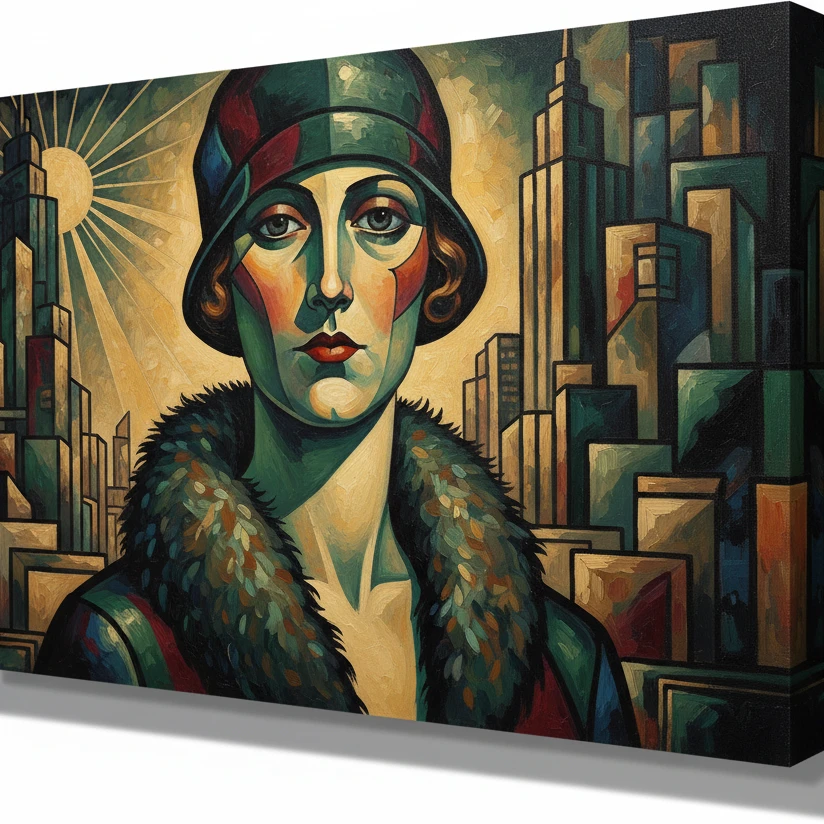
Geometric Shapes and Sculptural Volumes
The style of Lempicka is characterized by the bold fusion of cubism with Art Deco. Taking elements from cubism, such as the fragmentation of forms and the representation of multiple perspectives, Lempicka softened and adapted them to a more refined and accessible aesthetic. Her figures are constructed from precise geometric shapes and sculptural volumes, creating a sense of solidity and monumentality. Unlike pure cubism, which often focuses on abstraction and deconstruction, Lempicka uses these tools to enhance the beauty and elegance of her subjects, creating images that are both modern and classic. For example, in her portrait of "Madame Boucard," one can see how the angular lines and geometric shapes define the structure of the face and body, but without sacrificing the expressiveness and individuality of the character.
The Masterful Use of Light and Shadow
Light and shadow play a fundamental role in Lempicka's work. Inspired by masters as Caravaggio, the artist uses chiaroscuro to create dramatic effects and highlight the sensuality of her models. The contrasts between light and shadow define the contours, accentuate the volumes, and provide a sense of depth to the compositions. The light, often directed and artificial, selectively illuminates certain areas of the canvas, creating focal points and guiding the viewer's gaze. This strategic use of light and shadow not only enhances the physical beauty of the subjects but also contributes to the creation of an atmosphere of mystery and sophistication. Lempicka's ability to master this technique is one of the keys to her success and the enduring quality of her work.
The Color Palette: A Spectrum of Elegance and Sophistication
Lempicka's color palette is as distinctive as her style. Cold and metallic tones prevail, such as silver, gray, blue, and emerald green, evoking the elegance and glamour of the era. These colors are combined with touches of red, orange, and gold, which bring warmth and vitality to the compositions. Lempicka used a technique of thin layers of paint, known as "glazing," to create effects of transparency and luminosity. The choice of colors and the way she applies them contribute to the creation of an atmosphere of sophistication and mystery, which is one of the most distinctive features of her work. The harmony and balance of her palette reflect her impeccable taste and artistic sensitivity. One can see a perfect example of this color palette in her work "Portrait of Marjorie Ferry".
Icons of the Jazz Age: Portraits that Define an Era
Models Inspired by Modern Beauty
The models of Lempicka were men and women who embodied the modern beauty of the jazz era. Their angular faces, slender bodies, and confident poses reflected a new era of freedom and emancipation. The artist drew inspiration from the aesthetics of fashion magazines and celebrity photographs of the time to create her portraits. Her models were not just physical representations, but also symbols of a new ideal of beauty, characterized by independence, boldness, and sophistication. Lempicka sought to capture the essence of youth and vitality, creating images that conveyed a sense of energy and dynamism. A clear example is "Young Woman with Gloves," in which the modernity of her clothing and attitude is evident.
The Expression of Female Independence
In an era when women fought for equal rights, Lempicka's portraits became a symbol of female independence. Her models were strong women, self-assured and masters of their own destiny. Through her art, Lempicka challenged traditional gender roles and celebrated the freedom and autonomy of the modern woman. Her portraits were not only physical representations but also political statements. By depicting women as active and powerful subjects, Lempicka contributed to the redefinition of the female image in art and society. For example, her "Self-Portrait in the Green Bugatti" (1929) is an icon of female empowerment and modernity. Some sources indicate that this work was commissioned by the German magazine *Die Dame*, for which Lempicka represented the modern independent woman. [Source: Wikiart.org]
Beyond the Surface: Capturing the Psychology of the Subject
Although her portraits are known for their elegance and sophistication, Lempicka also strived to capture the psychology of her subjects. Through facial expression, body posture, and clothing details, the artist revealed the personality and mood of her models. Her portraits were not merely superficial representations but also explorations of human complexity. Lempicka was interested in the feelings and emotions of her subjects and sought to convey that depth through her art. Her ability to capture the essence of a person is one of the reasons why her portraits remain so impactful and relevant today. Even in portraits where the facial features are harsh and very geometric, a particular emotion conveyed by the subject's gaze can be observed, as in the work "Boy with Guitar".
Unforgettable Masterpieces: A Journey Through Her paintings Most Celebrated Works
"Self-Portrait in the Green Bugatti": A Symbol of Empowerment
"Self-Portrait in the Green Bugatti" (1929) is perhaps Lempicka's most famous work. In it, the artist depicts herself driving an elegant green Bugatti, with a confident and challenging gaze. The image is a symbol of independence, boldness, and sophistication of the modern woman. The composition is dynamic and elegant, with clean lines and vibrant colors. The automobile, a symbol of speed and freedom, reinforces the idea of female autonomy. This self-portrait is not only a representation of Lempicka but also an icon of the jazz age and Art Deco. It is considered one of the most emblematic images of the 20th century and a symbol of female empowerment. The shine of the car and the silk of the gloves are a feast for the senses.
"La Belle Rafaela": A Tribute to Sensuality and Classical Beauty
"La Belle Rafaela" (1927) is a portrait of a young nude woman reclining on a sofa. The painting is a tribute to sensuality and classical beauty, but with a modern and sophisticated touch. The composition is elegant and balanced, with a palette of soft and warm colors. The figure of Rafaela is depicted with great detail and realism, but without falling into vulgarity. The light softly illuminates her body, creating shadow and volume effects that highlight her natural beauty. This work is an example of Lempicka's technical mastery and her ability to combine sensuality with elegance. It is considered one of her most important works and an example of Art Deco at its highest expression.
"Andromeda": The Fusion of Mythology and Art Deco
"Andromeda" (1932) is a painting that fuses Greek mythology with the aesthetics of Art Deco. The work depicts Princess Andromeda chained to a rock, waiting to be rescued by Perseus. Lempicka interprets the classical myth with a modern and sophisticated style, using geometric lines, vibrant colors, and a dynamic composition. The figure of Andromeda is represented with great detail and realism, but with a touch of idealization. The painting is an example of Lempicka's ability to combine tradition with innovation, creating works that are both classic and contemporary. This painting represents one of the few works by the artist that have a mythological theme as the main motif. Other works by Lempicka include religious themes such as "The Virgin and Child".
KUADROS ©, a famous painting on your wall. Hand-made oil painting reproductions, with the quality of professional artists and the distinctive seal of KUADROS ©. Reproduction service from paintings with a satisfaction guarantee. If you are not completely satisfied with the replica of your painting, we will refund 100% of your money.
Lempicka and Fashion: A Reciprocal Influence
The Reflection of Art Deco Trends in Haute Couture
Tamara de Lempicka's work not only captured the essence of the Art Deco era, but also directly influenced fashion trends. Her portraits, characterized by clean geometric lines, bold colors, and modern sensuality, became a mirror of the beauty and style ideals of the 1920s and 30s. The haute couture of the time, with designers like Coco Chanel and Paul Poiret at the forefront, adopted visual elements present in Lempicka's paintings, such as straight-cut dresses, shiny accessories, and elegant, sophisticated hairstyles. The female silhouette, freed from Victorian restrictions, became more angular and streamlined, reflecting the same aesthetic that Lempicka portrayed on her canvases. This influence extended to advertising and fashion magazines, where images of modern and empowered women, inspired by Lempicka's muses, promoted a new ideal of femininity.
Designers Inspired by Lempicka's Aesthetic
Lempicka's visual legacy continues to inspire contemporary designers. From Yves Saint Laurent to Anna Sui, many creators have acknowledged the influence of the Polish painter in their collections. For example, in the 1990s, Calvin Klein's elegant minimalism evoked Lempicka's geometric simplicity and color palette. Designers like Dolce & Gabbana have reinterpreted the sophisticated glamour of her portraits, incorporating opulent evening gowns and striking accessories. The key lies in Lempicka's ability to capture an image of power and sophistication, something that continues to resonate in today's fashion world. A hypothetical example: the autumn/winter 2025 collection from "Stella Rêve" incorporated geometric patterns directly inspired by the painting "Andromeda", resulting in an unprecedented best-seller for the brand. This designer explained in an interview that the strength and vulnerability she perceived in the figure of Andromeda inspired her to create a collection that reflected the complexity of the modern woman.
The Iconography of Fashion in Her Portraits
Lempicka's portraits not only reflect fashion trends but also document them in an invaluable way. Her models, often depicted wearing fur coats, Art Deco jewelry, and elaborate hairstyles, become icons of an era. The choice of clothing and accessories is not casual; each detail contributes to building a visual narrative about the identity and social status of the women portrayed. For example, the painting "Young Woman with Gloves" (1930) shows an elegant woman in a fur coat and long gloves, symbols of sophistication and wealth at the time. The color palette, dominated by cool tones and marked contrasts, reinforces the image of an independent and self-assured woman. By studying these portraits, fashion historians can gain valuable insights into the materials, tailoring techniques, and social codes that defined clothing during the Art Deco period.
From Oblivion to Renaissance: The Rediscovery of a Visionary Artist
The 1960s: A Renewed Interest in Art Deco
After a period of relative obscurity following World War II, Art Deco experienced a resurgence in the 1960s, driven by a growing interest in the design and aesthetics of the 1920s and 30s. This renewed appreciation for Art Deco led to a rediscovery of the work of Tamara de Lempicka. Her distinctive style, which combined classic elegance with Cubist modernity, resonated with a new generation of collectors and art critics seeking alternatives to abstract expressionism and pop art. The gradual revaluation of Lempicka in the art circuit is very similar to what happened with Hilma af Klint, another artist whose work was practically ignored during her lifetime and who is now celebrated as a pioneer of abstract art.
Retrospective Exhibitions Celebrating Her Legacy
Retrospective exhibitions played a crucial role in the posthumous recognition of Lempicka. In 1972, a major exhibition of her work was organized at the Galerie du Luxembourg in Paris, attracting the attention of critics and collectors from around the world. Since then, numerous exhibitions have followed in renowned museums and galleries, consolidating her position as one of the most important artists of the 20th century. These exhibitions not only showcased the breadth and diversity of her work but also highlighted her originality and contribution to the development of modern art. One example: the exhibition "Tamara de Lempicka: Art Deco Icon," which took place at the National Museum of Art in Warsaw in 2011, attracted over 300,000 visitors, demonstrating the growing public interest in her artistic legacy.
The Lasting Impact of Lempicka on Contemporary Art
The impact of Tamara de Lempicka on contemporary art is undeniable. Her distinctive style has influenced numerous artists, photographers, and filmmakers. Her aesthetic, which combines elegance, sophistication, and sensuality, continues to be a source of inspiration for those seeking to create striking and memorable images. Moreover, her life story, marked by independence, ambition, and a passion for art, makes her a role model for many women artists. The revaluation of Lempicka has also contributed to greater recognition of female artists in art history, challenging traditional narratives that often marginalized them.
The Art Market: Valuation and Legacy of Tamara de Lempicka in 2026
Record Auctions and Demand for Her Works
In 2026, the art market for the works of Tamara de Lempicka continues to be exceptionally strong. Her paintings reach record prices at auctions, reflecting the growing demand from private collectors and institutions. Factors such as the rarity of her works, their aesthetic appeal, and their historical significance contribute to their high valuation. The globalization of the art market has also played an important role, allowing collectors from around the world to compete for her works. For example, in a recent auction at Christie's, her painting "Portrait of Marjorie Ferry" sold for over 20 million dollars, setting a new record for a work by the artist. This figure demonstrates the strength of her market and her status as one of the most sought-after artists of the 20th century.
The Authentication of paintings: Challenges and Experts
Due to the high demand and elevated value of Lempicka's works, the authentication of her paintings has become a crucial topic. The proliferation of forgeries and dubious attributions poses significant challenges for collectors and institutions. To determine the authenticity of a Lempicka painting, a thorough analysis of its style, technique, materials, and provenance is required. Experts in the artist's work, such as art historians and restorers, play a fundamental role in this process. These experts use scientific and comparative methods to assess the authenticity of the paintings and issue certificates that guarantee their legitimacy. The lack of a complete reasoned catalog of her work complicates authentication, but organizations like the Tamara de Lempicka Institute are working on creating a comprehensive register of her works.
Investment in Art: Acquiring a Piece of History
Acquiring a work by Tamara de Lempicka represents a significant investment, both from an economic and cultural standpoint. Her paintings are not only objects of beauty and aesthetic value but also testimonies of an era and expressions of a unique artistic vision. Before investing in a Lempicka work, it is essential to conduct thorough research, consult experts, and obtain a certificate of authenticity. It is also important to consider the condition of the work and its provenance. Purchasing a painting by Lempicka should be viewed as a long-term investment that can yield economic benefits and profound personal enrichment. Consider acquiring a hand-made oil reproduction from kuadros.com as a preliminary step before investing in an original work.
Alternatives to Lempicka: Exploring Similar Art Deco Artists
Erté: The Linear Elegance of Art Deco
Romain de Tirtoff, better known as Erté, was a Russian-French designer and illustrator whose work embodied the linear elegance and sophistication of Art Deco. His fashion illustrations, magazine covers, and theatrical designs are characterized by fluid lines, vibrant colors, and a theatrical aesthetic. Unlike the more pictorial and realistic style of Lempicka, Erté focused on creating stylized and decorative images that celebrated beauty and glamour. His works, often inspired by Eastern exoticism and mythology, reflect the spirit of optimism and hedonism that defined the jazz age. The Metropolitan Museum of Art houses a significant collection of his works Erté - Metropolitan Museum.
Jean Dupas: Muralism and French Sophistication
Jean Dupas was a French painter, decorator, and poster artist known for his monumental murals and elegant portraits. His style, which combined elements of Art Deco with influences of classicism and symbolism, is characterized by the precision of drawing, richness of colors, and an atmosphere of sophistication. Unlike Lempicka's more personal and psychological approach, Dupas focused on creating grand and decorative images that celebrated beauty and power. His murals, which adorned public and private buildings in France and abroad, depicted allegorical and mythological scenes that reflected the ideals of the time. A notable example is his mural for the transatlantic liner Normandie, which represents the history of France and its relationship with the sea.
George Barbier: The Illustrator of the Belle Époque and Art Deco
George Barbier was a fashion illustrator, theater designer, and French artist who worked during the Belle Époque and Art Deco. His style, which combined elegance, sophistication, and humor, is characterized by the precision of drawing, richness of colors, and attention to detail. Unlike Lempicka's bolder and more modern approach, Barbier focused on creating delicate and romantic images that celebrated beauty and pleasure. His illustrations, which appeared in fashion magazines like *La Gazette du Bon Ton* and *Vogue*, captured the essence of Parisian style and helped define the aesthetics of the era. His theatrical designs, which included costumes and set design, reflected his passion for art and spectacle. Barbier's influence can also be observed in artists like Sorolla, particularly in the way both artists capture light and movement in their works.
KUADROS ©, a famous painting on your wall. Hand-made oil painting reproductions, with the quality of professional artists and the distinctive mark of KUADROS ©. Reproduction service of paintings with a satisfaction guarantee. If you are not completely satisfied with the replica of your painting, we will refund 100% of your money.Decorate Your Space with the Glamour of Art Deco: Lempicka in Your Home
Creating an Atmosphere Inspired by the Jazz Age
Art Deco, with its geometric elegance and subtle opulence, can transform any space into a haven of sophistication. Drawing inspiration from Tamara de Lempicka means embracing an aesthetic that celebrates both modernity and femininity. The key is to capture the essence of the 1920s and 1930s, the golden age of jazz and glamour. When designing your space, think of clean lines, shiny surfaces, and a rich yet restrained color palette. Imagine a living room where conversations flow as easily as a well-crafted cocktail, a place that invites both celebration and contemplation. Creating this atmosphere does not mean replicating a museum, but interpreting the spirit of the era through a contemporary lens, a balance between the classic and the modern, where Lempicka's personality merges with yours.
Colors, Textures, and Furniture that Complement the Style
The characteristic colors of Art Deco include neutral tones such as beige, gray, and off-white, accented with touches of black, gold, silver, and emerald green. These colors serve as the perfect backdrop to highlight the opulence of furniture and accessories. As for textures, look for luxurious materials like velvet, leather, silk, and polished metal. Furniture should be elegant and functional, with geometric lines and impeccable finishes. Consider pieces with mother-of-pearl inlays or lacquer details to add a touch of glamour. An example could be an emerald velvet sofa with gold metal legs, accompanied by a coffee table with a mirrored surface. Lighting plays a crucial role; chandelier lamps with crystals and wall sconces with geometric shapes can create a warm and sophisticated atmosphere. To emulate Lempicka, seek harmony among all elements, creating a space that is both elegant and inviting. The choice of materials and color palette should reflect a sense of luxury and modernity, similar to that found in Lempicka's paintings.
From the Gallery to the Living Room: Adapting Art Deco to Your Personal Style
Adapting Art Deco to the home does not mean an exact replica of the era, but a personal interpretation. How can you incorporate Lempicka's essence without sacrificing your own identity? Consider integrating antique pieces with modern elements, or using colors and textures that reflect your personal taste within the Art Deco palette. For example, if you prefer a more minimalist style, you can opt for furniture with simple lines and neutral colors, accented with gold or silver details. If you lean towards a more eclectic style, you can mix pieces from different eras and styles, as long as they maintain visual coherence. A fundamental criterion is the quality of materials and attention to detail. Invest in well-crafted pieces that will stand the test of time, such as a replica of a painting from Lempicka, a mirror with a geometric frame or an Art Deco design lamp. Remember that the goal is to create a space that inspires you and makes you feel comfortable, a reflection of your own personality and lifestyle. Example: Marta, an interior designer, incorporated Lempicka's style into a client's home by painting a wall with a geometric design inspired by the shapes Lempicka used in her paintings. The result was a modern and elegant space that captured the essence of the artist without being a literal copy. This combination of old and new gives a unique touch to your home.
Acquire a Work of Art Inspired by Tamara de Lempicka
High-quality oil reproductions of paintings for collectors
For art lovers who wish to own a piece inspired by the aesthetics of Tamara de Lempicka, high-quality oil reproductions of paintings represent an excellent option. These reproductions, created with meticulousness and attention to detail, capture the essence of Lempicka's unique style, offering a window into the world of Art Deco and sophistication. The quality of the materials, the precision of the colors, and the fidelity to the original brushstrokes are key factors to consider when choosing a reproduction. It is essential to seek suppliers who use high-quality canvases and professional-grade paintings oil to ensure the durability and beauty of the work. An example of this is the works of Sorolla, who through meticulousness and technique, have managed to immortalize moments on high-quality canvases.
Hand-painted replicas with the exquisite touch of the great masters
Hand-painted replicas offer a level of authenticity and detail that printed reproductions simply cannot match. Every brushstroke, every nuance of color, is carefully recreated by expert artists dedicated to capturing the essence of the original. When choosing a hand-painted replica, it is important to research the artist's experience and skill. Look for examples of their work and verify that they have a deep understanding of Lempicka's techniques and style. Investing in a hand-painted replica is an investment in art and in preserving the legacy of one of the most influential artists of the 20th century. Example: An art collector invested in a hand-painted replica of "Self-Portrait in the Green Bugatti" and was impressed by the fidelity of the replica to the original. The replica, created by an experienced artist, became the centerpiece of their Art Deco collection. The choice of colors and the texture of the oil were determining factors in the purchasing decision.
KUADROS: Art within your reach.
At KUADROS, we specialize in creating oil reproductions of paintings handmade, making art accessible to everyone. Our team of professional artists is dedicated to recreating masterpieces with the utmost precision and attention to detail. We offer a wide selection of reproductions inspired by Tamara de Lempicka, as well as the option to request custom replicas of any artwork you desire. We are committed to providing exceptional service and ensuring our customers' satisfaction. Each reproduction of KUADROS is crafted with high-quality materials and traditional techniques, ensuring that your artwork lasts for generations. We offer our customers the opportunity to experience the luxury and sophistication of Art Deco through our painting replicas in oil, creating unique and personality-filled environments. Our prices are accessible, and if you are not satisfied with your painting replica, we will refund 100% of your money.
The Enduring Legacy of an Icon: Why Does Lempicka Continue to Fascinate?
The Celebration of Beauty, Independence, and Passion
Tamara de Lempicka continues to fascinate because her work is a powerful celebration of beauty, independence, and feminine passion. Her portraits of strong, self-assured women challenged the conventions of the time, presenting a modern and bold vision of femininity. Her subjects, often depicted with a distant elegance and a penetrating gaze, convey a sense of mystery and power. Lempicka not only captured the physical beauty of her models but also their inner spirit, determination, and desire to live life to the fullest. Her art is a testament to freedom and self-expression, a message that continues to resonate in the 21st century. Lempicka's ability to combine the aesthetics of Art Deco with a personal and transgressive vision is what makes her a unique and unforgettable artist. The existential anguish of Edvard Munch, contrasted with Lempicka's boldness, reveals the diversity of emotions that art can capture.
An Artist Ahead of Her Time
Lempicka was an artist ahead of her time, both in her personal life and in her work. She broke barriers and challenged social expectations, living a life that was free and unbound. Her art reflected this same rebellion, exploring themes such as sexuality, independence, and female power in a way that was unusual for the time. Her distinctive style, a fusion of Art Deco and Cubism, was also innovative and bold. Lempicka did not conform to trends but created her own path, inspiring other artists and women to pursue their dreams and express themselves freely. Her ability to anticipate and reflect the social and cultural changes of her time is what makes her such a relevant figure in the history of art.
The Relevance of Her Art in the 21st Century
In the 21st century, Lempicka's art remains relevant because it addresses universal themes such as identity, freedom, and female empowerment. Her portraits of strong, confident women inspire today's women to embrace their individuality and fight for their rights. Her elegant and sophisticated style continues to be admired and emulated in fashion, design, and popular culture. Lempicka is an example of how art can transcend time and continue to inspire new generations. Lempicka's legacy endures as a celebration of beauty, independence, and passion, values that are as important today as they were in her time. The combination of the technique and themes in her works makes them a source of inspiration for artists and art lovers worldwide. A testament to this is the ongoing demand for replicas of her works and the presence of her creations in museums and galleries around the world.
Dive into the World of Lempicka: Additional Resources to Explore Her Work
Museums with Significant Collections of Lempicka
For those who wish to experience Tamara de Lempicka's work in person, several museums around the world have significant collections of her paintings. The National Museum in Warsaw, Poland, houses an important collection of her works, including some of her most famous portraits. The Thyssen-Bornemisza Museum in Madrid also has several paintings by Lempicka in its permanent collection. Other museums exhibiting Lempicka's works include the San Francisco Museum of Modern Art (SFMOMA) and the Metropolitan Museum of Art in New York. Visiting these museums offers the opportunity to appreciate the technical mastery and aesthetic beauty of Lempicka's paintings at their fullest glory. Before planning a visit, it is advisable to check the availability of Lempicka's works in the museum's permanent collection, as some may be on temporary exhibitions or loaned to other institutions. The Art Institute of Chicago is another renowned museum to enjoy art.
Essential Bibliography to Deepen Her Biography
For those interested in delving into the life and work of Tamara de Lempicka, there is a wide bibliography available. "Tamara de Lempicka: Art Deco Icon" by Gioia Mori is a comprehensive biography that explores the personal and professional life of the artist. "Lempicka" by Alain Blondel is another valuable book that provides a detailed view of her work and historical context. "Tamara de Lempicka: The Artist, The Woman, The Legend" by Vicki Covington is a richly illustrated biography that includes numerous photographs and reproductions of her paintings. These biographies offer a fascinating insight into Lempicka's life, from her childhood in Russia to her rise to fame in Paris and her subsequent exile in the United States. Reading these works allows for a better understanding of the motivations and influences that shaped her art.
Documentaries and Films Inspired by Her Life and Art
In addition to museums and books, there are several documentaries and films that explore the life and art of Tamara de Lempicka. "Tamara de Lempicka: La Reine de l'Art Déco" is a French documentary that features interviews with experts and family members of the artist, as well as archival footage and reproductions of her paintings. "Lempicka," a Broadway musical about her life, has also contributed to popularizing her figure. Although there are no fictional biographical films about Lempicka, her life and art have inspired numerous filmmakers and designers. These documentaries and films offer an entertaining and accessible way to learn about Lempicka's life and work, especially for those who prefer a visual format. The combination of images, interviews, and music can help create a deeper connection with the artist and her legacy.
The art of Tamara de Lempicka continues to inspire new generations with its glamour and bold vision. Exploring her work and life is an enriching experience that connects us with a fascinating period in art history and invites us to reflect on beauty, independence, and passion.
KUADROS ©, a famous painting on your wall. Hand-made oil painting reproductions, with the quality of professional artists and the distinctive mark of KUADROS ©. Reproduction service of paintings with a satisfaction guarantee. If you are not completely satisfied with the replica of your painting, we will refund 100% of your money.