El Lissitzky, a name that resonates with the boldness of the Russian avant-garde, was much more than an artist. He was a visionary, a designer, an architect, and a master of propaganda, whose ideas transcended the boundaries of art to influence graphic design and architecture in the 20th century. His work, intertwined with the movements of Suprematism and Constructivism, reflects a constant pursuit of innovation and an unwavering commitment to social revolution.
Early 20th-century Russia was a crucible of revolutionary ideas and social transformations. The tsarist regime was wobbling, giving way to unprecedented political and artistic fervor. In this context of effervescence, avant-garde movements such as Suprematism and Constructivism emerged, seeking to break with the conventions of the past and create a new visual language for the new society. This atmosphere stimulated the creativity of artists like El Lissitzky, providing him with fertile ground to experiment and develop his own style.
El Lissitzky (1890-1941), whose real name was Lazar Markovich Lissitzky, was a Russian artist whose work spanned a wide range of disciplines, from painting and graphic design to architecture and typography. His importance lies in his ability to merge abstract art with revolutionary ideals, creating works that were both aesthetically innovative and politically committed. Lissitzky was a pioneer in the use of geometry and abstraction to communicate powerful messages, influencing generations of designers and artists. His multidisciplinary approach and his integrative vision of art make him a key figure in the history of the avant-garde. Other artists of the time, such as Matisse, also experimented with new forms of expression, but Lissitzky stood out for his commitment to the revolution and his ability to translate his ideals into a visual language accessible to the masses.
Proun, short for "Project for the Affirmation of the New" (in Russian: Проект утверждения нового, Proyekt Utverzhdeniya Novogo), is the name El Lissitzky gave to his abstract works, which lie between painting, architecture, and three-dimensional design. The Prouns are not simply paintings; they are conceptual models for a new built environment. Lissitzky imagined the Prouns as transit stations between painting and architecture, exploring the possibilities of a dynamic and utopian space. They are characterized by the use of basic geometric forms, vibrant colors, and an isometric perspective that challenges the traditional perception of space.

Black Square, Kazimir Malevich
El Lissitzky's work was deeply influenced by Kazimir Malevich and Suprematism, an artistic movement that sought the "supremacy of pure feeling" through geometric abstraction. Malevich, with his famous "Black Square," reduced painting to its essential elements, freeing it from figurative representation. Lissitzky adopted the geometric language of Suprematism, but expanded and transformed it, introducing elements of dynamism and spatial depth. While Suprematism focused on spiritual contemplation, Lissitzky sought to apply Suprematist principles to the creation of a new physical and social environment. His transition from Suprematism to Constructivism can be seen as a natural progression in his search for an art that was both aesthetically beautiful and socially useful. Like other great masters, Lissitzky's evolution reflects his constant pursuit of innovation and his desire to break with the conventions of the past.
The Proun served as a bridge between Suprematism and Constructivism, two of the most important movements of the Russian avant-garde. Constructivism, unlike Suprematism, focused on the construction of functional and socially useful objects. Lissitzky, through his Proun, explored the possibilities of applying the abstract principles of Suprematism to the design of buildings, furniture, and other everyday objects. The Proun, therefore, were not simply artworks, but also experiments for a new kind of design that would integrate art and technology to create a more harmonious and functional environment. This integrative vision of art and design is one of the distinctive features of El Lissitzky's work and makes him a precursor of modern design.

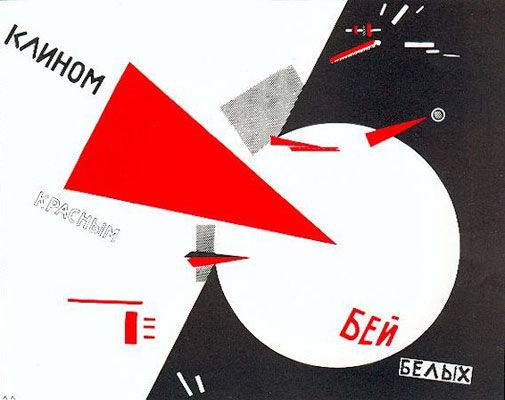
Beat the Whites with the Red Wedge, El Lissitzky
After the Russian Revolution of 1917, El Lissitzky put his talent at the service of revolutionary propaganda. He created striking and visually innovative posters that sought to communicate the ideals of the revolution to the masses. His posters were characterized by the use of simple geometric forms, contrasting colors, and bold typography. He avoided realistic imagery and opted for an abstract visual language that was more universal and accessible. Lissitzky's posters were not simply illustrations; they were powerful communication tools that sought to mobilize the population and build a new collective identity. His decision to use abstraction in propaganda was bold, but effective, as it made it possible to convey complex messages in a clear and concise way. For example, the poster "Beat the Whites with the Red Wedge" (1919) is an iconic example of his ability to combine abstract art with political propaganda.
El Lissitzky worked closely with the poet Vladimir Mayakovsky in the creation of propaganda books and posters. Mayakovsky, a fervent supporter of the revolution, contributed his literary talent and his knowledge of colloquial language, while Lissitzky handled the visual design. Together, they created works that combined poetry and art in an innovative and effective way. Their children’s books, for example, used abstract illustrations and rhyming texts to educate and entertain young readers. The collaboration between Lissitzky and Mayakovsky is a paradigmatic example of how art and literature can come together to create a powerful political and social message. Let us consider the book "For the Voice" (1923), where Lissitzky’s typography and illustrations complement and amplify the power of Mayakovsky’s poems, creating an aesthetic and emotionally resonant experience for the reader.
El Lissitzky was a master in the use of typography as an artistic element. He did not consider typography simply as a means of conveying information, but as an art form in itself. He experimented with different fonts, sizes, and layouts to create typographic designs that were both functional and aesthetically appealing. In his posters and books, typography was not merely an accompaniment to the text, but an integral part of the visual composition. Lissitzky believed that typography could express emotions and convey meanings in a way as powerful as images. His innovative approach to typography influenced twentieth-century graphic design and remains relevant today. A clear example is his use of typography in the magazine "Veshch/Gegenstand/Objet", where the arrangement of the letters and words creates a visual rhythm that complements the content of the articles.
El Lissitzky’s artistic path was a constant evolution from figuration toward abstraction. In his early works, elements of traditional representation can still be appreciated, but as he delved into Suprematism and Constructivism, his work became increasingly abstract. This evolution was not simply a change of style, but a conceptual process that reflected his growing interest in the ideas and principles underlying art. Lissitzky believed that abstraction was the purest form of artistic expression, as it made it possible to communicate ideas and emotions in a direct and universal way, without the limitations of figurative representation. His transition from figuration to abstraction was a personal journey that led him to discover new creative possibilities and develop a unique and original visual language. Initially, Lissitzky painted realistic landscapes and portraits, but gradually he simplified the forms and reduced the colors until he reached the geometric abstraction of his Proun.
Although El Lissitzky was a defender of art committed to social reality, he also sought a spiritual dimension in geometry. He believed that basic geometric forms, such as the square, circle, and triangle, possessed transcendent meaning and could evoke deep emotions and moods. In his Prouns, Lissitzky used geometry not only as a visual language, but also as a means of exploring the relationship between human beings and the universe. His search for spirituality in geometry can be seen as a continuation of the Russian mystical tradition, which sought union with the divine through contemplation of abstract forms. This search for spirituality sets his work apart from other Constructivists, who focused more on the functionality and utility of art. Geometry, for Lissitzky, was a portal to transcendence, a way to connect with the eternal through the tangible.
The relationship between El Lissitzky and Kazimir Malevich was fundamental to Lissitzky's artistic development. Malevich was his master and mentor, and introduced him to the world of Suprematism. Lissitzky deeply admired Malevich and considered him a genius, but he also sought to develop his own style and overcome the limitations of Suprematism. Although Lissitzky adopted Malevich's geometric language, he transformed and expanded it, introducing elements of dynamism and spatial depth that were absent from his master's work. The relationship between Lissitzky and Malevich was a mix of admiration and rivalry, a creative dialogue that pushed both artists to explore new frontiers of abstract art. Lissitzky, as an advanced disciple, did not limit himself to imitating his master, but instead took his ideas as a starting point to create something new and original. Malevich's influence is undeniable, but Lissitzky succeeded in developing his own visual language, distinguished by its dynamism, spatial depth, and social commitment.
The 1928 Cologne Pressa International Exhibition represented a high point in El Lissitzky's career, establishing him as one of the most innovative and avant-garde designers of his time. This exhibition, dedicated to the press and advertising, gave him the opportunity to bring his ideas about visual communication and propaganda to life on a large scale. For Lissitzky, Pressa was not simply an exhibition, but a manifesto of his artistic and political principles, a space where form and function merged to convey a clear and persuasive message. Participation in this event required him to make crucial decisions regarding the selection of materials, the distribution of space, and the integration of graphic and photographic elements. Lissitzky understood that every detail had to contribute to the overall narrative, creating an immersive experience for the viewer. Success at Pressa depended not only on aesthetics, but also on the ability to communicate the ideas of the Soviet regime effectively. This duality, the tension between artistic avant-garde and political propaganda, was a constant in his work.Lissitzky was a master in the use of photography and montage to create striking and persuasive images. In the context of Pressa, photography was not simply a means of documentation, but a propaganda tool. Lissitzky manipulated images, combining them with text and graphic elements to create complex and multifaceted visual messages. He used photomontage techniques to juxtapose disparate images, creating unexpected contrasts and associations. Typography played a crucial role in his montages, complementing and reinforcing the visual message. Lissitzky experimented with different fonts, sizes, and arrangements, creating dynamic and expressive typographic compositions. His works often featured prominent figures from the Soviet government and society, projecting an image of strength and unity. An example of his mastery of montage is his series of posters "Beat the Whites with the Red Wedge", where he used geometric shapes and contrasting colors to represent the struggle between revolution and counterrevolution. To better understand his approach, it is worth exploring the principles of Russian constructivism, a movement that deeply influenced his work.
The 1928 Cologne Pressa International Exhibition holds a prominent place in the history of graphic design and architecture. Not only did it consolidate El Lissitzky’s reputation as an innovator, but it also influenced the development of exhibition design and visual communication. Lissitzky’s avant-garde approach, his bold use of photography and photomontage, and his integration of multimedia elements laid the foundation for future generations of designers. Pressa demonstrated the power of design as a tool for propaganda and political communication, a concept that has been used and reinterpreted throughout the 20th and 21st centuries. The exhibition also highlighted the importance of interdisciplinary collaboration, combining architecture, graphic design, photography, and film to create a cohesive and striking experience. Pressa’s legacy can be seen in the design of museums, trade fairs, and contemporary exhibitions, where the goal is to create immersive and stimulating spaces that convey a clear and persuasive message. The exhibition served as a platform for spreading the ideas of Russian Constructivism and Suprematism, movements that transformed the artistic and cultural landscape of the 20th century.
El Lissitzky’s influence as a graphic designer extended far beyond his specific projects, leaving an indelible mark on the Bauhaus and on the development of modern typography. His innovative and experimental approach, his commitment to functionality, and his vision of visual communication as a powerful tool inspired a generation of designers. Lissitzky believed that graphic design should be accessible, understandable, and relevant to everyday life, rejecting unnecessary ornamentation and elitist aesthetics. His work at the Bauhaus, though brief, was fundamental to the adoption of a more radical and experimental approach to design. He introduced new techniques and materials, encouraging collaboration between different disciplines and challenging traditional conventions. A key aspect of his influence was his emphasis on legibility and clarity, seeking to create typefaces that were easy to read and understand, even in small formats or in motion. This practical and functional approach became a distinctive feature of modern graphic design.
El Lissitzky’s collaboration with Jan Tschichold and other typographers of the time was fundamental to the development of “New Typography” (Die Neue Typographie ) This collaboration was not only limited to the exchange of ideas and techniques, but also involved the joint production of projects and the dissemination of its principles through publications and exhibitions. Tschichold, influenced by Lissitzky's work, adopted a more functional and geometric approach to typography, moving away from traditional typefaces and seeking to create a more modern and accessible visual language. Together, Lissitzky and Tschichold, along with other typographers such as Herbert Bayer, promoted the use of sans-serif typography, left alignment, and the structuring of information through type size and weight. These revolutionary ideas transformed the design of books, posters, and magazines, laying the groundwork for modern visual communication. A notable example of this collaboration is Lissitzky's influence on Tschichold's book and magazine cover designs, which adopted a more dynamic and experimental style. These collaborations demonstrated the power of teamwork to drive innovation in graphic design.

El Lissitzky, Die Neue Typographie
“New Typography” (Die Neue Typographie), driven by El Lissitzky, Jan Tschichold, and other designers, represented a radical break with traditional typographic conventions, seeking to create a more modern, functional, and accessible visual language. It was based on the principles of constructivism and functionalism, rejecting unnecessary ornamentation and aiming for maximum clarity and legibility. One of the defining features of New Typography was the predominant use of sans-serif typefaces, such as Futura and Helvetica, considered more modern and easier to read than traditional serif typefaces. The use of left alignment was also promoted, considered more natural and efficient for reading than centered or justified alignment. Structuring information through type size, weight, and color was another key aspect of New Typography, allowing designers to guide the reader’s attention and highlight the most important elements. New Typography not only influenced the design of books and magazines, but also signage, advertising, and visual communication in general, transforming the visual landscape of the 20th century. This movement laid the foundations for the digital typography and web design we see today.
El Lissitzky revolutionized book and magazine design, seeking to integrate typography, image, and space in an innovative and functional way. For Lissitzky, the book was not simply a container for text, but a dynamic and expressive object that had to communicate a coherent visual message. He experimented with different formats, sizes, and materials, aiming to create books that were both attractive and easy to read. He integrated photography and photomontage into his designs, creating striking visual compositions that complemented the text. Typography played a crucial role in his designs, using different fonts, sizes, and layouts to create rhythm and visual hierarchy. A notable example of his innovation in book design is his work on the magazine "Veshch/Gegenstand/Objet", where he experimented with different formats and layouts to communicate the ideas of Russian constructivism. He also designed several books for children, using bright colors and simple geometric shapes to create attractive and educational images. His innovative and functional approach influenced book and magazine design for decades, laying the foundations for modern visual communication. Lissitzky's work in this field demonstrated that design can be both artistic and practical, improving the reader's experience and conveying information more effectively. To learn more about the impact of graphic design on communication, you can research current trends in website user journey optimization.
El Lissitzky's legacy endures to this day, inspiring designers, artists, and architects around the world. His innovative vision and commitment to experimentation have influenced the development of graphic design, architecture, art, and visual communication. Lissitzky showed that design can be a powerful force for social and political change, using his work to promote his ideals and transform the world around him. His interdisciplinary approach, bold use of technology, and belief in collaboration have laid the foundations for contemporary design practice. Lissitzky not only created artworks striking works, but also articulated a design philosophy that remains relevant in the 21st century. His legacy reminds us of the importance of creativity, innovation, and social commitment in design practice.
El Lissitzky's impact on graphic design and architecture is undeniable. In graphic design, his influence can be seen in the use of sans-serif typography, left alignment, the prioritization of information, and the integration of photography and montage. His work laid the foundations for the design of posters, magazines, books, and websites, transforming the way we communicate visually. In architecture, his influence can be seen in the use of simple geometric shapes, the integration of graphic elements into buildings, and the creation of dynamic and functional spaces. His "Prouns" (Projects for the Affirmation of the New) were an attempt to fuse painting, architecture, and design, creating a new visual language that influenced the development of constructivism and modern architecture. Lissitzky believed that architecture should be a tool for social change, creating spaces that promoted equality and justice. His innovative vision and commitment to experimentation have inspired generations of architects and designers to create buildings and spaces that are both beautiful and functional. The integration of art into architecture, as evidenced in his work, remains a relevant trend in contemporary design.
El Lissitzky's influence also extends to contemporary art, where his innovative approach and experimentation with forms, colors, and materials continue to inspire artists from diverse disciplines. His legacy can be seen in abstract art, minimalism, conceptual art, and digital art, where artists explore new forms of expression and visual communication. Lissitzky was a pioneer in the use of technology in art, experimenting with photography, photomontage, and film to create innovative and provocative works. His work has influenced artists who use technology to create interactive installations, video art, and generative artworks. Lissitzky believed that art should be accessible to everyone, rejecting elitism and seeking to create works that were relevant to everyday life. His commitment to experimentation and his innovative vision have made El Lissitzky a key figure in the history of modern and contemporary art. His ability to fuse art, design, and technology remains a source of inspiration for artists seeking to break barriers and explore new creative frontiers.
Appreciating the work of El Lissitzky in the 21st century requires an effort to understand the historical and cultural context in which it was created, as well as an openness to his innovative and experimental approach. It is important to recognize his role as a pioneer of graphic design and modern architecture, as well as his commitment to experimentation and innovation. To fully appreciate his work, one can visit museums and galleries that display his works, read books and articles about his life and work, and explore online resources that offer information and analysis of his work. It is also useful to study the principles of Constructivism and Suprematism, artistic movements that deeply influenced his work. By understanding the historical and cultural context of his work, as well as its artistic and philosophical principles, we can fully appreciate the beauty, complexity, and relevance of El Lissitzky’s work in the 21st century. His legacy continues to be a source of inspiration for those seeking to innovate and transform the world through art and design. Likewise, it is possible to observe his influence in the work of other artists, such as in the use of color and form by Matisse: Color as Emotion and Freedom, although each with their own style.
El Lissitzky explored theater as a stage for the avant-garde, seeking to transform the theatrical experience through experimentation with set design, costume, lighting, and movement. For Lissitzky, theater was not simply a place to stage dramatic works, but a space for artistic experimentation and technological innovation. He believed that theater could be a powerful tool for social and political transformation, creating immersive experiences that challenged conventions and promoted change. His innovative approach and experimentation with different media and techniques have influenced the development of modern and contemporary theater. El Lissitzky saw theater as a laboratory where he could explore new ideas and concepts, creating experiences that were both artistic and relevant to everyday life.
El Lissitzky revolutionized stage and costume design, seeking to create theatrical environments that were dynamic, expressive, and functional. He rejected traditional stage design, which he considered static and realistic, and sought to create spaces that were abstract, geometric, and three-dimensional. He used simple geometric shapes, such as cubes, cylinders, and spheres, to create stage structures that were both beautiful and functional. He experimented with different materials, such as wood, metal, and plastic, seeking to create interesting textures and visual effects. In costume design, Lissitzky sought to create garments that were both expressive and functional, reflecting the characters' character and personality. He used bright colors and geometric shapes to create costumes that were visually striking and easy to recognize. His innovative approach and his experimentation with different materials and techniques have influenced stage and costume design for decades, inspiring generations of designers to create theatrical environments that are both artistic and functional. El Lissitzky's costume design, with its geometric shapes and contrasting colors, significantly influenced fashion trends and costume design in modern art.
El Lissitzky experimented with light and movement in theater, seeking to create immersive sensory experiences that actively engaged the viewer. He used light as a sculptural element, creating dynamic visual effects that transformed the stage space. He experimented with different types of lighting, such as direct light, indirect light, and strobe light, seeking to create contrasting and expressive atmospheres. He also experimented with movement, creating choreographies that integrated the human body, machinery, and technology. He used moving platforms, lifts, and other mechanical devices to create complex and dynamic movements on stage. His experimentation with light and movement has influenced the development of experimental theater and performance art, inspiring artists to create sensory experiences that challenge conventions and explore new forms of expression. The integration of technology and art, as evidenced in his experimentation with light and movement, remains a relevant trend in contemporary theater and performance.
For El Lissitzky, theater was a space of transformation, both for artists and for the public. He believed that theater could be a powerful tool for social and political change, creating experiences that challenged conventions and promoted reflection. His innovative approach and his experimentation with different media and techniques have influenced the development of modern and contemporary theater, inspiring artists to create works that are both artistic and relevant to society. Lissitzky saw theater as a place where new ideas and concepts could be explored, creating experiences that were both stimulating and transformative. His legacy reminds us of the importance of theater as a space for creativity, innovation, and social commitment. In his view, theater not only entertained, but also inspired the audience to question the world around them and imagine a better future.
El Lissitzky's artistic legacy is manifested in a variety of works ranging from painting and graphic design to architecture and typography. His genius lies in his ability to merge different artistic disciplines with an avant-garde and revolutionary approach. By exploring his most emblematic creations, we can appreciate his stylistic evolution and his commitment to the transformation of art and society.

Proun 19D (c. 1922): An Example of His Visual Language
Proun 19D is a fundamental work for understanding El Lissitzky's visual language. This series, short for "Project for the Affirmation of the New," represents the synthesis of his ideas about space, geometry, and abstraction. In this piece, Lissitzky explores the interaction between three-dimensional and two-dimensional geometric forms, creating a sense of depth and dynamism. The choice of colors, often contrasting, reinforces the visual tension and sense of movement. This work is not only an aesthetic exploration, but also a proposal for a new visual order that reflects the ideals of the Russian Revolution. Lissitzky envisioned the Prouns as transit stations between painting and architecture, influencing the design of habitable spaces and urban planning. A hypothetical example of his influence could be the design of a subway station in Moscow, where Proun principles were applied to create a dynamic and stimulating environment for passengers.
Beat the Whites with the Red Wedge (1919): Icon of Revolutionary Propaganda
This famous poster is perhaps El Lissitzky's most iconic work and a powerful example of his use of art as a propaganda tool. The design is simple yet striking: a red triangle (symbolizing the Bolsheviks) pierces a white circle (representing the counterrevolutionaries). The dynamic composition and combination of primary colors convey a clear and forceful message. The typography used in the poster, in Russian, reinforces the revolutionary message. The success of this poster lies in its ability to communicate a complex idea in a visually accessible and memorable way. The poster was widely distributed during the Russian Civil War, and its impact was significant in mobilizing support for the Bolshevik cause. The decision to use simple geometric shapes and contrasting colors was a deliberate choice to reach a broad audience, regardless of their level of education or literacy. This innovative approach set a precedent for modern graphic design and visual communication. To better understand the historical context and impact of this work, specialized academic and museum resources on the Russian avant-garde can be consulted.

The Isms of Art (1925): A Manifesto of the Avant-Garde
The Isms of Art is a typographic work that reflects El Lissitzky’s fascination with experimentation in design and visual communication. In this work, Lissitzky explores the relationship between different avant-garde art movements, presenting an integrated and dynamic vision of modern art. Using a variety of typographic fonts, sizes, and arrangements, he creates a visually stimulating composition that reflects the diversity and vitality of the art of his time. The work is a manifesto in itself, a statement of the importance of innovation and experimentation in art. Lissitzky not only presents the different "isms" of art, but also connects them to one another, suggesting a continuous flow of ideas and a constant evolution of visual language. One possible pitfall in interpreting this work is to focus solely on the textual content, ignoring the importance of typographic design as a fundamental expressive element. It is crucial to appreciate how the way the words are presented contributes to the overall meaning of the work.
El Lissitzky was a visionary who anticipated the convergence of art and technology, exploring new forms of expression through photography, photomontage, and experimentation with innovative materials. His futuristic approach made him a pioneer in integrating art with the technological advances of his time, laying the foundations for the development of modern design and visual communication.
El Lissitzky understood the potential of photography and photomontage as revolutionary artistic tools. He used these techniques to create images that challenged the traditional conventions of representation, exploring new forms of perception and visual expression. In his photomontages, Lissitzky combined photographs, illustrations, and typographic elements to create dynamic and provocative compositions. One example of his mastery of photomontage is his series of self-portraits known as "The Constructor," in which he represents himself as an engineer and artist, blending creativity and technical precision. This series reflects his belief in the power of art to build a better future. The decision to use photomontage allowed him to create images that were impossible to achieve with traditional painting, opening up new possibilities for artistic expression. Let us consider, as an example, the creation of propaganda posters that conveyed complex messages quickly and effectively, taking advantage of the visual impact of combining images and text.
El Lissitzky was an innovator in experimenting with new materials and techniques. He did not limit himself to traditional methods of painting and sculpture, but explored the possibilities of materials such as metal, glass, and plastic. He was also a pioneer in the use of airbrushing and other industrial techniques in art. This experimentation allowed him to create works that were both aesthetically appealing and technically innovative. One example of his experimentation with new materials is his design for the 1928 Cologne Press International Exhibition, where he used metal structures and luminous elements to create a dynamic and interactive space. Lissitzky understood that art should not be limited to museums and galleries, but should be integrated into people's everyday lives. His innovative approach influenced the development of industrial design and modern architecture. A common pitfall when replicating his work is not fully understanding the properties of the materials, leading to poor execution.
El Lissitzky's work is imbued with a futuristic vision of art and society. He believed in the power of art to transform the world and create a better future. His avant-garde approach and commitment to innovation made him a key figure in the development of modern art. Lissitzky imagined a future in which art, technology, and society would be harmoniously integrated. His ideas influenced a wide range of disciplines, from graphic design and architecture to digital art and virtual reality. One example of his futuristic vision is his concept of the "Proun Room," a habitable space designed according to Proun principles, which sought to create a dynamic and stimulating environment for its inhabitants. Lissitzky's vision remains relevant in the 21st century, as technology continues to transform our lives and our relationship with art. To better understand his vision, it is worth exploring theoretical texts and manifestos from the period, such as the writings of other avant-garde artists like Vladimir Tatlin, who influenced the conception of monuments to the Third International.
El Lissitzky's legacy has seen a resurgence in the 21st century, with numerous exhibitions, retrospectives, and publications dedicated to his work. His influence on art, design, and architecture is increasingly recognized, and his work continues to inspire artists and designers around the world. The recovery and celebration of his work are essential to understanding the evolution of modern art and the importance of innovation and experimentation.
In recent years, important exhibitions and retrospectives dedicated to the work of El Lissitzky have been organized in museums around the world. These exhibitions have given the public the opportunity to appreciate the breadth and depth of his work, from his early paintings to his final architectural designs. A recent example was the exhibition "El Lissitzky: A Retrospective" at the Van Abbemuseum in Eindhoven, the Netherlands, which brought together a wide selection of his most important works. These exhibitions not only celebrate his legacy, but also encourage research and study of his work. The catalogues of these exhibitions often include essays by leading art experts that offer new perspectives on his life and work. Attending these exhibitions is a crucial step for artists seeking inspiration.
Works by El Lissitzky are found in the permanent collections of the world’s most important art museums, including MoMA in New York, Tate Modern in London, and the Reina Sofía Museum in Madrid. These institutions recognize his importance as a key figure in the development of modern art and are dedicated to preserving and exhibiting his work for future generations. The presence of his works in these museums ensures that his legacy remains accessible to the public and that his influence continues to be relevant in the 21st century. El Lissitzky’s inclusion in these collections is a testament to his talent and vision, as well as recognition of his contribution to the world’s cultural heritage. One example is MoMA, which houses several of his most important works, including "Proun 1A."
It is essential to preserve El Lissitzky’s legacy for future generations. His work represents an example of innovation, creativity, and social commitment that remains relevant in the 21st century. Preserving his works, his writings, and his ideas is essential to understanding the evolution of modern art and the importance of the avant-garde. In addition to the physical conservation of his works, it is important to promote research and the study of his work, as well as to spread his legacy through exhibitions, publications, and educational programs. Access to primary sources, such as his diaries and correspondence, is crucial to understanding his creative process and his worldview. Likewise, digitizing his works and documents makes them accessible to a wider audience, including researchers and students from around the world. Creating scholarships and residency programs for artists and designers inspired by his work is another way to honor his legacy and foster innovation in art and design.