Johannes Vermeer, master of Delft, transformed everyday life into visual poetry through his masterful handling of light. More than a simple lighting element, light in his canvases becomes an active character, shaping the atmosphere, revealing depth, and telling subtle stories that continue to captivate viewers to this day.
Entering Vermeer’s universe means discovering how the perception of reality can be altered and elevated through the interplay of light and shadow. His works invite slow contemplation, where each ray of light seems to have a purpose, inviting us to unravel the secrets that lie in the intimacy of his scenes.
Delft and Light: A Privileged Setting for Vermeer’s Brilliance
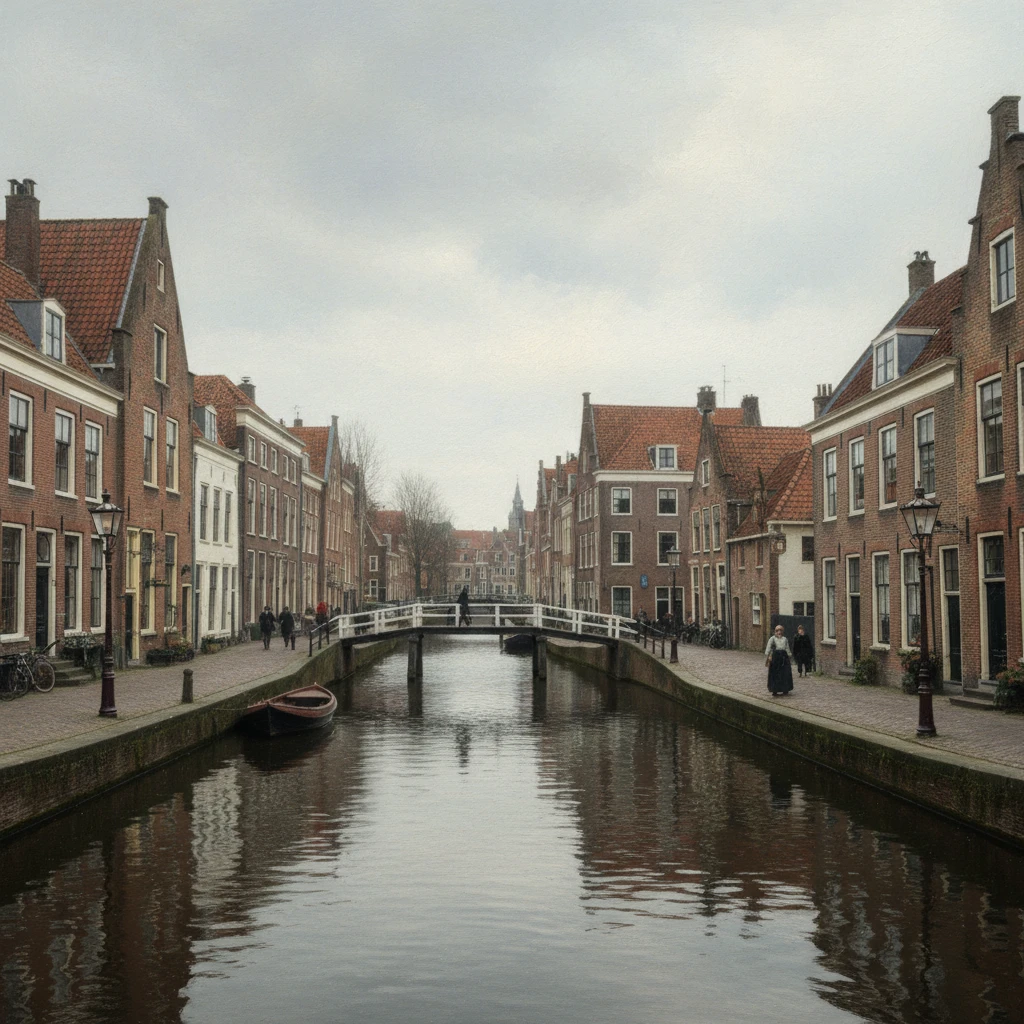
The city of Delft, in the heart of the Netherlands, was not a casual backdrop for Johannes Vermeer’s work. Its surroundings, imbued with the spirit of the Dutch Golden Age, provided a unique ecosystem that undoubtedly influenced his artistic approach. The prosperity of the era, marked by commerce, science, and a growing appreciation for scenes of everyday life, created an environment conducive to detailed observation and the intimate representation of reality. The meticulous attention to detail, characteristic of Flemish painting from which Vermeer drew inspiration, found fertile ground in Delft to flourish, manifesting itself in the depiction of fabrics, household objects, and the city’s architecture with astonishing verisimilitude. This cultural context not only provided Vermeer with themes for his paintings, but also fostered a collective appreciation for technical skill and the faithful representation of the visible world.

Natural light, omnipresent in the Netherlands, played a crucial role in daily life and, by extension, in the artistic practice of the painters of the time. The working day of an artist like Vermeer was intrinsically tied to the availability and quality of sunlight. Windows, often large and unobstructed in Dutch houses, were the main sources of illumination, dictating the times of day when work could be done most effectively. Artists had to be masters at capturing the subtleties of this changing light, adapting their palettes and techniques to different lighting conditions. This deep understanding of how light interacts with objects and spaces became a fundamental skill, and Vermeer took it to an unprecedented level of mastery, using light not only to see, but to model form and evoke emotions. His constant observation of how light fell on interiors, how it filtered through the panes, and how it created tonal gradations on surfaces became the core of his visual language, allowing him to capture fleeting moments with moving permanence.
Light as Brushstroke: Beyond Color
Vermeer elevated light from being a mere component of the scene to becoming a primary tool of his pictorial technique, almost a brushstroke in itself. His ability to capture the atmospheric quality of light, its translucency, and its capacity to bathe objects in a soft glow is what sets his works apart. Instead of relying exclusively on color to define forms and planes, Vermeer used luminous nuances to sculpt volume. Let us observe, for example, the delicate modulation of light on a woman's face or on the curve of a jug; it is not the pure pigment but the subtle gradation of light that gives us the sense of three-dimensionality. This approach moves away from more schematic or flat representations, introducing an almost tactile quality to the depicted surfaces. The way light disperses, how it reflects, or how it is absorbed by different materials is rendered with a precision that reveals a deep understanding of optical phenomena, knowledge that translates directly into the feeling of realism and presence in his canvases.
This mastery of light is particularly evident in his use of what could be described as a "Vermeer-esque sfumato," a subtle technique that softens contours and creates imperceptible transitions between light and shadow. Unlike Renaissance sfumato, more associated with Leonardo da Vinci, Vermeer’s is more atmospheric and deeply tied to the quality of natural light that floods his interiors. It is not about aggressively blurring lines, but about allowing light itself to dissolve the edges, creating a sense of depth and vibrant air. This technique contributes to the serene and enveloping atmosphere of his paintings, allowing the figures to seem to emerge gently from the background rather than being sharply outlined. The result is a dreamlike yet profoundly real quality, where the textures of fabrics, the softness of skin, and the materiality of objects are suggested through these delicate light transitions, inviting the viewer into a space of intimate contemplation.
Windows, Curtains, and Reflections: Light Artifacts in His Works
The side window stands as a recurring and fundamental element in Vermeer’s composition, serving as the main orchestrator of lighting in his interiors. Consistently placed on the left side of most of his canvases, this artificially controlled light source casts a soft, diffused glow that bathes the scenes in an ethereal quality. This compositional choice is not arbitrary; it allows Vermeer to model figures and objects with exquisite tonal gradations, creating a strong sense of volume and presence. The light, falling from a single point, generates predictable yet richly nuanced shadows that define the spaces and guide the viewer’s eye. The consistency of this light source lends his interiors an atmosphere of calm and order, almost a study of light itself, where each element is illuminated deliberately, inviting a slow contemplation of domestic life. This window becomes the portal through which exterior light enters to bring the interior scene to life, a device Vermeer masters to perfection for his narrative and aesthetic purposes.

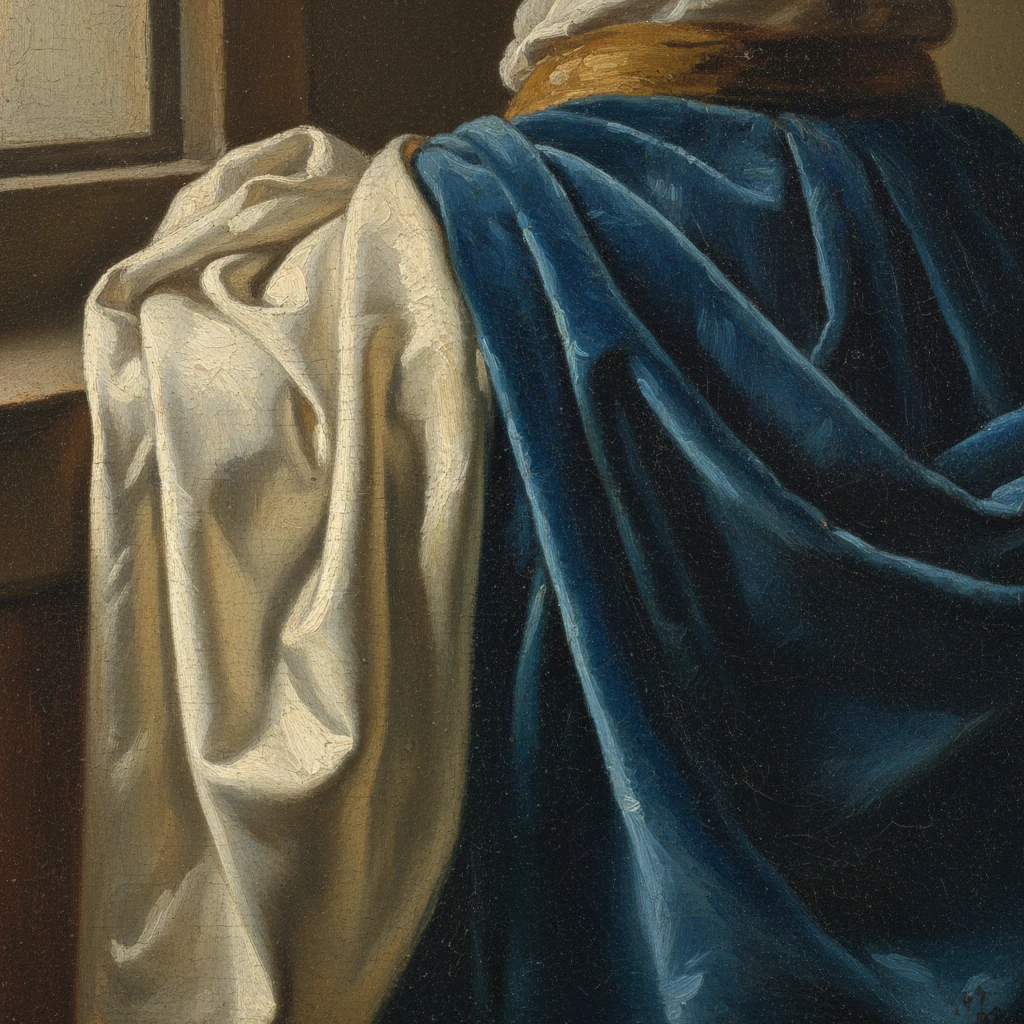
Curtains, often present in his works, transcend their merely decorative function to become highly important narrative and compositional elements. These fabrics, whether heavy and opaque or light and translucent, act as a visual frame, directing attention toward the main space of the painting and emphasizing the sense of intimacy. The way Vermeer depicts curtains, with their natural drape and subtle folds, adds texture and depth to the composition. At times, they seem to partially conceal the scene, creating suspense or suggesting the privacy of the moment portrayed, while at other times, when drawn back, they reveal the main action. These fabrics act as barriers between the viewer and the inner world, intensifying the feeling of observing a private moment. Their texture and the way they interact with light, catching and scattering the rays, contribute to the overall atmosphere of serenity and contemplation that characterizes many of his compositions, elements we can appreciate in the detailed study of Secrets of Flemish Painting: Detail and Profound Realism.
The use of reflections is another layer of sophistication that Vermeer adds to his compositions to enhance the sense of depth and realism. Although they are not always explicit, the subtle gleams and glints on polished surfaces, such as a metal jug, the human eye, or even the water held in a bowl, capture light dynamically. These reflections not only demonstrate his astonishing technical skill in representing the interaction of light with different materials, but also add a vibrant dimension to the stillness of the scene. They make it possible to suggest elements outside the main field of view or to reinforce the presence of ambient light. In works such as "The Milkmaid," the tiny points of light on the ceramic jug and on the bread are not mere embellishments, but indicators of a sharp observation of how light manifests in the real world, infusing his paintings with extraordinary vitality and credibility, an approach that resonates with the search for reality in other masters such as Velázquez in Velázquez: The Reflection of the Spanish Court.
The Power of Yellow and Blue Light: An Emotional Palette

Ochre yellow, with its earthy warmth and soft quality, is a color that Vermeer uses with notable frequency, often associating it with the intimacy and domesticity of his scenes. This tone, far from being harsh, lends a cozy and serene atmosphere, enveloping the figures and objects in a comforting halo. Ochre yellow is wonderfully suited to the depiction of fabrics, skin, and backgrounds, imbuing them with an inner light that suggests the warmth of a home. In Vermeer’s hands, this color does not merely describe, but evokes a sense of peace and contemplation, inviting the viewer to share the stillness of the room. Its use contributes to the meditative atmosphere of his paintings, where the simplicity of everyday life is elevated to a plane of transcendent beauty. The richness and depth of this pigment allow light to seem to emanate from the surfaces themselves, creating an effect of soft, steady luminosity that is distinctive of his work.
In contrast, ultramarine blue, obtained from lapis lazuli, was an extraordinarily expensive pigment in Vermeer’s time, and its use was reserved for representations of great value, often associated with royalty, divinity, or nobility. In Vermeer’s works, this vibrant and deep blue is used strategically, frequently in garments or accessories, lending an air of luxury and sometimes spirituality to the depicted figures. Ultramarine not only adds a focal point of intense color, but also elevates the dignity and status of the characters. Its brilliance and depth create a captivating contrast with warmer tones, such as ochre yellow, generating a visual tension that enriches the composition. The presence of this costly pigment, even in domestic scenes, speaks to the importance Vermeer gave to every element and every color in building his visual narrative, adding a layer of meaning that goes beyond mere realistic representation.
The interaction between ochre yellow and ultramarine blue in Vermeer’s paintings is key to understanding the emotional and atmospheric depth of his works. These two colors, placed side by side, create a harmonious contrast that intensifies the viewer’s visual experience. The warm and inviting ochre yellow, which often illuminates a figure’s face or clothing, is enhanced by the presence of an ultramarine blue detail, such as a shawl or headdress. This combination not only adds visual richness but can also evoke a complex range of emotions: the serene intimacy of yellow merges with the elegance and depth of blue. The result is a unique atmosphere, where the everyday is tinted with an almost sacred quality, and where light, through the careful selection of these pigments, becomes a vehicle for expressing subtle and profound feelings, similar to how color is used to evoke emotions in artists like Rothko in Rothko: Color as an Emotional Portal.
Woman and Light: Moments Captured in Domestic Intimacy
Johannes Vermeer’s work is distinguished by its deep connection to the representation of everyday life, and it is in the interaction of his figures, predominantly women, with light that much of his genius lies. The light in his canvases is not merely an element of illumination, but a leading actor that shapes the atmosphere, reveals emotions, and builds intimate narratives. Vermeer often captures women in moments of introspection or domestic activity, bathed in a light that enters gently through a side window, creating an atmosphere of serenity and focus. This careful lighting allows the viewer to be a silent witness to private moments, as if observing something fleeting.
The choice of reading and writing scenes under this soft light is a recurring theme. Think of the calm and contemplation conveyed by a woman absorbed in a letter or a book. The light settles delicately on her hands, the paper, and the outline of her face, defining shapes and textures with almost tactile precision. This use of light not only highlights the action itself, but also suggests the importance of knowledge, communication, and inner life in the domestic space. The apparent simplicity of these compositions conceals a complex orchestration of light and shadow that invites reflection on the value of personal time and each individual’s inner world. The subtlety of how the light defines the folds of clothing or the glint of an earring is a testament to his mastery, capturing the essence of moments of introspection and learning.
Exploring reading and writing scenes under soft light
Reading and writing scenes in Vermeer’s work are fundamental to understanding his interest in inner life and privacy. Light, as it falls on the face of a reader or the paper she is writing on, not only illuminates the physical act, but also seems to illuminate the mind . The light source, generally a window on the left, bathes the figures in an even glow that softens the features and accentuates the atmosphere of concentration. In works like "Young Woman with a Water Pitcher" (although she is neither reading nor writing, the contemplative pose and the light are similar), the light shapes the form with exquisite delicacy, allowing the viewer to feel the stillness of the moment. Mastery in the handling of light transforms these everyday activities into visual meditations, inviting the observer to share in that atmosphere of peace and dedication.
The light that illuminates music and contemplation
Beyond intellectual activities, Vermeer also used light to capture the essence of moments of leisure and contemplation, such as musical practice or simply serene introspection. In paintings like "Lady Seated at a Virginal," light plays a crucial role by highlighting not only the figure of the woman, but also the instrument and the surroundings, creating an atmosphere of visual and sonic harmony. The light seems to envelop the lady, suggesting an intimate connection with the music she performs or listens to. These kinds of scenes, imbued with soft, enveloping light, speak to the importance of the arts and reflection in private life, elevating seemingly simple moments into expressions of profound beauty and meaning. The texture and volume of the objects are enhanced by this lighting, making the scene come alive and conveying a sense of peace and aesthetic delight.
The intimate portrait: light as a revealer of mood
Vermeer's ability to capture the mood of his sitters through light is one of the most moving aspects of his art. Light not only defines the features, but also seems to modulate the expression and psychology of the subject. In a portrait, soft light caressing the face can suggest melancholy, serenity, or deep contemplation. Conversely, a more intense glow on certain details could emphasize a specific quality, such as attentiveness or curiosity. This technique allows each figure, even within the apparent simplicity of a domestic scene, to possess remarkable psychological depth. The interaction between exterior light and the character's inner atmosphere creates an intimate portrait that transcends mere physical representation, inviting the viewer to connect with the humanity of the painted subject.
The Mystery of the Camera Obscura: Tool or Inspiration?
The debate over Johannes Vermeer's use of the camera obscura has fascinated art historians and enthusiasts for generations. The almost photographic precision in the depiction of perspective, light, and detail in his works has led many to speculate about whether he used this optical tool. The camera obscura, a device that projects an inverted image of the outside onto a surface, could have provided Vermeer with a visual reference of extreme accuracy . However, it is crucial to understand that the use of this tool does not diminish his artistic genius. On the contrary, the ability to interpret, select, and translate that projected image through his brush, infusing it with life, color, and emotion, is what defines his mastery. Precision was not the ultimate goal, but rather a means to achieve a truer and more moving representation of reality, one that he, and he alone, could masterfully orchestrate.
Theories about the use of the camera obscura suggest that Vermeer may have employed it to achieve the remarkable fidelity in perspective and proportion of his scenes. Light effects, such as the circle of confusion that appear in some of his works, are also characteristic of images projected by a camera obscura. However, interpreting these observations is complex. While the camera obscura may have served as an aid to capturing spatial arrangement and the relationship between objects, the emotional atmosphere and ethereal beauty that permeate his paintings are unmistakably his own. The question is not whether he used it, but how he integrated it into his creative process to enhance his artistic vision. His ability to synthesize observed reality with his interpretive genius is what elevates his works beyond a mere visual transcription, bringing them closer to the very essence of life.
Theories about the use of the camera obscura in optical precision
Theories about Vermeer’s use of the camera obscura focus mainly on the geometric accuracy and perspective of his compositions. Careful observers have noted how the vanishing points and spatial relationship between objects in his paintings often align with a precision that could be difficult to achieve without a direct visual reference. In addition, the presence of a peculiar blur effect in certain luminous details of his works has been noted, technically known as "circle of confusion," which is produced when light is projected through a lens with specific apertures, something the camera obscura, by using lenses, would replicate. While this tool may have facilitated the reproduction of complex scenes and the arrangement of elements, it is important to remember that the camera obscura is a projection device, not a tool for artistic creation in itself. Selection, composition, and the infusion of emotion remain the exclusive domain of the artist.
The camera obscura as a catalyst for light and perspective effects
Vermeer’s possible use of the camera obscura goes beyond simple precision in perspective; it is also believed to have influenced his distinctive treatment of light and atmosphere. Projecting images through lenses can generate unique lighting effects, such as the aforementioned blurring of points of light, which Vermeer captured with unusual sensitivity. Far from being an error, these effects contribute an almost ethereal quality and a depth of field that enhance the immersive atmosphere of his works. In this sense, the camera obscura would not only have helped to outline three-dimensional space convincingly, but also to capture the way light spreads and fades , creating that unmistakable sense of realism and, at the same time, dreaminess that characterizes his style. It is the way Vermeer interpreted and applied these optical phenomena that demonstrates his deep understanding of the art of seeing.
Vermeer and 'Genre Painting': A New Approach to Everyday Life
 Johannes Vermeer is a towering figure within 17th-century Dutch genre painting, an artistic movement focused on depicting scenes from everyday life, often from the middle class. What sets Vermeer apart is his intimate and reflective approach to these seemingly mundane subjects. His canvases are not mere snapshots of domestic life, but carefully orchestrated compositions that explore the beauty, stillness, and dignity inherent in daily activities. Lighting, as we have seen, plays a primary role in this elevation of the ordinary into the extraordinary. Light, by subtly modeling forms, defining textures, and creating enveloping atmospheres, transforms scenes of reading, writing, or food preparation into moments of deep contemplation and serenity.
Vermeer's technique, especially his masterful use of light and color, infuses his paintings genre paintings with a timeless quality. Unlike other genre artists who might focus on more narrative or even moralizing aspects, Vermeer favored the capture of a suspended moment, laden with implicit meaning. The arrangement of objects, the stillness of the figures, and the luminous atmosphere combine to evoke a sense of peace and order. This attention to detail and atmosphere contributed significantly to the evolution of genre painting, demonstrating that everyday life, represented with sensitivity and technical mastery, could achieve a comparable artistic depth to that of great historical or religious subjects.
Lighting as a creator of realism in domestic scenes
In Vermeer's domestic scenes, lighting is the key to building a tangible and evocative realism. The light that enters through the window not only illuminates objects and people, but also defines the space, establishes the atmosphere, and guides the viewer's gaze. The subtle gradients of light and shadow create volume and texture, making fabrics seem soft, surfaces shine, and objects acquire an almost tangible presence. This realistic handling of light, combined with his meticulous attention to detail, gives his depictions of everyday life exceptional verisimilitude. It is not just about seeing, but about feeling the warmth of the light, the stillness of the air, and the intimacy of the home. Every luminous detail, from the glint on a pearl to the way light rests on a face, contributes to the atmosphere of truth and the work's deep realism.
The impact of his technique on the evolution of genre painting
Vermeer's pictorial technique, particularly his revolutionary use of light and his focus on atmosphere, had a deep and lasting impact in the evolution of genre painting. While other Flemish masters artists such as Jan van Eyck were already exploring detail and realism, Vermeer added a dimension of serenity and psychological depth through his mastery of light. His ability to capture the intimate essence of everyday moments, elevating the mundane to the sublime, inspired later generations of artists. The emphasis on atmospheric quality and subtle light rather than dramatic action or explicit narrative opened new paths for artistic expression within the genre. His legacy showed that scenes from daily life could be as rich in meaning and aesthetic beauty as any historical or mythological subject, thus consolidating the importance of genre painting in the artistic canon. While artists such as Velázquez also ventured into courtly life with penetrating realism, Vermeer’s focus on domestic intimacy and light was distinctive and immensely influential.
The Resonance of Vermeer’s Light in Contemporary Art

The influence of Johannes Vermeer and his distinctive treatment of light transcends the centuries, resonating in surprising ways in contemporary art, from painting to photography and film. 21st-century artists continue to explore and reinterpret his mastery of light, seeking to capture the same intimacy and enveloping atmosphere that characterize his masterpieces. Whether through digital techniques or traditional media, many creators draw inspiration from the way Vermeer transformed ordinary scenes into visual meditations through light. The elegance of simplicity and the deep emotional connection evoked by his canvases remain a beacon for those who seek to represent the human condition in its most everyday and serene moments.
In contemporary painting, artists such as those associated with abstract expressionism, although with a different approach, share with Vermeer a deep exploration of light and color as carriers of emotion. While Mark Rothko used large fields of color to evoke intense emotional experiences, Vermeer’s precision and luminous subtlety serve as a fascinating counterpoint, showing that emotional expression can be achieved through both intensity and delicacy. Vermeer’s skill in suggesting narratives and moods through light continues to be a reference point, inspiring painters to seek depth in atmosphere and in the interaction of light with form, creating works that invite contemplation and an intimate connection with the viewer.
21st-century artists who revisit his treatment of light
In today’s art scene, numerous creators continue to draw inspiration from Vermeer’s luminous genius. Contemporary painters, like Vermeer, use light to create evocative atmospheres and enhance intimacy of the scenes represented. We observe this influence in the way some artists use soft, focused lighting to draw the viewer’s attention to the details or expressions of their subjects, evoking that same sense of stillness and contemplation so characteristic of Dutch master. The psychological depth that Vermeer achieved through the gradation of light and shadow remains a goal for many, who seek to convey subtle emotions and complex moods without resorting to opulence or explicit drama. Subtlety is the key, and light, its most powerful vehicle.
The influence on modern photography and film
Vermeer’s mark is especially notable in the fields of photography and cinema. Many cinematographers and contemporary photographers strive to emulate that soft, directional lighting that Vermeer used to model his scenes, creating an intimate and almost tangible atmosphere. The way Vermeer used light to suggest the time of day, temperature, or even a character’s mood is a masterclass for any still or moving-image professional. Films with a carefully crafted aesthetic often feature shots that recall Vermeer’s compositions, where light plays a leading role, creating depth and realism. Vermeer’s ability to make light tell a story remains a constant source of inspiration, demonstrating the universality of his art and its lasting relevance. KUADROS ©, a famous painting on their wall. Hand-made oil painting reproductions, with the quality of professional artists and the distinctive seal of KUADROS ©. paintings reproduction service with a satisfaction guarantee. If you are not completely satisfied with the replica of your painting, we will refund 100% of your money.
Vermeer Today: Admiration and Reproduction of His Luminous Genius
The work of Johannes Vermeer, despite its limited number of pieces, exerts a lasting influence on the art world. His ability to capture light and the intimate atmosphere of everyday scenes continues to fascinate viewers and artists alike. Today, this admiration is expressed not only in academic study but also in artistic practice, where contemporary artists seek to recreate Vermeer’s magic. The demand for high-quality reproductions of his works is a testament to their timeless appeal. These replicas are not mere copies, but an attempt to understand and honor the genius of the Dutch master, allowing his light to illuminate new spaces and captivate new generations. The meticulousness required to reproduce the subtlety of his glazes and the depth of his shadows challenges even the most experienced painters, turning each attempt into a profound exercise in learning and reverence.
The pursuit of mastery in oil on canvas reproductions
Recreating a Vermeer painting in oil on canvas is a task that requires a deep understanding not only of composition and color, but especially of the masterful handling of light . Artists who undertake this work must master specific techniques, such as the use of translucent glazes to build depth and luminosity, and the careful handling of impastos to simulate the texture of skin or fabrics. A crucial aspect is the recreation of atmosphere, that ethereal quality that permeates Vermeer’s scenes. This involves not only replicating the tones, but also the way light interacts with surfaces, creating subtle reflections, delicate highlights, and soft, enveloping shadows. The choice of canvas and pigments also plays a fundamental role; the materials must be able to support the layers of paint needed to achieve the richness and translucency characteristic of Vermeer. Often, the challenge lies in capturing the dreamlike and serene quality of his works, making the light seem to emanate from within the canvas rather than being simply cast upon it. The result is a piece that, although not the original, aspires to evoke the same emotional and contemplative response in the viewer.
The technical challenges are considerable. For example, in works such as "The Milkmaid," the apparent simplicity conceals extreme complexity in the way the light models the volume of the pitcher and the texture of the flour. Artists must experiment with different mixtures of pigments and oils to achieve the desired transparency in the glazes, ensuring that each layer contributes to the overall luminosity. Patience is an essential virtue; Vermeer worked slowly, and a faithful reproduction requires comparable time to build the image gradually. The most common pitfalls include the use of opaque paintings that kill the light, the application of layers that are too thick and reduce subtlety, or the inability to capture the specific direction and quality of the light that Vermeer used so skillfully. An artist experienced in reproductions could spend weeks on the base layer of light and shadow alone, ensuring the correct luminous structure before adding the final details.
How replicas capture Vermeer’s luminous essence
Capturing Vermeer’s "luminous essence" in an oil on canvas replica goes beyond simple imitation of tones and forms; it is about reproducing the atmosphere and emotion that his particular use of light evokes. Vermeer used light, often coming from a window on the left, to softly model figures, create a sense of depth, and draw the viewer’s eye toward specific focal points. Successful replicas achieve this through the careful application of thin, translucent layers of paint, known as glazes. These layers allow light to penetrate the paint and bounce off the underlying layers, creating an inner glow and subtle luminosity that is distinctive of his work. Mastery of the use of chiaroscuro, although not as dramatic as in Caravaggio, is essential to define volumes and create a sense of tangible realism, just as seen in works that explore Caravaggio’s chiaroscuro. For example, in the recreation of "Girl with a Pearl Earring," it is not enough to paint the sparkle of the earring; it is necessary to recreate how the window light illuminates the young woman’s face, defining the curve of her cheek and the soft contour of her lips, creating an almost palpable intimacy .
To achieve luminous essence, artists must pay attention to color temperature, using warm tones for highlighted areas and cool tones for shadows, which gives scenes a serene and inviting atmosphere. The choice of high-quality pigments and their precise application are crucial. External links on painting techniques can offer a deeper perspective on the handling of media and pigments, similar to how the secrets of Flemish painting are explored in their detail and profound realism. A successful replica not only reproduces the visual appearance, but also conveys the feeling of stillness and contemplation that defines Vermeer’s genius. A common mistake is using pure white for highlights, which results in an artificial shine; Vermeer often mixed whites with other pigments to achieve a softer, more natural light. In the end, the goal is to create a work that, when viewed, invites the spectator to immerse themselves in the scene, feeling the same stillness and beauty that the master Dutchman captured centuries ago.
KUADROS ©, a famous painting on their wall. Hand-made oil painting reproductions, with the quality of professional artists and the distinctive seal of KUADROS ©. Reproduction service of paintings with satisfaction guarantee. If you are not completely satisfied with the replica of your painting, we will refund 100% of your money.