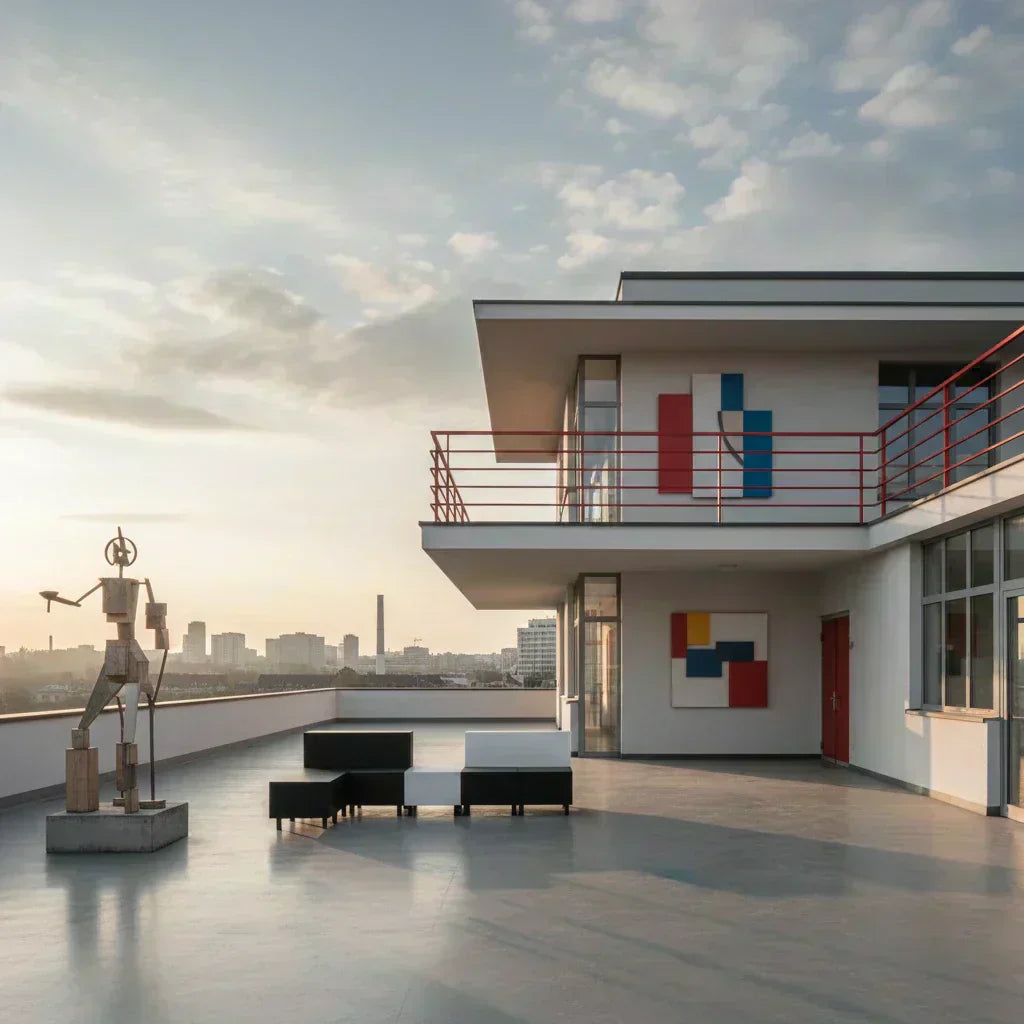
The Bauhaus, more than a simple art and design school, was a revolutionary cultural movement that sought to transform society through aesthetics. Founded in 1919 by Walter Gropius in Weimar, Germany, the Bauhaus aimed to unify art, craft, and technology, with the goal of creating a new type of artist-craftsman capable of designing functional and beautiful objects for everyday life. Its influence extends to the present day, permeating architecture, graphic design, industrial design, and art in general.
The Bauhaus represented a break with the prevailing academicism and historicism of the time, embracing simplicity, functionality, and innovation. Its aesthetic principles, based on geometry, abstraction, and the use of modern materials, laid the foundations of modern design and remain relevant in the 21st century. The legacy of the Bauhaus can be appreciated, for example, in the influence it had on textile art.
The Bauhaus was not without controversies and political pressure. Initially established in Weimar, the school was forced to move to Dessau in 1925 due to increasing hostility from conservative sectors. This move was not merely geographical; it marked a new stage in the evolution of the Bauhaus, characterized by greater openness to industry and mass production. Dessau offered a more favorable environment for experimentation and the implementation of Bauhaus ideas. The Bauhaus building in Dessau, designed by Gropius, became a symbol of the new aesthetic.

Walter Gropius founder of Bahaus
Walter Gropius, the founder of the Bauhaus, firmly believed in the need to reconcile art, craft, and industry. In his founding manifesto, Gropius called for the creation of a new guild of craftsmen, without the class distinctions that separated artists from artisans. The goal was to train professionals capable of integrating artistic creativity with the demands of industrial production. Gropius envisioned a future in which functional and aesthetic design would be within everyone’s reach, raising quality of life through well-designed objects. Gropius’s vision sought to unify artistic and industrial production, resulting in objects of functional beauty that transformed everyday life.

Paul Klee Cat and Bird
The Bauhaus attracted a wide variety of avant-garde artists, architects, and designers, becoming a center of experimentation and creativity. Among its ranks were figures such as Paul Klee, Wassily Kandinsky, Josef Albers, Marcel Breuer, and many others, each contributing their own vision and talent. The diversity of perspectives and interdisciplinary collaboration were key elements of the Bauhaus’s success.
Paul Klee, recognized for his unique style that fused abstraction with figuration, was an influential master at the Bauhaus. His classes focused on color theory and form, exploring the relationship between visual elements and emotional expression. Klee believed that art should reveal the inner laws of nature, and his works reflect a deep connection with the natural world and imagination. One criterion used to evaluate students in his classes was their ability to convey complex ideas through simple and harmonious visual compositions. For example, in 1922, Klee led a workshop on "Color Theory and Its Application to Textile Art," where students experimented with different color combinations to create abstract patterns.

Painting by Wassily Kandinsky
Wassily Kandinsky, a pioneer of abstraction, was also a central figure at the Bauhaus. Kandinsky developed an art theory based on spirituality and the connection between color and emotion. At the Bauhaus, Kandinsky taught classes on color theory and abstract design, seeking to apply his principles to the creation of functional objects. His influence can be seen in the design of posters, furniture, and other Bauhaus products. A clear example is his 1928 workshop "Color and Space," where students had to design a room that evoked a specific emotion through the strategic use of color and form, demonstrating the transposition of his abstract theories into a practical context.

Josef Albers
Josef Albers, known for his series "Homage to the Square," was a fundamental master at the Bauhaus, especially in the study of color. Albers explored the interaction of color and its subjective perception, demonstrating that color does not exist in isolation, but is affected by its surroundings. His teaching was based on experimentation and observation, encouraging students to develop their own sensitivity to color. A common exercise in his classes was to ask students to create optical illusions using only colored paper, without resorting to lines or outlines. Albers's approach to color became a powerful tool for design and visual communication. Albers's legacy continues to this day, influencing artists and designers around the world.
Radical architecture: Form follows function
Architecture was a fundamental pillar of the Bauhaus, seeking to create functional, modern, and affordable spaces. The slogan "form follows function" became a guiding principle, prioritizing utility and efficiency over unnecessary ornamentation. The Bauhaus promoted the use of modern materials such as steel, glass, and concrete, as well as standardization and prefabrication to reduce costs and speed up construction.

The Gropius House in Dessau: A livable manifesto
The Gropius House in Dessau, built in 1926, is a paradigmatic example of Bauhaus architecture. Designed by Walter Gropius as his personal residence, the house stands out for its simplicity, functionality, and integration with its surroundings. The structure is made up of interconnected geometric volumes, with large windows that let in natural light. The interior spaces are open and flexible, adapting to the needs of its inhabitants. The Gropius House is a habitable manifesto of Bauhaus principles.
Bauhaus was concerned with creating affordable, high-quality social housing. Bauhaus architects designed several experimental housing complexes, such as the housing development in Dessau-Törten, which sought to offer innovative solutions for urban housing. These projects were characterized by their functional design, energy efficiency, and integration with the surroundings. Bauhaus believed that architecture could help improve people's lives by creating dignified, accessible living spaces for everyone. An experimental housing project in Dessau, developed in 1928, implemented a central heating system to reduce energy consumption and costs for residents, showing an early approach to sustainability.
Bauhaus aspired to democratize aesthetics, bringing good design into all areas of everyday life. The school produced a wide range of objects, from furniture and lamps to textiles and ceramics, characterized by their functionality, simplicity, and modern aesthetic. The goal was to create beautiful, affordable objects for everyone, improving quality of life through design.

Marcel Breuer's Wassily Chair: Steel Tubing and Minimalism
The Wassily Chair, designed by Marcel Breuer in 1925, is an icon of Bauhaus design. The chair, originally known as the B3 chair, revolutionized the furniture industry by using bent steel tubing, an industrial material, to create a light, strong, and elegant structure. Its minimalist and functional design made it a symbol of Bauhaus aesthetics. The Wassily Chair, named in honor of Wassily Kandinsky, who admired the design, is an example of how Bauhaus integrated technological innovation with artistic creativity.

Bauhaus Table Lamp designed by Wilhelm Wagenfeld and Carl Jacob Jucker
The lamps designed at Bauhaus reflect the school's principles: functionality, simplicity, and modern aesthetics. These lamps are characterized by their geometric design, the use of materials such as metal and glass, and their ability to provide efficient and pleasant lighting. The Bauhaus table lamp, designed by Wilhelm Wagenfeld and Carl Jacob Jucker, is an iconic example of Bauhaus design, combining form and function harmoniously.

The Bauhaus wallpaper: Geometry on the walls
Wallpaper produced at the Bauhaus was characterized by its geometric and abstract designs, reflecting the school’s modern and functional aesthetic. These wallpapers sought to create bright and harmonious environments, using light colors and simple patterns. The Bauhaus believed that interior design could influence people’s well-being, and wallpaper was an important tool for creating pleasant and inspiring living spaces. The use of repetitive patterns and neutral colors allowed the wallpaper to blend easily into different decorating styles, demonstrating the versatility of Bauhaus design.

Anni Albers: From tapestry to industrial textile design
The Bauhaus textile workshop, often considered a predominantly female space, was much more than a simple place of craft production. It became a laboratory for experimentation and a center of innovation where women artists challenged conventions and explored the possibilities of weaving as a medium of expression. While the Bauhaus school aspired to equality, reality showed an implicit gender division, directing women to the textile workshop. However, this did not prevent figures like Anni Albers from shining in their own right and transforming the field of textile design. Anni Albers, perhaps the most emblematic figure of the textile workshop, transcended the traditional notion of tapestry as mere decoration.
Albers experimented with a variety of materials, from silk and cotton to cellophane and metallic fiber, seeking new textures and visual effects. Her innovative approach led her to develop industrial weaving techniques, seeking mass production without sacrificing aesthetic quality. A fundamental criterion in her work was the functionality of the textile; for Albers, a textile had to be both beautiful and practical. One example of her work is the creation of soundproof fabrics for architecture, combining aesthetics and utility. Her legacy lies in her ability to elevate textile design to the category of art and in her vision of a world where industrial design could be both aesthetic and functional. Learn more about textile art and its evolution, including the work of other women artists who, like Anni Albers, have challenged the boundaries of creativity in this article.

Gunta Stölzl: Experimentation with materials and techniques
Gunta Stölzl, the first woman to head the Bauhaus textile workshop, was a key figure in the development of its program and philosophy. Her leadership was characterized by promoting experimentation with materials and the search for new weaving techniques. Stölzl believed that textiles should not be limited to reproducing decorative patterns, but should be an expression of creativity and innovation. One of her greatest achievements was the creation of a rigorous curriculum for the workshop, combining color theory and composition with practical weaving. This educational approach ensured that students had a solid foundation in design principles and the technical skills needed to carry out their own ideas.
Under her direction, the workshop became a space where new forms of production were explored, from hand weaving to the use of industrial looms. Stölzl encouraged collaboration among students and experimentation with different materials, which led to the creation of innovative fabrics with unique properties. One concrete example is the development of fire-resistant and water-resistant textiles, designed for use in architecture. In addition, Stölzl introduced the idea of mass production in the workshop, which allowed Bauhaus designs to reach a wider audience. However, this approach also generated tensions within the school, as some members felt that mass production compromised the artistic quality of the products. Despite these controversies, Stölzl's legacy endures as a testament to her vision and her ability to transform the textile workshop into a center of innovation and experimentation.
The Bauhaus exerted a profound and lasting influence on 20th-century architecture, especially through the spread of functionalism. This principle, which dictates that the form of a building must follow its function, became a central dogma of modern architecture. The Bauhaus advocated the idea that buildings should be designed to meet the needs of their occupants in the most efficient and economical way possible, rejecting unnecessary ornamentation and historicist styles. A key criterion was the optimization of space and the use of modern materials such as steel, glass, and concrete.
A residential complex designed under Bauhaus principles would prioritize the efficient layout of the apartments, natural lighting, and ventilation, using straight lines and simple geometric shapes. Superfluous decorative elements would be avoided, and the building would be integrated with its surroundings. The result would be a functional, economical, and aesthetically restrained building. The influence of Bauhaus can be seen in numerous buildings around the world, from social housing in Weimar Germany to the skyscrapers of New York. However, functionalism has also been criticized for its coldness and lack of expressiveness. Some argue that the obsession with function has led to the creation of impersonal and dehumanized buildings. Despite these criticisms, the legacy of Bauhaus in functionalist architecture remains undeniable. In Spain, for example, we can find notable examples in the rationalist architecture of the 1930s. You can also explore Ephemeral Architecture to contrast these principles with transient works.
Beyond architecture, Bauhaus revolutionized graphic design and typography. The principles of clarity, readability, and functionality were applied to the design of posters, magazines, brochures, and all kinds of printed materials. Bauhaus promoted the use of sans-serif typefaces, such as Herbert Bayer's *Universal*, which was considered more modern and easier to read than traditional serif typefaces. Experiments were made with the arrangement of elements on the page, seeking visual hierarchy and effective communication of the message. An important criterion was the simplification of forms and the elimination of unnecessary ornamentation. Colors were used strategically to highlight important elements and create visual impact.
A poster designed according to Bauhaus principles would use a sans-serif typeface, flat colors, and simple geometric shapes. The information would be presented clearly and concisely, with a visual hierarchy that would guide the viewer through the message. Realistic illustrations would be avoided in favor of abstract or schematic images. The influence of Bauhaus on graphic design can be seen in advertising, editorial design, and the corporate identity of numerous companies. However, the Bauhaus style has also been criticized for its rigidity and lack of warmth. Some argue that the obsession with functionality has led to the creation of cold, impersonal designs. Despite these criticisms, the legacy of Bauhaus in graphic design remains undeniable. Contemporary digital art draws on many of these principles, as discussed in this article, albeit with new tools and perspectives.
The Bauhaus maintained a constant dialogue with abstract art, influencing each other mutually. Many of the Bauhaus teachers, such as Wassily Kandinsky, Paul Klee, and Josef Albers, were prominent abstract artists. Their ideas about color, form, and composition influenced art teaching at the Bauhaus, and their works served as inspiration for the students. The Bauhaus promoted experimentation with different materials and techniques, which led to the creation of innovative abstract artworks. An important criterion was the search for pure expression, free of figurative representations. The intrinsic properties of materials were explored, and harmony among visual elements was sought.
The rise of the Nazi regime in Germany marked the beginning of the end for the Bauhaus. The Nazi party considered modern art, including that produced at the Bauhaus, to be "degenerate" and contrary to German values. The Bauhaus was accused of promoting cosmopolitanism, internationalism, and communism, ideas that were anathema to the Nazi regime. Pressure on the Bauhaus gradually increased, with the withdrawal of public funding, the dismissal of teachers, and the censorship of exhibitions. In 1933, the Bauhaus was definitively closed by the Nazi authorities. The criterion used by the Nazis to define "degenerate art" was vague and subjective, but it was based on the idea that art should be understandable, realistic, and patriotic.
Abstract art, expressionism, and other forms of modern art that did not meet these criteria were labeled "sick" and "subversive". Example: A "degenerate" art exhibition organized by the Nazis included works by artists such as Kandinsky, Klee, and Ernst, which were mocked and presented as examples of the moral and cultural decay of German society. The closure of the Bauhaus was a severe blow to the world of art and design. Many of its teachers and students were forced into exile, taking their ideas and talent with them to other countries. Elevated Herbals' extraction methods guide reminds us how innovation and creativity can be persecuted under oppressive regimes, similar to the Bauhaus experience.
The closure of the Bauhaus did not mean the end of its ideas. On the contrary, the diaspora of its teachers and students contributed to the spread of its principles around the world. Many of them found refuge in the United States, where they founded new art and design schools or taught at existing universities. The *New Bauhaus* in Chicago, founded by László Moholy-Nagy, was one of the most important examples of the Bauhaus influence in the United States. Other Bauhaus teachers, such as Josef Albers and Walter Gropius, taught at universities such as Yale and Harvard, training a new generation of architects and designers.
In the 21st century, Bauhaus design continues to be a source of inspiration for architects, designers, and artists. Its principles of functionality, simplicity, and clarity are just as relevant today as they were a century ago. However, Bauhaus design is not limited to a mere repetition of formulas from the past. Contemporary designers are reinterpreting Bauhaus principles, adapting them to new technologies, new materials, and the new needs of society. Furniture, objects, and buildings are being created that combine Bauhaus aesthetics with technological innovation and environmental sustainability. An important criterion is the search for harmony between form and function, but also the consideration of the social and ecological aspects of design.
Bauhaus was not only a school of art and design, but also an innovative educational model. Its focus on experimental learning, interdisciplinary collaboration, and creativity remains relevant today. Bauhaus promoted the idea that students should learn by doing, experimenting with different materials and techniques, and working on real projects. Collaboration between students from different disciplines, such as architecture, design, painting, and sculpture, was encouraged in order to create innovative solutions to complex problems. An important criterion was the development of critical thinking and problem-solving skills.
The Bauhaus-Archiv at the Museum for Design in Berlin is the nerve center for understanding the philosophy and production of Bauhaus. This museum, designed by Walter Gropius himself, houses the world's largest collection on the history of Bauhaus. When visiting the museum, one can appreciate up close the original furniture prototypes, architectural models, typographic examples, and graphic designs that emerged from the school. You can observe the subtle differences between the various pieces, gaining a better understanding of the decisions that led to the consolidation of Bauhaus aesthetic principles. Examining, for example, the variants of the Wassily chair makes it possible to appreciate the optimization process and the search for **functional and aesthetic perfection**. The visit requires time to absorb the information, compare styles, and examine the different solutions proposed by the students and masters.

Bauhaus-Universität Weimar: Cradle of the movement
The Bauhaus-Universität Weimar is not simply a museum, but a living place where the philosophy of Bauhaus continues to resonate. Founded as the School of Arts and Crafts of the Grand Duchy of Saxony, it was here that Walter Gropius founded the Bauhaus in 1919. Walking through its classrooms and workshops is to immerse oneself in the very history of the movement. One point of interest is the *Haus am Horn*, the only house built directly according to Bauhaus principles for the 1923 exhibition. It is crucial to analyze how this building incorporated **new materials and technologies**, and how it strove to create efficient and accessible living spaces. In Weimar, you can take part in workshops and courses that explore craftsmanship and design from the Bauhaus perspective.
The Masters' Houses in Dessau: A tour of the residences of the masters
After moving from Weimar, the Bauhaus found a new home in Dessau. Here, the **Masters' Houses** were built, the residences of the masters, designed by Gropius. These houses were not only homes, but also manifestations of the Bauhaus philosophy in architecture. The arrangement of the spaces, the use of light, and the integration with the surroundings reflect the pursuit of a **connection between art, technology, and life**. Exploring the houses of Gropius, Moholy-Nagy, Feininger, Klee, and Kandinsky offers an intimate view of the daily life of the masters and how their ideas were reflected in their personal environment. An important tip is to book the visit in advance and read about the history of each master to enrich the experience.The Bauhaus remains relevant in 2026 because its fundamental principles — **simplicity, functionality, and beauty** — are timeless. In an increasingly complex and overloaded world, the pursuit of clarity and efficiency in design remains a valuable aspiration. The Bauhaus reminds us that form should follow function, and that beauty can arise from simplicity. This ideal continues to inspire designers, architects, and artists around the world. The key is to understand that simplicity is not synonymous with empty minimalism, but with a careful selection of essential elements.