Mark Rothko did not paint paintings; he created experiences. His monumental canvases, filled with blocks of vibrant and ethereal color, invite deep introspection. Far from conventional narratives, the artist invited the viewer into a silent dialogue where color stood as the only language capable of evoking the most primal and complex emotions of the human being.
This radical approach transformed the landscape of abstract art. By stripping his works of all figurative representation, Rothko freed color from its descriptive function and turned it into the direct vehicle of emotional experience. His legacy lies in this bold proposition: the belief that art, in its purest form, can act as a portal to the depths of the soul.
The Chromatic Universe of Mark Rothko: A Journey to the Heart of Feeling

The work of Mark Rothko is defined by his bold exploration of color as the very essence of artistic expression. For Rothko, color was not a mere embellishment or a descriptive element, but the main vehicle for conveying raw and universal emotions. His canvases, often large in scale, are composed of fields of color that merge and vibrate, seeking to evoke deep emotional states in the viewer. This transcendence of pure color is what sets Rothko apart from many of his contemporaries. Instead of representing the outside world or telling an explicit story, Rothko sought to touch the observer's sensitive core, appealing to a visceral and often spiritual experience. The goal was to achieve a direct connection, a resonance that only color, stripped of any narrative or figurative artifice, could achieve. The Hand-made oil painting reproductions by KUADROS capture the essence of this pursuit, allowing Rothko's chromatic intensity to fill your spaces.
The transcendence of pure color: Beyond representation was the pillar of Rothko's artistic philosophy. He rejected the idea that art should imitate reality or tell stories. For him, color possessed a life of its own and an inherent capacity to generate emotional responses. In his own words, Rothko aspired to paint "large paintings... deeply expressive", where color and form worked together to generate an intense experience. The apparent simplicity of his compositions is deceptive; every hue, every blurred edge, every layer of pigment is carefully orchestrated to maximize emotional impact. This renunciation of the narrative and the figurative aligns him with movements that sought to explore subjectivity and inner experience, such as Surrealism, although Rothko developed a unique and deeply personal visual language.
Rothko emerged as a key figure in the postwar art scene, a period marked by devastation and existential introspection. In this context, his search for an art that addressed the great questions of life and death, tragedy and redemption, found a profound echo. The context of his emotional search The Second World War influenced his desire to create works that offered comfort or, at the very least, a form of honest confrontation with the human condition. Unlike other artists who turned to geometric abstraction or more energetic expressions, Rothko chose a chromatic subtlety and a scale that invited a contemplative and moving experience. His art became a refuge and a mirror of the anxieties and hopes of a society in reconstruction, resonating with the human need for meaning and connection in times of uncertainty.
Resonant Forms: The Underlying Architecture of His Canvases

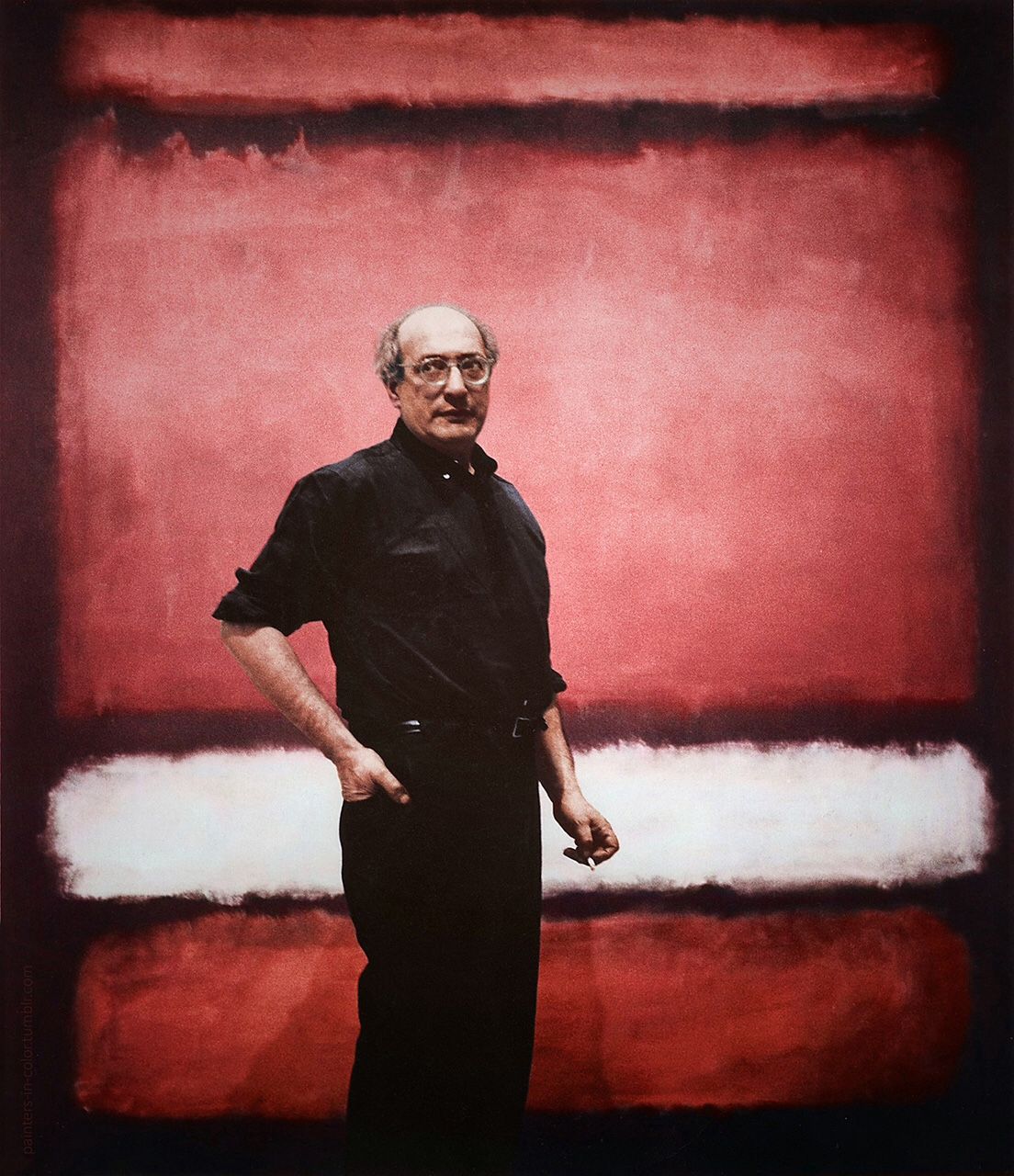
Mark Rothko’s compositions, despite their apparent simplicity, possess a carefully constructed visual architecture that enhances their emotional impact. The recurring structure of two or three color rectangles floating on a similar background is the unmistakable signature of his mature work. This duality of the floating rectangles is not merely decorative; it is the framework that allows color to act directly on the viewer. The rectangles, often with soft, blurred edges, seem to vibrate and breathe on the canvas, creating a sense of depth and internal movement. There are no hard lines or clear divisions, which fosters a visual continuity and a fusion of forms that contributes to the immersive atmosphere of his paintings. This deliberate arrangement invites serene and profound contemplation, allowing the viewer’s mind to get lost in the subtleties of color and form.
The role of the blurred edge and the absence of defined contours is crucial in Rothko’s aesthetic. By renouncing crisp lines, Rothko dissolves the barriers between color fields and between the painting and the viewer. These soft edges create a sense that the colors extend beyond the limits of the canvas, suggesting an infinite, boundless universe. The lack of clear contours allows the colors to interact and influence one another in subtle ways, creating unexpected tonal and luminous gradations. This technique not only contributes to the ethereal atmosphere of his works, but also invites an active perceptual experience on the part of the observer, who must complete the forms and merge the colors in their own mind. It is an invitation to transcend superficial vision and enter a more intuitive and emotional perception.
The layering and transparency in the paint layers is another fundamental technique that Rothko used to build depth and vibration in his canvases. By applying thin layers of translucent pigment, the artist achieved effects of luminosity and chromatic complexity that seemed to emanate from within the work. The underlying colors shine through the upper layers, creating a tonal richness that goes beyond the simple mixing of pigments. This almost ethereal quality of his pictorial surfaces contributes to the feeling that the rectangles float in an undefined space, moving away from the flatness of the canvas and entering the viewer’s psyche. It is this intangible depth the one that allows the artwork to feel alive and in constant transformation, offering a dynamic and ever-evolving visual experience.
Palettes That Speak: The Emotional Syntax of Color

Rothko’s choice of colors was not random; each hue and every combination was charged with emotional and psychological meaning. His palettes, often dominated by intense primary or secondary colors, sought to evoke visceral responses. The reds that move us in his works are not simply reds; they are expressions of passion, drama, ecstasy, and even latent pain. The intensity of these tones can be overwhelming, drawing the viewer into a deep and sometimes cathartic emotional experience. In contrast, his reds can also suggest a powerful vital energy, a celebration of existence. The way Rothko uses red invites reflection on the intensity of human experience, from euphoria to the deepest melancholy, demonstrating the intrinsic power of color to resonate with our most intimate emotions.

The deep blues and greens in Rothko’s work evoke a sense of calm, serenity, and contemplation. These colors, often associated with nature, the sky, and the sea, invite introspection and meditation. In his canvases, these tones can suggest the vastness of the universe, the stillness of the soul, or a deep melancholy. The sense of infinity they convey creates a mental and emotional space for the viewer, allowing an escape from the everyday world into a state of inner peace or profound existential reflection. It is in this ability to evoke the ineffable, to touch mystery, that much of the power of these color palettes lies, offering a visual refuge for contemplation.

The vibrant yellows and oranges in Rothko’s work radiate light, energy, and a sense of transcendence. These warm colors can evoke the warmth of the sun, the vitality of life, or moments of spiritual enlightenment. In his canvases, these tones often create an effect of inner luminosity, as if the painting were radiating its own light. The expansive energy of these colors can be stimulating and euphoric, inviting the viewer into an experience of joy and transcendence. Rothko used these palettes to explore the duality between joy and the fragility of existence, achieving a delicate balance between earthly vitality and the aspiration toward the sublime, manifesting an impulse toward the light inherent in the human experience.
The importance of color combinations in Rothko’s works is fundamental to creating their emotional impact. It is not just about choosing individual colors, but about how they interact with one another. The harmonies and dissonances which he achieves through the juxtaposition of tones, creating a complex visual symphony that can evoke a wide range of feelings. A combination of complementary colors can generate vibration and tension, while analogous tones can induce a sense of calm and unity. Rothko was a master in orchestrating these chromatic interactions to create experiences that were both subtle and powerful, designing compositions that speak directly to the subconscious through the pure interaction of color.
Immersive Experience: The Viewer Facing the Artwork

The monumental scale of many of Rothko's canvases is a deliberate element intended to transform the viewer's experience. When confronted with a large-format Rothko, one does not merely observe the work from a distance; one is surrounded by it. This forced intimacy, this physical and psychological immersion, removes the barriers between the observer and the art, inviting a face-to-face encounter with the pure emotion the artist sought to convey. The size is not meant to impress, but to envelop, so that the viewer feels part of the chromatic space, allowing the colors and forms to act directly and without intermediaries. The goal is a personal dialogue, a deep connection that transcends mere aesthetic contemplation.
The interaction of light with pigment is another crucial factor in the immersive experience of Rothko's works. The artist was highly aware of how lighting would affect the perception of his colors. He sought for his paintings to seem to radiate light from within, creating a unique and ever-changing atmosphere. The thin, translucent layers of pigment he used allowed light to be reflected and refracted, giving his colors an ethereal and vibrant quality. The atmospheric quality of light in his works is essential to creating the desired emotional state, making the color fields seem to pulse and breathe. In galleries and museums, careful lighting is key to reproducing this experience, allowing the viewer to get lost in the subtle nuances of light and color.
The elimination of narrative in Rothko's paintings is a deliberate act to invite personal contemplation. By stripping away any explicit figurative or symbolic element, the artist frees the viewer from the task of interpreting a story or deciphering a predetermined meaning. Instead, Rothko offers an open space for projection and individual reflection. Each viewer brings their own story, their own emotions, and their own experiences to the encounter with the work, allowing color to act as a catalyst for self-exploration. This invitation to introspection is what gives his paintings their enduring power, turning each visit into a unique and deeply personal experience, a true journey into one's inner self.
The Genesis of an Emotion: Rothko's Creative Process
Mark Rothko’s canvas was a battlefield and a sanctuary, a space where pigments became the raw material of introspection. His creative process was less about rendering a predetermined image and more about a deep immersion in the universal language of color and form. Rothko sought to evoke raw, direct emotional responses, stripping his work of any explicit narrative or figurative reference. Each work was a dialogue between the artist, the viewer, and color itself, inviting silent contemplation and an intimate encounter with the depths of being. The essence of his art lay in the ability of his canvases to resonate with human experience, generating moods that ranged from serene melancholy to restrained euphoria. This radical approach transformed the way abstract painting was conceived, elevating it from a formal exercise to an existential experience.
Layers of paint: The alchemy of texture and light
The visual complexity in Rothko’s works was not achieved through a direct application of color, but through a meticulous process of building up thin layers of paint. Using a mixture of oil, often thinned, Rothko applied translucent glazes that interacted with one another and with the underlying canvas. This technique allowed light to penetrate the lower layers and reflect back, creating unparalleled luminous depth and an inner vibration in the color. The transition areas between the large fields of color were not hard lines, but subtle, almost ethereal gradations that made the edges of the forms seem to float and breathe. The viewer was confronted with surfaces that changed subtly depending on the viewing angle or ambient lighting, an effect Rothko deliberately cultivated to intensify the visual and emotional experience. The textural richness, though subtle, felt like an echo of the emotions he sought to awaken.
The hidden brushstroke: The power of subtlety in application
Unlike many abstract expressionist artists who flaunted their gestures on the canvas, Rothko deliberately concealed the action of the brushstroke. His goal was to eliminate any trace of the artist’s manual intervention that might distract from the pure experience of color. The surfaces of his paintings are, on the surface, smooth and homogeneous, but a closer look reveals a subtle texture and a thoughtful application. The lack of visible brush marks invited the viewer to focus not on the “how” of the work, but on the “what” it evokes. This almost ascetic control of color application reinforced the idea that the works were autonomous entities, capable of speaking directly to the viewer without intermediaries. The absence of visible virtuosity democratized the experience, allowing each individual to encounter the work on their own emotional terms.
The search for perfection: Multiple versions of the same theme
Rothko’s production was not linear; he often revisited and reexplored themes and color palettes throughout his career, not from a lack of ideas, but from an unceasing search for the purest expression . Each series, and even each painting within a series, represented another step in his journey toward the essence of color and emotion. The same color scheme could be explored on different canvases, subtly varying the proportions, the tensions between the fields, and the luminous intensity. This creative iteration was fundamental to his method; it was about refining, adjusting until achieving an emotional and visual balance that resonated with the depth he imagined. It was a process of distillation, where layers of repetition and variation brought him closer to the emotional truth he sought to convey. For example, his explorations of fiery oranges and reds in one period could evolve into deeper, more melancholic tones of burgundy and browns in another, each with a distinct expressive purpose.
The Chapel Series: A Spiritual Legacy in Texas
The culmination of Mark Rothko's artistic and spiritual journey took shape in the monumental Chapel series for the Community (The Rothko Chapel) in Houston, Texas. This project, conceived as a space for meditation and contemplation, went beyond the notion of a simple art gallery to become a secular sanctuary. The seven enormous paintings circular and the eight bipolar ones that adorn its interior walls were created specifically for this setting, designed to envelop the visitor in an immersive experience. Rothko sought to make the viewer feel transported to another state of consciousness, a place where art could facilitate an encounter with the transcendent and deep introspection. The architecture of the building, designed in collaboration with the artist, is as crucial as the works themselves, creating an intimate dialogue between space and color.
The conception of a sacred space through art
Rothko conceived the Chapels not as an art exhibition, but as a place for inner reflection, a space that would allow the individual to confront themselves and the complexity of existence. The imposing dimensions of the canvases, their dark and deep colors, and the absence of traditional focal points force the viewer to immerse themselves in the chromatic experience. There are no narratives to follow or figures to identify; only pure color and the presence of the canvas interacting with the light of the space. The artist wanted the room to function as a mirror of the human soul, where universal emotions –solitude, hope, spirituality– could be experienced at their fullest intensity. The absence of external distractions and the meditative arrangement of the space foster a deep and personal connection with the works.
Chromatic progression: From light to twilight

The Chapel series presents a fascinating thematic and chromatic progression that accompanies the visitor through an emotional journey. Initially, some works, though sober, radiate a restrained light and a palette of warmer or more luminous tones, suggesting an awakening or an opening. As the journey progresses, the colors become progressively darker and denser, moving into twilight and deep introspection . Rothko uses blacks, deep browns, grays, and occasionally touches of violet or crimson to evoke feelings of seriousness, solemnity, and even melancholy. This evolution is neither linear nor didactic, but rather suggests a path of descent inward, culminating in canvases of overwhelming darkness that invite a confrontation with the unknown and the sublime. The final panel, in particular, with its somber intensity, acts as a culminating point of this emotional journey.
The impact of the setting on the perception of the works
The experience of the Chapels is inseparable from their architectural surroundings. Rothko worked closely with architect Philip Johnson (and later with Mark Rothko himself for the octagonal version) to ensure that the space enhanced the emotional impact of his paintings. The octagonal shape of the chapel, the natural light filtering through a central skylight, and the silence that permeates the place create a unique atmosphere. The paintings, arranged so that the viewer is surrounded by them, generate a sense of wholeness, eliminating conventional visual reference points. The interaction between the work and the space is a key component; the light changes throughout the day, subtly altering the appearance and mood of the canvases. This holistic approach ensures that the perception of the works is never static, but becomes a living, constantly evolving experience.
Rothko and Abstraction: A Pioneer of New Languages
Mark Rothko is a central figure in the history of twentieth-century art, recognized as one of the pillars of American abstract expressionism. His approach, which prioritized emotion and subjective experience over figurative representation, placed him at the forefront of a movement that sought to break with the artistic conventions of the past. Rothko did not limit himself to exploring the formal possibilities of abstraction, but endowed it with unprecedented psychological and spiritual depth. He believed that abstract art had the potential to communicate universal truths about the human condition, evoking visceral responses that figurative painting often could not achieve. His work is a testament to the power of color and form to transcend the barriers of language and culture, connecting directly with the deepest emotions of the viewer.
From surrealism to abstract expressionism: Evolution of his style
Rothko's path toward abstract expressionism was a gradual and thoughtful evolution, marked by the exploration of different artistic languages. In his early years, he was influenced by surrealism, becoming interested in themes of the unconscious and the mythological. His early figurative works and later surrealist explorations, which often included biomorphic figures and dreamlike atmospheres, laid the groundwork for his later abstraction. In the late 1940s, Rothko underwent a radical transformation, abandoning figuration to focus on large fields of color, which would become his hallmark. This transition was not an abandonment of his thematic concerns, but a refinement of the medium to achieve a more direct and universal expression of emotions and moods, moving away from explicit narrative references.
The influence on later generations of artists
Mark Rothko’s legacy extends far beyond his own artistic output. His bold use of color and focus on the viewer’s emotional experience inspired countless artists who came after him. Figures in minimalism, conceptual art, and even contemporary artists working with abstraction have cited Rothko as a key influence. His ability to strip painting of superfluous elements, focusing on the pure interaction of color and form, opened new paths for artistic exploration. Artists seeking to create immersive experiences and provoke deep responses in the public often turn to the principles Rothko perfected. His work showed that abstraction could be a vehicle for the expression of complex ideas and universal feelings, a message that continues to resonate in today’s art world.
The universality of his message: Beyond the avant-garde
Although Rothko is an emblematic figure of abstract expressionism, his message transcends the labels of artistic movements. The universality of his art lies in its ability to connect with the fundamental human experience, regardless of cultural or historical context. His canvases, stripped of specific anecdotes, speak directly to the viewer through the primary language of color and emotion. This timeless quality has allowed his works to maintain a powerful relevance in the 21st century. Today’s viewer can find in Rothko’s vast fields of color a resonance with their own struggles, hopes, and reflections, demonstrating that the emotions he sought to evoke are intrinsic to the human condition.
The Enduring Power of Color: Reinterpreting Rothko Today
Mark Rothko’s art retains remarkable relevance in the contemporary art scene, proving that mastery in the use of color and emotional depth can transcend eras. His canvases, often large-format, continue to draw crowds in museums and galleries around the world, inviting contemplation and introspection. The ability of his works to evoke moods both complex and personal remains a testament to his genius. In a world saturated with fleeting visual stimuli, Rothko’s focus on the pure, extended experience of color offers a refuge, a space for pause and connection with oneself. His legacy lies not only in the masterpieces he created, but also in the way they continue to influence and engage in dialogue with artists and viewers in the present.
The relevance of his works in today’s galleries and museums
Mark Rothko’s works are pillars in the permanent collections of the world’s most important museums and are often the focus of highly anticipated temporary exhibitions. Institutions such as MoMA, Tate Modern, and the National Gallery in London house key pieces from his body of work, ensuring their accessibility to a global audience. The demand for his works for exhibitions underscores its continuing importance in the canon of modern and contemporary art. These exhibitions not only present his paintings most iconic works, but often explore lesser-known aspects of his career or contextualize his work within broader artistic movements, reaffirming his place as one of the most influential artists of the 20th century. Recent events, such as major retrospectives at contemporary art museums, demonstrate a renewed and deep interest in his artistic vision.
Collectors and the art market: Intrinsic and commercial value
The art market has witnessed the extraordinarily high valuation of Rothko's works, reflecting both their intrinsic artistic value and their status as an investment. His paintings are among the most expensive ever sold at auction, setting records that highlight their demand among private and institutional collectors. This high commercial valuation, while it may seem detached from the artist's original intention of creating art for contemplation, also underscores the enduring appeal and cultural significance of his work. Collectors' interest in Rothko is based on the uniqueness of his visual language and the profound emotional connection his works offer, viewing them not only as financial assets, but also as pieces of immense aesthetic and spiritual value.
The accessibility of abstract art: How to connect with Rothko's work
Approaching Rothko's abstract art may seem intimidating to those unfamiliar with it, but the key lies in allowing yourself to feel and observe without preconceived judgments. Rothko's invitation was to a personal experience; there is no single "right way" to interpret his canvases. To connect with his work, it is recommended to approach it with curiosity and emotional openness. Observe the colors, feel how they interact, how the light seems to emanate from the canvas. Allow the forms and tones to evoke sensations, memories, or moods. Do not look for an explicit narrative; instead, immerse yourself in the atmosphere the painting creates. Visiting exhibitions and viewing the works in person, as Rothko conceived them, is essential, since reproductions, even high-quality ones such as oil art replicas, do not fully capture the luminous depth and texture of the originals. Reading about his creative process and intentions can provide context, but the deepest connection is established through silent, personal contemplation. Each viewer has the potential to find a unique and meaningful significance in the subtlety of his fields of color.
The Viewer as Co-creator: Rothko's Invitation to Reflection

Mark Rothko’s work goes beyond mere visual contemplation; it stands as a portal to introspection. When faced with his monumental canvases, the viewer is not a passive observer, but an active participant in the creation of meaning. This invitation to co-creation lies in the very nature of his compositions, where vibrant, blurred fields of color interact subtly, appealing directly to the subconscious. It is not about deciphering a literal message, but about allowing the shapes and tones to resonate with one’s own life experience. Rothko sought to evoke primary emotions: tragedy, ecstasy, doom, and anything the public might feel in response to his works. The success of a Rothko painting, for him, depended on its ability to move the viewer, regardless of intellectual interpretation. The absence of recognizable figures or explicit narratives frees the observer from the need for conventional analysis, allowing a deeper and more personal connection.
The personal experience: Each encounter with the work is unique
The uniqueness of the Rothko experience lies in its intrinsic subjectivity. Each person who pauses before one of his paintings brings with them a unique background of memories, emotions, and perspectives. These elements act as filters through which color and form are perceived. For example, a deep red tone might evoke the warmth of a childhood memory for one person, while for another it could trigger a feeling of alarm or urgency. The depth and ambiguity of Rothko’s colors are deliberate; they do not seek to impose an emotion, but to offer a canvas onto which the viewer can project their own inner world. This absence of artistic dogmatism allows every visit to a gallery, every moment in front of a replica of a Rothko work, to be a renewed and deeply personal experience, similar to how a poem can resonate differently at different stages of life. Contemplative immersion is key; the viewer is encouraged to take time, to allow themselves to feel without judgment.
Art as a mirror of the soul: Awakening latent emotions
Rothko aspired for his paintings to serve as a mirror of the soul, reflecting and amplifying the depths of the human being. His large fields of color, often arranged in overlapping layers that create a visual vibration, act as catalysts for introspection. Rather than offering answers, his works pose inner questions. The viewer, as they become immersed in the chromatic vastness, can experience a range of feelings from serenity to melancholy, and from euphoria to contemplation of finitude. It is not a passive experience, but a silent dialogue between the canvas and the viewer. This ability to evoke such a visceral and varied emotional response is what sets Rothko apart and places him among the pillars of Abstract Expressionism. By stripping away figurative elements, he freed color and form to act directly on the viewer, appealing to a universal language of emotions, long before movements such as Surrealism will explore the depths of the subconscious in other forms of artistic expression.
The legacy of Rothko: A reminder of the depth of the human experience
Mark Rothko’s lasting impact on the art world and on the human experience is undeniable. His works continue to invite deep reflection on existence, emotion, and the connection between the individual and the universe. Beyond their aesthetic value or their place in art history, Rothko’s legacy lies in his ability to remind us of the richness and complexity of our own inner life. In an era often dominated by distraction and superficiality, his paintings offer a refuge, a space for contemplative silence and the recognition of our deepest emotions. The mastery with which he manipulated color to create enveloping atmospheres is a testament to the expressive power of art. The search for essence, the exploration of the human condition through abstract means, resonates today with the same force as it did in his time, demonstrating that the universal truths of art transcend eras, just as masterpieces endure through carefully crafted art reproductions.
KUADROS ©, a famous painting on your wall. Hand-made oil painting reproductions, with the quality of professional artists and the distinctive seal of KUADROS ©. paintings reproduction service with a satisfaction guarantee. If you are not completely satisfied with the replica of your painting, we will refund 100% of your money.