Claude Monet did not paint the world as it is, but as it fades before our eyes. In his canvases there are no certainties, only atmospheres; no rigid outlines, only vibrations of light that seem to exist for just a second before disappearing. That is the essence of his greatness: capturing the impossible, fixing in paint what by nature cannot stand still.
Born in Paris in 1840, Monet was not destined to become the father of an artistic revolution. He began as a caricaturist, a trade that gave him income and a certain local reputation. But everything changed on the coast of Normandy, when Eugène Boudin pushed him —almost literally— to go outdoors and paint directly before the landscape. There, facing the wind, the sea, and the changing light, Monet discovered something that would redefine his life: reality is not stable, but a fleeting construction of light.
This discovery was not well received by the Academy. In an era dominated by precision, history, and perfect finish, Monet and his contemporaries seemed to be committing sacrilege. Their brushstrokes were quick, fragmented, almost unfinished. Their colors, intense and unmixed, clashed against one another on the canvas. But what critics saw as a flaw, Monet saw as truth: the human eye does not see lines, it sees light.

Impression, Sunrise
When he presented Impression, Sunrise in 1874, the criticism was merciless. The term “Impressionism” was born as mockery. However, what began as an insult ended up naming one of the most influential movements in art history. Monet was not trying to represent the port of Le Havre with exactness, but to convey the feeling of that dawn: the cold, the dampness, the diffuse glow of the sun emerging through the mist. It was a painting not to be looked at, but to be felt.
From that moment on, Monet took his obsession to an almost scientific level. He understood that the same object does not exist in only one way, but in infinite forms depending on the light. Thus were born his series: the haystacks, Rouen Cathedral, the Houses of Parliament in London. They are not repetitions, but variations. It is not the object that matters, but its constant transformation.

Haystacks
In the Haystacks series, an apparently banal motif becomes a profound study of time. The same haystack can be golden, violet, blue, or almost black, depending on the time of day. Monet forces us to look again, to understand that reality is not fixed, but a moving phenomenon.

The Rouen Cathedral series
The cathedral of Rouen, for its part, ceases to be architecture and becomes a surface of light. The stone disappears, replaced by reflections, shadows, and color temperatures that change from one canvas to the next. Monet does not paint the cathedral: he paints the air that surrounds it.
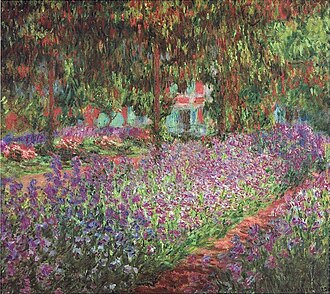
And then there is Giverny. In 1883, Monet settled in this small village and transformed his garden into a work of art in itself. It is not a simple natural space, but a deliberate construction of color, reflections, and seasons. The lily pond, the Japanese bridge, the carefully selected flowers… everything responds to a vision. Monet does not wait for nature to inspire him: he creates it.

The Water Lilies
The Water Lilies are the culmination of this quest. In them, form dissolves almost completely. There is no longer any horizon, no traditional depth. Only water, reflections, blotches of color floating in an ambiguous space. These works, which anticipate abstraction, do not represent a place: they are a total, immersive, almost meditative visual experience.
But Monet’s story is not only one of artistic triumph. In his later years, his eyesight deteriorated severely due to cataracts. The colors began to distort; the blues faded, the reds intensified. Many would have given up painting. Monet did not. He kept going, adapting, trusting his memory and his instinct. His final works, denser and more abstract, are not a decline, but a transformation. He was no longer painting what he saw, but what he felt should be there.
There lies one of Monet’s deepest lessons: art is not a copy of reality, but an interpretation. It is not about precision, but perception. Not about what is in front of us, but how we experience it.
Today, in a world saturated with perfect, digital, instant images, Monet’s work feels almost subversive. It forces us to stop. To look without haste. To accept that beauty is not in exact detail, but in the impression that remains.
A painting by Monet on a wall is not just decoration. It is a window into that philosophy. It is a reminder that light changes, that time passes, that each moment is unrepeatable. And that, perhaps, the true work of art is not the landscape… but the way we learn to see it.
KUADROS ©, a famous painting on your wall.
Hand-made oil painting reproductions, with the quality of professional artists and the distinctive seal of KUADROS ©.
Art reproduction service with a satisfaction guarantee. If you are not completely satisfied with your painting replica, we will refund 100% of your money.