Great paintings do not always reveal everything at first glance. A gesture, an object in the background, a barely visible figure, or a layer of paint uncovered through reflectography can change how we interpret a work. In some cases, we are dealing with well-documented technical discoveries; in others, with hypotheses that continue to fuel debate among historians, scientists, and enthusiasts.
In this selection of famous paintings you will find ten particularly fascinating examples. The aim is not to turn every detail into a conspiracy, but to distinguish between what we know, what is interpreted, and what remains open to the imagination. Looking closely also reveals how composition, color, and everyday objects create meaning.
If you enjoy taking your time with art, an oil reproduction can become a daily invitation to discover nuances: a hand, a gaze, a fold, or a shadow you may have overlooked. These are the stories hidden within ten masterpieces.
The Last Supper: Leonardo and the Mystery of Composition

In The Last Supper, Leonardo da Vinci depicts the moment when Jesus announces that one of the apostles will betray him. The figures' reactions—surprise, disbelief, outrage, and fear—turn a religious scene into an extraordinary study of human emotion. The apostles do not react uniformly: they gather in groups, lean in, point, and speak through their bodies.
The work also holds a technical secret. Leonardo did not use traditional fresco on wet plaster, but an experimental combination of pigments applied to dry plaster. The method allowed him to work more slowly and in greater detail, but it proved far less durable. The painting began to deteriorate early on and, over the centuries, suffered damage, restoration, vandalism, and even the effects of bombing. What we see today is the result of a complex history of conservation.
The novel The Da Vinci Code popularized the idea that the figure seated to Jesus' right is Mary Magdalene. However, the most widely accepted interpretation among experts identifies the figure as John, traditionally portrayed as a beardless young man with delicate features. Likewise, the "V" shape between the two figures can be understood as a Renaissance compositional solution, rather than necessarily a secret symbol.
Another theory, more curious than proven, comes from musician Giovanni Maria Pala. According to his reading, the placement of certain loaves, hands, and lines in the tablecloth could form a hidden musical score. Pala reconstructed a melody lasting around forty seconds, but the theory has no academic consensus. You can listen to this alleged melody that Da Vinci left hidden here. and decide what it suggests to you.
To observe the arrangement of the apostles, the refectory's perspective, and the tension of the moment in your own space, you can commission a hand-painted oil replica of The Last Supper painted in oils by professional artists.
The Creation of Adam: A Hidden Brain?

The near-touching fingers of God and Adam are among the most recognizable images in art history. Michelangelo concentrates the ideas of life, knowledge, and the relationship between the divine and the human within that tiny space. The minimal distance between the two hands makes the gesture seem about to be completed before our eyes.
The artist had a profound understanding of anatomy. In his youth, he studied cadavers to understand muscles, bones, and proportions—knowledge visible in his sculptures and frescoes. In 1990, neuroanatomists Ian Suk and Rafael Tamargo proposed that the cloak surrounding God and the angels reproduces the shape of a cross-section of the brain. They pointed to possible correspondences with structures such as the pituitary gland and optic chiasm.
The interpretation is compelling: God would not only breathe life into Adam, but also intelligence and the capacity for knowledge. Even so, it should be presented as a modern interpretation, not as an intention confirmed by Michelangelo. His documented interest in the human body makes the comparison understandable, but it does not replace documentary proof. An oil reproduction allows you to closely study the anatomy, movement, and extraordinary tension of the hands through a hand-painted oil replica of The Creation of Adam.
The Separation of Light from Darkness and Divine Anatomy

In this panel on the Sistine Chapel ceiling, God turns forcefully among the clouds as he separates light from darkness. The twisting pose reveals Michelangelo's interest in portraying the body as a powerful, almost sculptural structure. The foreshortening turns the figure into a dynamic presence, designed to be seen from the chapel floor.
Suk and Tamargo also observed shapes in the neck and chest that may recall the brainstem and spinal cord. According to this hypothesis, cosmic creation is linked to human consciousness. As with other anatomical readings of the Sistine Chapel, the observation can enrich contemplation even without definitive proof that the artist planned it.
The work is also part of the history of fresco censorship. After Michelangelo's death, the nude bodies of numerous figures were covered. Daniele da Volterra, tasked with adding draperies and cloths, was nicknamed "Il Braghettone," the painter of breeches. This episode reminds us that masterpieces also change in appearance and meaning according to the standards of each era.
If you would like to appreciate the body's twist and the details that have inspired these interpretations, you can commission a hand-painted replica of The Separation of Light from Darkness painted by hand.
Café Terrace at Night: A Possible Last Supper

Vincent van Gogh's painting, completed in 1888, shows an illuminated terrace beneath a blue, starry sky. The café's warmth contrasts with the darkness of the street, creating a welcoming yet intense scene. Artificial light guides the eye toward the customers, while the street opens up a more uncertain, silent counterpoint.
In 2015, researcher Jared Baxter proposed that the composition might contain a modern allusion to The Last Supper. According to this reading, the central figure surrounded by twelve people recalls Christ and the diners; a figure disappearing into darkness may evoke Judas, while vertical lines and lights form a suggested cross.
It is not a proven interpretation, but Van Gogh's biography makes it understandable that some viewers seek spiritual references in his painting. Before dedicating himself fully to art, he wanted to become a preacher, and in a letter to his brother Theo he spoke of his deep need for religion. This information provides context for the hypothesis, though it does not make it certain evidence of the artist's intention.
Beyond the hypothesis, its palette of yellows, blues, and greens works beautifully in contemporary interiors. At KUADROS, we create the hand-painted oil replica of Café Terrace at Night in oils, seeking to preserve the energy of its brushstrokes and the contrast of the nocturnal scene.
The Prophet Zechariah and the Angels' Gesture

Michelangelo depicts Zechariah reading a large book, accompanied by two young angels. The prophet appears above the entrance to the Sistine Chapel, a location that reinforces the importance of his message about judgment and the "day of the Lord." His concentration contrasts with the liveliness of the figures behind him.
One of the angels makes a gesture that may go unnoticed today: he places his thumb between his index and middle fingers, historically known as making the fig sign. In the context of the period, it could function as an insult. Rabbi Benjamin Blech suggested that the gesture concealed Michelangelo's criticism of Pope Julius II, his demanding patron.
The exact intention cannot be confirmed, but the detail shows how an apparently secondary hand can alter the reading of a solemn scene. It also reminds us that historical gesture codes do not always match those of today. To study every gesture and the prophet's focused expression, you can commission a hand-painted oil replica of The Prophet Zechariah created in oils.
The Mona Lisa: Layers, Letters, and Unresolved Questions

The Mona Lisa combines an apparently simple pose with a landscape and a smile open to endless interpretation. The most widely accepted identity of the sitter is Lisa Gherardini, wife of the Florentine merchant Francesco del Giocondo, although historical debate has never entirely disappeared. Her expression seems to change depending on the vantage point and the time spent looking at her.
Some researchers have suggested that the position of her hands and veil could indicate pregnancy. Others have claimed to find tiny letters and numbers in the eyes and landscape, including a possible "L," an "S," and the number 72. These readings have received media attention, but there is no general consensus regarding their authenticity or meaning.
Technology has, however, confirmed changes made during the working process. Infrared reflectography and X-rays have revealed details of the dress, transparent layers of the veil, and changes to the position of the fingers. They have also helped distinguish varnish alterations from alleged marks present from the beginning. This is a crucial distinction: a mark detected today does not necessarily amount to a deliberate message from Leonardo.
Eight Technical Details Worth Observing
- The lace of the dress, barely visible to the naked eye.
- The layers of the veil, which blend the figure into the landscape.
- Changes in the position of certain fingers.
- The portrait's historical damage, including the impact of a stone in 1956.
- The blanket covering the knees and part of the abdomen.
- The finger on the left hand that appears unfinished.
- Varnish alterations in the eyes and chin.
- The poplar wood panel on which it is painted.
These elements explain why the work continues to raise questions even when we know it by heart. If you would like to enjoy its sfumato and study its color transitions at home, you can commission a hand-painted oil replica of the Mona Lisa in oils.
The Arnolfini Portrait: A Mirror Full of Information

In The Arnolfini Portrait, Jan van Eyck presents a couple in a Flemish bourgeois interior from 1434. The convex mirror in the background expands the scene and reflects two people standing outside the main space. Above it, the artist wrote "Johannes de Eyck fuit hic," a statement that amounts to recording his presence.
The woman's hand on her abdomen was long interpreted as a sign of pregnancy. Today, many specialists associate it with the volume of the dress, typical of the fashion of the time. The dog symbolizes fidelity; the oranges may allude to prosperity, and the clogs to the sacred nature of the space. The red bed and other objects reinforce associations with marriage, fertility, and domestic life.
The painting rewards slow looking: every object functions as part of a carefully constructed visual language. The mirror in particular is not only a technical marvel, but also a device that incorporates the viewer into the scene. You can commission a hand-painted oil replica of The Arnolfini Portrait to appreciate these details in your home.
The Ambassadors: A Skull That Appears When You Change Angle

Hans Holbein the Younger surrounds Jean de Dinteville and Georges de Selve with globes, books, scientific instruments, and musical objects. The scene celebrates knowledge and prestige, yet includes a warning about the fragility of life. The luxury of the fabrics and the precision of the objects make the visual anomaly in the foreground even more surprising.
At the bottom, an elongated form appears that seems unreadable from the front. Viewed from a very oblique angle, it turns into a skull. This technique is called anamorphosis and requires the viewer to move in order to complete the image. The effect is not merely decorative: it physically transforms the way we look at the painting.
The skull serves as a memento mori: even wealth, education, and power are subject to the passage of time. The broken lute string and the Lutheran hymnal add possible references to the religious discord of the period. The work thus balances humanist confidence in knowledge with a call to humility.
With its visual impact and conversational appeal, it is an ideal work for a social space. You can commission a hand-painted oil replica of The Ambassadors created by professional artists.
The Old Guitarist: A Painting Beneath the Paint
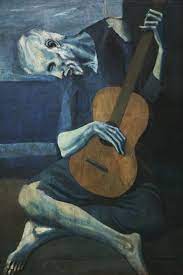
The hunched figure in The Old Guitarist, painted by Pablo Picasso between 1903 and 1904, captures the melancholy and hardship of his Blue Period. The cool tones and elongated body draw all attention to the musician's fragility. The warmer-toned guitar holds a small reserve of life within an austere atmosphere.
Studies using X-rays and infrared reflectography revealed another scene beneath the surface: the portrait of a seated woman, possibly with a child. Picasso reused the canvas, a practice consistent with the financial difficulties of his early years. Cracks in the upper layer occasionally allow certain features of the earlier composition to show through.
Research by the Art Institute of Chicago and the Cleveland Museum of Art has helped reconstruct that underlying painting. The work reminds us that many artists altered, covered, and reused their supports rather than always beginning on a new surface. Examination technologies make it possible to recover part of this material history without removing the visible image.
An oil reproduction retains the interest of the layers, pose, and introspective character of the scene, although the image available for this article is of limited resolution. It is an especially evocative choice for those seeking a piece with a human, contemplative tone.
Madam X: The Scandal of a Strap

In 1884, John Singer Sargent presented his portrait of Virginie Amélie Avegno Gautreau, a prominent figure in Parisian society. The black dress, pale skin, and elegant profile created a deliberately striking image. The restrained palette and the sitter's pose intensified a presence that Salon audiences considered too daring.
In the original version, one of the straps fell from the shoulder. Salon audiences considered the detail overly provocative, and the reception damaged the artist's reputation. Sargent repainted the strap, changed the title to the more enigmatic Madam X and eventually moved to London.

The image above is of Primavera by Sandro Botticelli and does not document Sargent's portrait or its repainted strap; it is retained here as a visual element of the article. To understand the episode surrounding Madam X, it is best to focus on Gautreau's profile, the dark dress, and the historical difference between the first exhibited version and the final image.
Over time, the scandal became part of the work's history. The episode shows that perceptions of beauty and decorum change from one era to another. Today, the portrait is regarded as a masterpiece of Western painting and an image of great sophistication.
A reproduction can bring elegance to an interior and spark conversations about fashion, reputation, and standards of beauty. At KUADROS, we can create a hand-painted replica of Madam X painted by hand.
The Mystery Remains: How to Enjoy These Works
A painting's hidden details may be intentional symbols, discoveries made beneath layers of color, or interpretations that invite debate. The best way to approach them is with curiosity, while distinguishing between technical evidence and speculation. Careful looking does not need to solve every mystery to be valuable: sometimes, it is enough to ask better questions.
When contemplating a work, try exploring it by areas: first the overall composition, then the gestures, background objects, relationships between figures, and finally the painted surface itself. This method helps identify devices such as altered perspectives, pigment changes, glazes, or overpainting without automatically assigning a secret intention to every irregularity.
KUADROS reproductions are hand-painted oil paintings created by professional artists. They are usually shipped rolled, not framed, to make transport easier and allow each customer to choose the finish and frame that best suit their space. This lets you bring home an artistic interpretation of these works without confusing it with the museum original.
hand-painted replica of Primavera
For practical questions about orders, lead times, shipping, and service, see the KUADROS frequently asked questions.