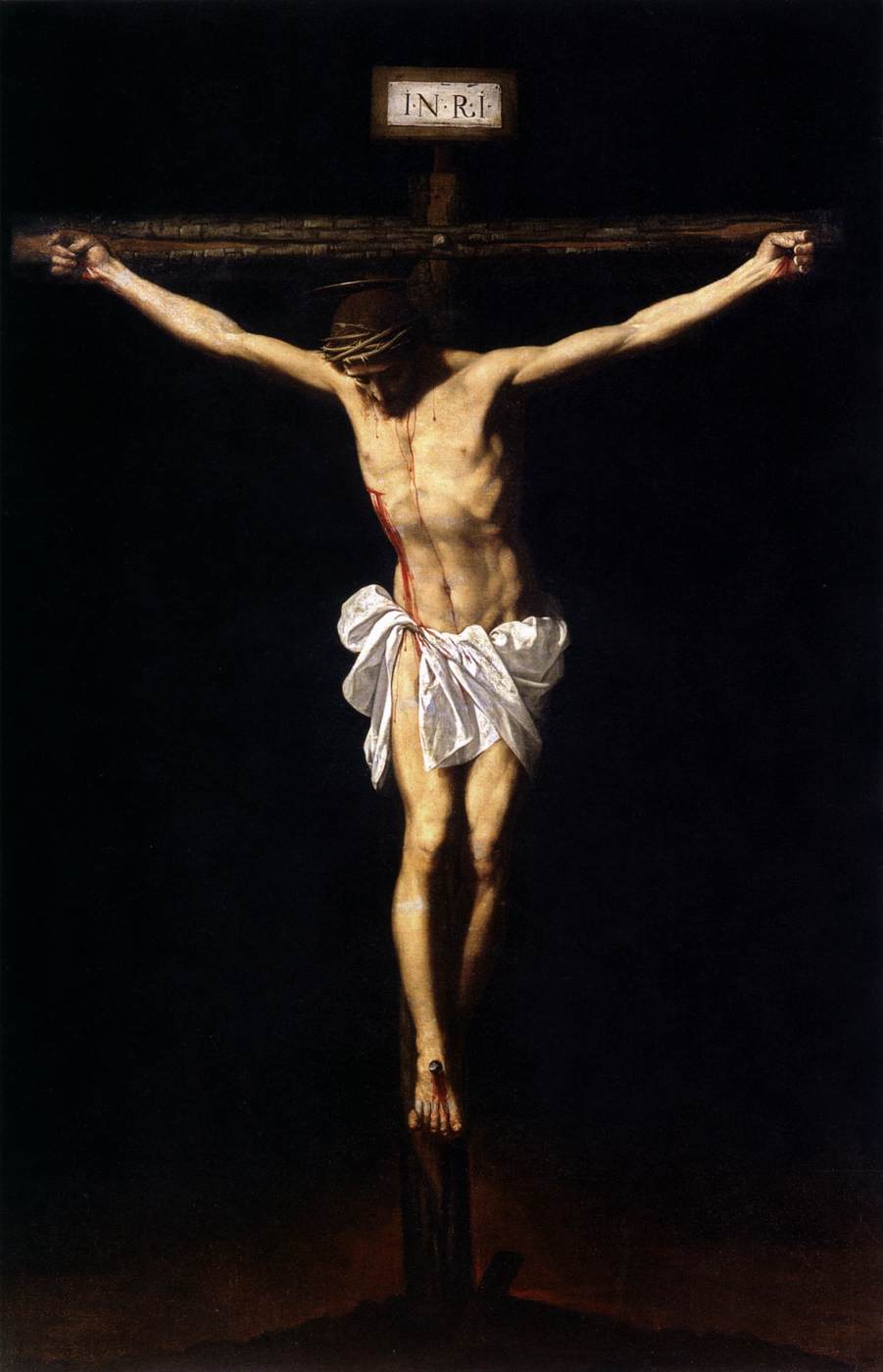
Now that UFOs and extraterrestrials are once again dominating conversations, headlines, and public debate, including the process of the official declassification of UFO files by the United States government, it is compelling to turn our gaze back to historical art. Many historical images contain lights, discs, spheres, or celestial apparitions that are sometimes interpreted today as foreshadowing the "phenomenon." Among them, spherical forms appearing in different paintings are particularly striking, with some observers comparing them to the so-called Buga Sphere, recovered in Colombia in 2025. This visual resemblance alone does not prove a historical connection, but it helps explain why these images continue to spark curiosity:

Have you ever looked at the stars and wondered whether we are alone in the universe? This question spans eras and cultures, and it has also found an echo in one of humanity's most enduring forms of expression: art. From the dawn of civilization to the age of space exploration, artists have captured fascination, fear, and curiosity about what they could not fully explain.
This journey brings together ten works that, clearly or subtly, have been associated with the possibility of other worlds and other beings. Some contain details that many people now read as UFOs; others imagine planetary futures or landscapes that seem to come from another galaxy. The aim is not to turn popular interpretations into evidence, but to observe how an image's meanings change when viewed from the present day.
In most cases, the strongest historical explanations are religious, allegorical, or astronomical. That is precisely where their appeal lies: a symbol of the Sun, a miraculous star, or a divine ray can take on, in contemporary eyes, the appearance of a spacecraft, capsule, or signal from the cosmos. Join KUADROS on this journey through paintings and frescoes associated with close encounters, and discover how every brushstroke reflects the fears, hopes, and dreams of its time.
Ten Paintings Linked to the Extraterrestrial Mystery
1. "Madonna with Saint Giovannino" – School of Filippo Lippi (15th century)

The Madonna with Saint Giovannino, attributed to the school of Filippo Lippi, has also become known as the "Madonna of the Flying Saucer." The scene depicts the Virgin Mary with the infant Jesus and the young John the Baptist. Behind Mary's right shoulder, in the sky, appears a curious dark object surrounded by a luminous halo. Nearby, a man raises his hand as if shielding himself from an intense light while staring upward.
The figure's gesture and the object's position explain the work's popularity among UFO enthusiasts. For many art historians, however, the motif may refer to a symbolic celestial phenomenon or a divine presence, both common devices in Renaissance religious painting. The tension between these two readings makes the detail one of the most frequently cited examples of a possible unidentified flying object in historical art. If these mysterious images fascinate you, you can also admire a similar Renaissance scene in the work Madonna with Saint George, available as an oil reproduction.
2. "The Crucifixion" – Visoki Dečani Monastery (c. 1350)
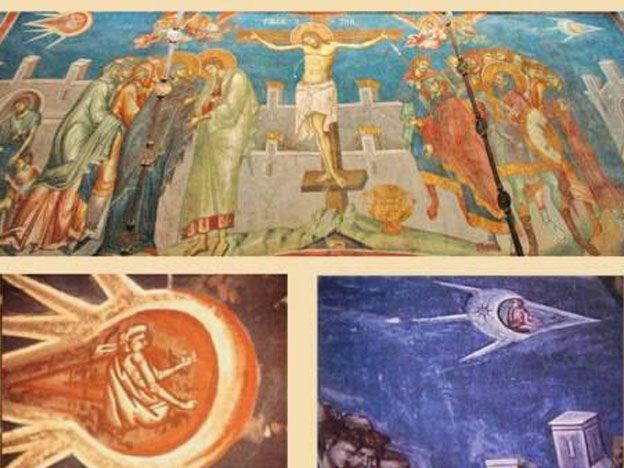
In this Byzantine fresco at Visoki Dečani Monastery, in present-day Kosovo, the crucifixion of Jesus is framed by rich, carefully ordered iconography. In the upper corners, two circular, almost capsule-like forms appear, each containing a figure. At a quick glance, they may resemble small piloted celestial vehicles flying over the event.
Christian tradition, however, interprets these figures as personifications of the Sun and Moon, cosmic presences that symbolically take part in the drama of the Crucifixion. This reading is consistent with medieval visual language, in which celestial bodies could be portrayed as beings with bodies and faces. Whatever the artist's original intention, the fresco demonstrates just how essential the sky and its mysteries have been as a device for representing the divine—or, in some modern readings, the extraterrestrial.
3. "The Creation of Adam" – Michelangelo (1512)

The Creation of Adam, painted on the ceiling of the Sistine Chapel, is one of the most recognizable images in art history. The tiny gap between the hands of God and Adam concentrates a powerful idea: the moment when life, consciousness, and the creative spark pass from the divine to the human.
The composition has been reinterpreted through scientific and symbolic lenses. Some researchers have noted that the reddish shape surrounding God and his entourage bears a striking resemblance to a human brain; others have speculated that it might recall a vessel or capsule carrying the deity. There is no evidence that Michelangelo imagined beings from other worlds. What is clear, however, is his desire to associate the creation of humankind with a higher, vast, almost cosmic knowledge. This visual ambiguity has fueled theories about advanced intelligence beyond Earth.
4. "The Triumph of Death" – Pieter Bruegel the Elder (c. 1562–1563)
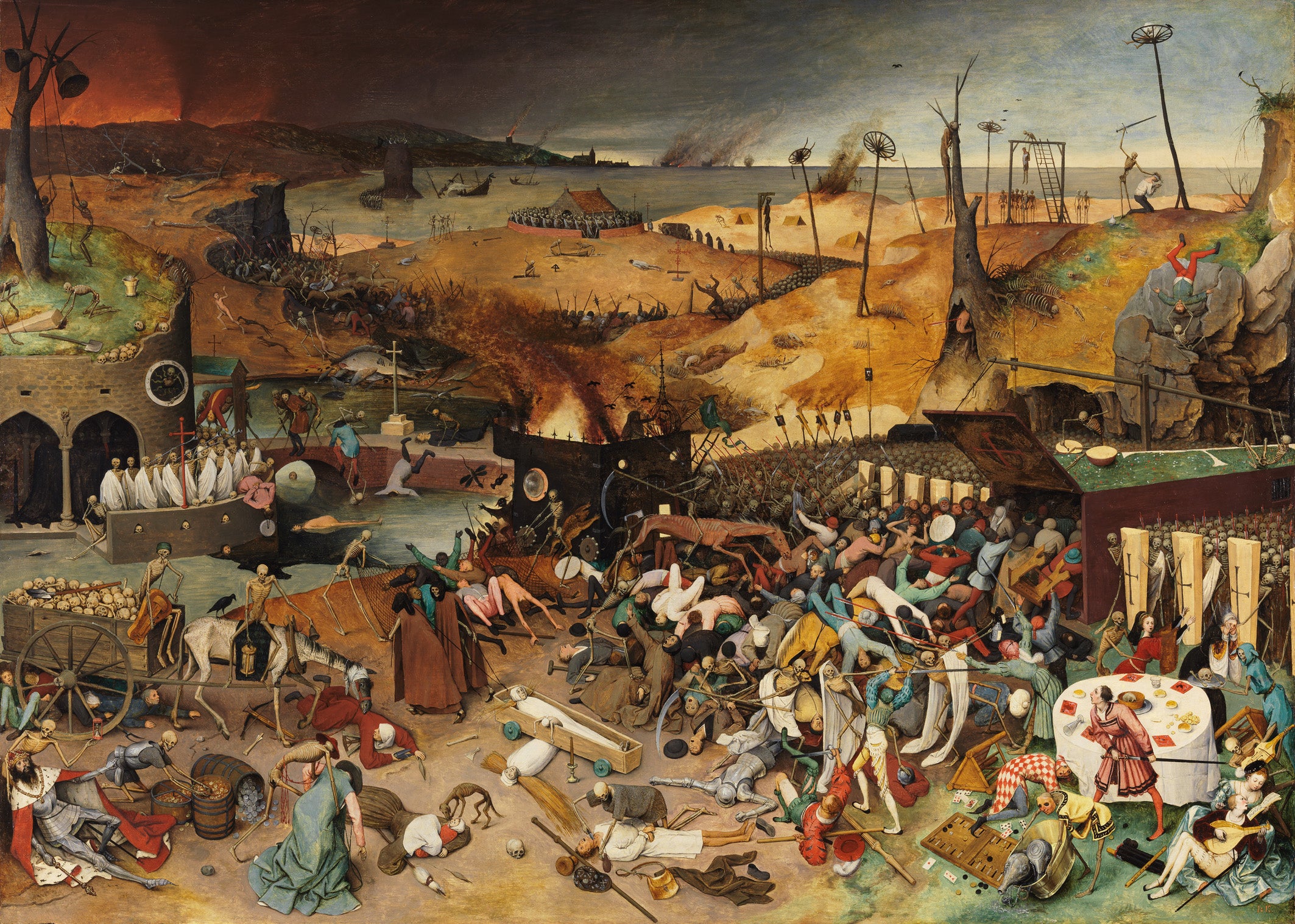
In The Triumph of Death, Pieter Bruegel the Elder depicts an apocalyptic landscape in which death lays waste to everything: peasants, nobles, soldiers, and even kings. Armies of skeletons advance upon terrified humanity, while fires, ruins, and unsettling objects fill the horizon.
The work is commonly read as an allegory of human fragility in the face of wars, epidemics, and disasters. Yet its extraordinary accumulation of strange scenes—machines, ambiguous structures, and episodes verging on the fantastical—has led some viewers to imagine a nightmare of invasion or global catastrophe. Rather than evidence of extraterrestrial life, the painting reminds us that art conceived worlds ruled by uncontrollable forces centuries before science fiction, reducing human security to ashes.
5. "The Miracle of the Snow" – Masolino da Panicale (15th century)

The Miracle of the Snow, also known as the Foundation of Santa Maria Maggiore, depicts the legendary snowfall that, according to tradition, fell over Rome on a summer night in the 4th century. The miracle was meant to indicate the site where the Basilica of Santa Maria Maggiore would be built. Numerous white specks descend over the city from a clear area of sky, with no visible clouds.
The religious reading identifies this white shower as the Virgin's direct intervention. Some UFO enthusiasts, by contrast, have suggested that it might resemble a discharge of lights or particles from a celestial object. These are modern hypotheses, not a proven explanation of the work. Beyond them, the fresco illustrates the freedom with which medieval and Renaissance artists visualized miracles, atmospheric phenomena, and events beyond everyday experience.
6. The "Star of Bethlehem" in Painting (various artists)

Over the centuries, countless artists have depicted the Star of Bethlehem guiding the Three Wise Men to the birth of Jesus. Sometimes it appears as a conventional point of light; in other compositions, it takes the form of a radiant disc, a star with expanding rays, or a comet with an exaggerated tail dominating the entire sky.
Astronomers have attempted to explain the biblical phenomenon as a planetary conjunction, a comet, or a nova. Certain esoteric and ufological movements, meanwhile, maintain that it may have been an object of non-terrestrial origin that guided the wise men. None of these speculations changes the paintings' central meaning: the star functions as a sign, a guide, and a promise. Its persistence shows how art translates celestial phenomena beyond ordinary experience into images, turning them into stories of travel, revelation, and hope.
7. "Visions of the Future" – NASA Series (21st century)

Leaping into the present, the poster series Visions of the Future, created for NASA by the Jet Propulsion Laboratory, imagines tourist journeys to Mars, Jupiter, and distant exoplanets. With an appealing retro graphic style, these posters present alien landscapes, habitable moons, and multiple skies that inspire a desire to explore.
Unlike the religious examples, space here appears not as a supernatural mystery but as a scientific and poetic frontier. Although they are contemporary illustrations, they extend an ancient artistic tradition: speculating about other worlds before seeing them. The extraterrestrial ceases to be a threat and becomes a possible destination for humanity's curiosity, research, and scientific collaboration.
8. "Landscapes from Another World" – Roberto Matta (1940s)
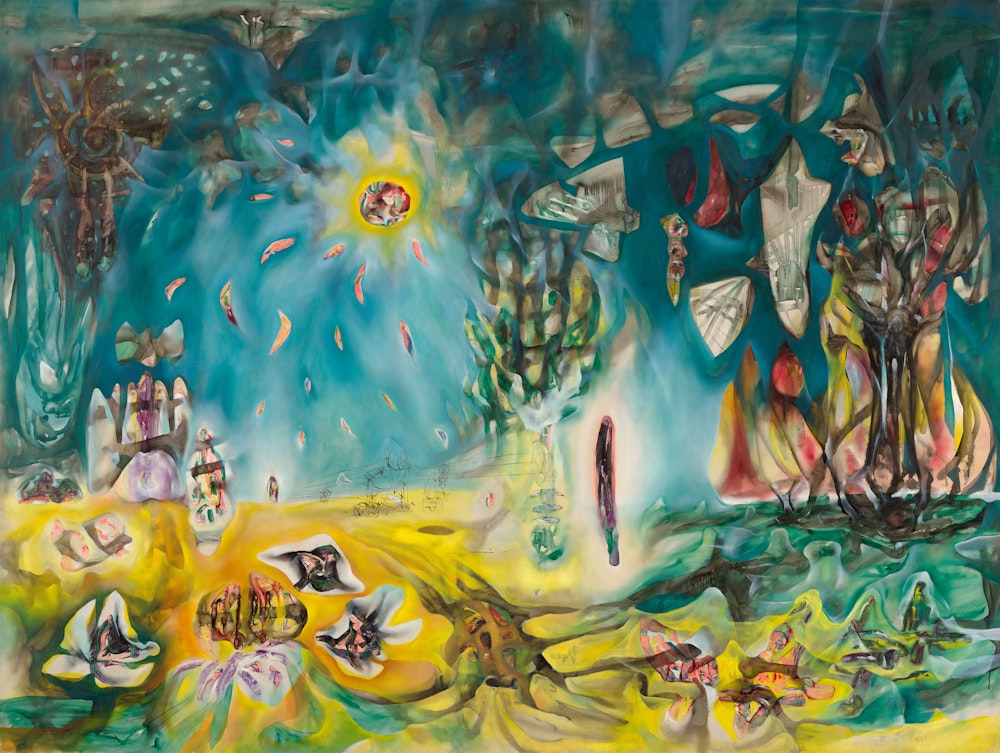
Chilean artist Roberto Matta, a key figure in Surrealism, developed large canvases throughout the 1940s populated by organic forms, floating structures, and impossible spaces. Works such as The Earth Is a Man place the viewer in a landscape that is at once internal and cosmic, as though contemplating a living planet, matter in transformation, or a parallel dimension.
His compositions have been interpreted as visions of worlds in formation, alien atmospheres, and projections of the human mind toward the unknown. Matta does not need to depict spacecraft or specific creatures: his way of suggesting the extraterrestrial is to suspend familiar laws of scale, perspective, and gravity. The result is a visual experience that makes the viewer feel like a stranger before a universe that nevertheless seems to arise from their own imagination.
9. "Livre des Bonnes Meurs" – Traditionally Attributed to Jacques Legrand (c. 1338)
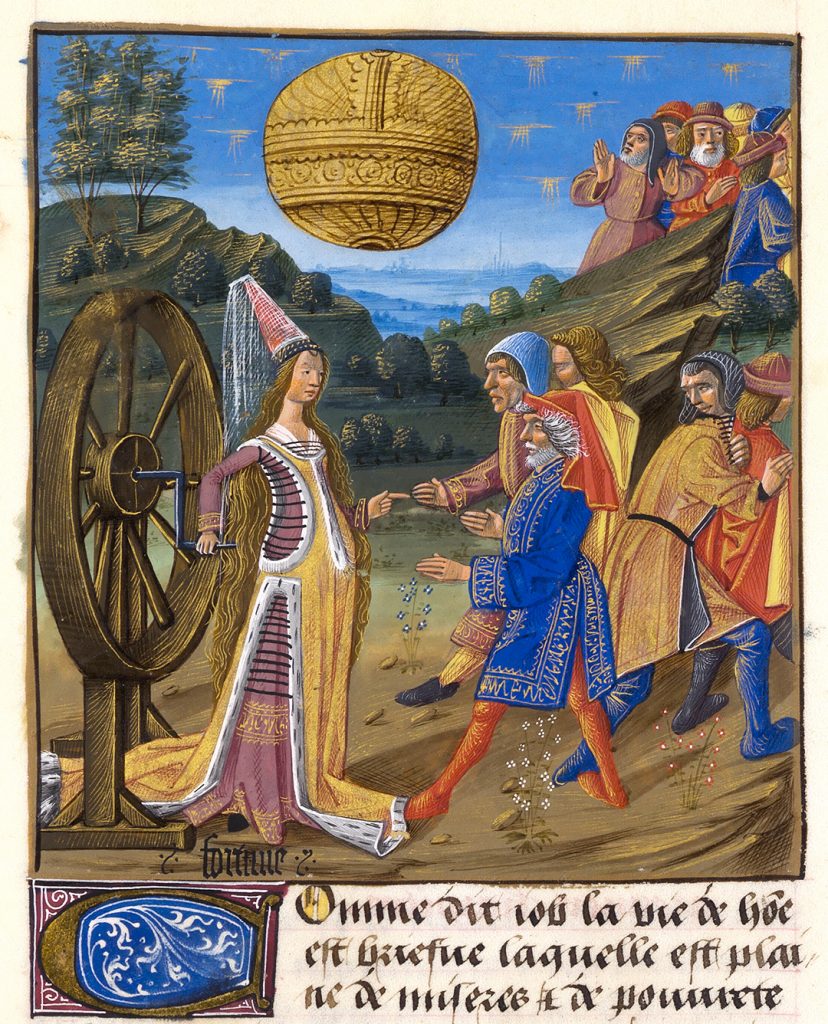
In a famous miniature from the moralizing manuscript Livre des Bonnes Meurs a group of courtly figures appears beneath an enormous golden sphere dominating the sky. The detail recalls a globe, an ornamented celestial body, or a floating artifact, which is why the image often circulates in compilations of alleged UFOs in medieval art.
Specialists generally interpret the sphere as an allegorical symbol, possibly related to Fortune or the cosmic order. Even so, its voluminous form and elaborate ornamentation have sparked the imagination of those who compare it to the "Death Star" of popular culture. Its striking visual resemblance to the Buga Sphere has also been noted; it is an intriguing association, but it should be understood as a contemporary comparison rather than a historically proven coincidence. The example shows how a modern gaze can completely transform the perceived meaning of an image created centuries ago.
10. "The Annunciation with Saint Emidius" – Carlo Crivelli (1486)

In The Annunciation with Saint Emidius, Carlo Crivelli depicts the biblical scene in an elaborate urban setting filled with architecture, figures, and everyday details. In the upper left of the sky appears a luminous circular formation from which a fine ray of light descends directly toward the Virgin Mary.
This pictorial device refers to the Holy Spirit and divine conception, within a clearly religious iconographic tradition. Yet the almost technical precision with which Crivelli paints the ray has led many viewers to compare it to a laser beam emitted by a spacecraft. The most widely accepted interpretation remains symbolic, but the painting has become a favorite among those seeking alleged evidence of ancient contact with beings from other worlds. Its power lies precisely in the fact that a 15th-century devotional convention can seem surprisingly modern.
Special Mention: H. R. Giger (20th century)

Swiss artist H. R. Giger revolutionized extraterrestrial iconography with his unmistakable biomechanical style. His design for the creature in the film Alien, a blend of organic nightmare and futuristic machinery, forever changed the way beings from other planets are imagined. In many of his personal works, human bodies and technological structures merge into dark, sensual, enigmatic landscapes.
Rather than suggesting ancient visits, Giger explores what coexistence—sometimes violent—between the human and the nonhuman might be like. His figures question where the body ends and the machine begins, or what happens when the familiar takes on a radically strange appearance. For this reason, his visions remain a touchstone for generations of filmmakers, illustrators, and science fiction enthusiasts.
The Mystery Also Lies in the Eye of the Beholder
From medieval frescoes to space-age posters, art has served as a canvas for projecting questions about the universe and the possibility that we are not alone. Some of these works arose from religious narratives; others from scientific speculation or artistic imagination. In every case, the extraterrestrial functions as a metaphor for what eludes us: the origin of life, humanity's destiny, the vastness of the cosmos, or the mystery of consciousness.
These paintings remind us that art records not only visible reality but also the countless possibilities that inhabit the mind. A miraculous star, a golden sphere, a ray of light, or a landscape from another world can receive very different interpretations depending on the era of the observer. Looking at them closely allows us to enjoy both their original meanings and the new questions they continue to provoke.
Whether as a religious symbol, an apocalyptic vision, or a space fantasy, each image invites us to look to the sky and wonder what might exist beyond. In doing so, it also encourages us to reflect on our own place in the cosmos and on art's capacity to give form to the unknown.
For practical questions about orders, delivery times, shipping, and service, see the KUADROS FAQs.