In a time dominated by the speed of digital images, painting might seem like an anachronistic medium, unable to compete with the immediacy of photography, video, or social media. However, in recent decades, certain paintings have demonstrated exactly the opposite. Some paintings were not only seen: they were discussed, questioned, defended, auctioned, preserved, or even destroyed before the eyes of the world. They became cultural symbols, turning points, visual documents of their time.
The works gathered in this journey do not share a common style or intention. What unites them is their ability to transcend the frame of the canvas and situate themselves at the center of real debates: political power, collective memory, the representation of the body, the art market, identity, and recent history. Each of these paintings was observed with attention because something was at stake in them, whether it was a radical gesture, an institutional change, or a new way of looking at what until then seemed invisible.
This catalog does not propose a definitive canon or a closed hierarchy. Rather, it proposes an attentive look at ten images that, for concrete and verifiable reasons, marked the visual culture of recent decades and confirmed that painting, far from being exhausted, remains an active space of meaning, tension, and memory.
1. Love Is in the Bin — Banksy (2018)
Few paintings —or pictorial actions— have been observed in real time as closely as Love Is in the Bin . The work literally came to life before the public when, after being auctioned at Sotheby’s, a hidden mechanism in the frame began to partially shred the canvas. The gesture was neither accidental nor subsequent: it was officially recognized as part of the work and authenticated by the artist himself. Visually, the fragmented image reinforces the ephemeral and critical nature of the original scene of the girl with the balloon, turning destruction into meaning. The painting ceased to be just an image and became a historical event in contemporary art.
Transformed into a performance conceptual, the work questions the commodification of art and permanence, turning the act of destruction into a new milestone of creation.
2. Portrait of Barack Obama — Kehinde Wiley (2018)
The official portrait of Barack Obama broke with centuries of presidential iconographic convention. Wiley places the former president in a frontal composition, surrounded by dense vegetation that refers to specific episodes of his biography. The background is not decorative: it invades the space, surrounds the figure, and challenges the classical hierarchy between the portrayed and the environment. The work was presented by the National Portrait Gallery and quickly became a cultural symbol, not only for its style but also for the historical fact of being the first presidential portrait created by an African American artist.
The work subverts the conventions of power, using the artist's hyperrealistic style to humanize the leader and reflect on racial identity and historical legacy.
3. The Visitor — Marlene Dumas (1995)
In The Visitor, Marlene Dumas presents a human figure treated with an economy of means that intensifies its emotional weight. The image seems suspended between presence and disappearance, with a body that is not fully asserted. The painting responds to Dumas' usual practice of working from photographs, but the result is deeply pictorial: the material dissolves, the contours become unstable, and identity remains open. The work is part of a trajectory recognized for its constant exploration of the body, vulnerability, and gaze.
The work explores the tension between the private and the public, using the ambiguity of faces to question how we perceive the body and identity in contemporary art.
4. Suddenly Last Summer — Cecily Brown (1999)
This painting belongs to a key moment in the resurgence of expressive figuration in the late 20th century. At first glance, the scene appears abstract, but prolonged observation reveals bodily fragments, gestures, and physical tensions. Brown deliberately works on that threshold between abstraction and figuration, where the body appears as an unstable pictorial construction. The work was fundamental in placing the artist within a broader debate about desire, pictorial tradition, and the renewal of oil painting language.
Inspired by the tradition of the "old masters" but executed with modern urgency, the painting challenges the viewer to find coherent forms within dazzling chromatic chaos.
5. Hüter der Nacht — Neo Rauch (1997)
In Hüter der Nacht, Neo Rauch combines human figures, industrial architecture, and an ambiguous narrative atmosphere. The painting does not offer a linear reading; rather, it evokes fragments of collective memory linked to post-reunification Germany. Rauch's style, associated with the New Leipzig School, is characterized by the coexistence of references to socialist realism and a dreamlike imaginary. This work was part of the process by which German painting regained a central place in the international debate.
It is a masterful example of the Leipzig School, where German history and fantasy intertwine in an indecipherable way.
6. September — Gerhard Richter (2005)
Richter addressed the September 11 attacks with extreme restraint. September is a small, deliberately blurred painting based on a recognizable yet distanced photographic image. The blur does not erase the event; it transforms it into a fragile, almost elusive image. The work was acquired by MoMA and is often cited as an example of how painting can confront a traumatic historical fact without resorting to spectacle or direct illustration.
The image of the Twin Towers appears almost erased, filtered through layers of gray and blue paint, and constitutes a reflection on the impossibility of representing absolute tragedy and the fallible nature of visual memory.
7. Benefits Supervisor Sleeping — Lucian Freud (1995)
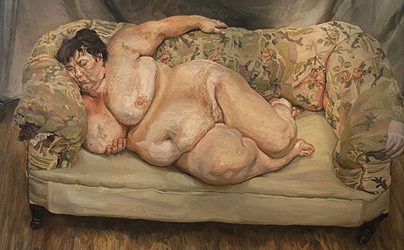
This monumental portrait shows a naked body without any idealization. Freud observes the anatomy with an almost clinical attention, but deeply human. The painting gained exceptional notoriety when it was auctioned in 2008 for a record sum for a living artist at that time. Beyond the market, the work has become a reference for its direct representation of the contemporary body and its frontal rejection of any notion of conventional beauty.
The painting rejects idealization, celebrating instead the monumental physical presence and the vulnerable intimacy of the subject.
8. Works on the Sichuan earthquake — Ai Weiwei (2009)
Although Ai Weiwei is mainly known for his conceptual work, his pictorial and graphic works related to the Sichuan earthquake are part of a visual investigation based on real data and testimonies. These pieces do not seek an ornamental aesthetic; they function as visual records of a documented tragedy. Exhibited internationally, they integrate into an artistic practice where the image becomes a form of memory and denunciation.
By using steel bars recovered from the collapsed schools, Weiwei transforms debris into minimalist art with a deep ethical burden, honoring the victims and criticizing government corruption and negligence.
9. White Canoe — Peter Doig (1996)
White Canoe It presents a seemingly serene night scene, but loaded with ambiguity. The reflection in the water, the artificial light, and the isolated figure create a sense of temporal suspension. Doig works the landscape as a psychological space rather than a descriptive one. The work gained significant public visibility after its auction sale in 2007 and is considered one of the most representative images of contemporary figurative painting.
Representing a solitary canoe on a nighttime lake, this work is a study of atmosphere and memory. Doig uses dense textures and reflective effects to create a sense of unreality. The painting sits on the border between figuration and abstraction, evoking a tense calm and a cinematic nostalgia.
10. Past Times — Kerry James Marshall (1997)
In Past Times, Kerry James Marshall reinterprets typical leisure scenes from the Western painting tradition, but starring Black figures depicted with deliberate chromatic intensity. The composition is complex, filled with cultural and visual references. The work has been widely analyzed in museum and academic contexts for its contribution to a critical rereading of art history and for its affirmation of Black presence within the pictorial canon.
This monumental work rewrites the history of Western art by inserting Black figures into pastoral leisure scenes traditionally reserved for the white aristocracy. With a masterful use of chromatic black and a composition that alludes to the Grand Style, Marshall claims a space of dignity, richness, and normalcy for the African American experience.
KUADROS ©, a famous painting on your wall.
Hand-made oil painting reproductions, with the quality of professional artists and the distinctive seal of KUADROS ©.
Art reproduction service with a satisfaction guarantee. If you are not completely satisfied with the replica of your painting, we refund 100% of your money.