

Description
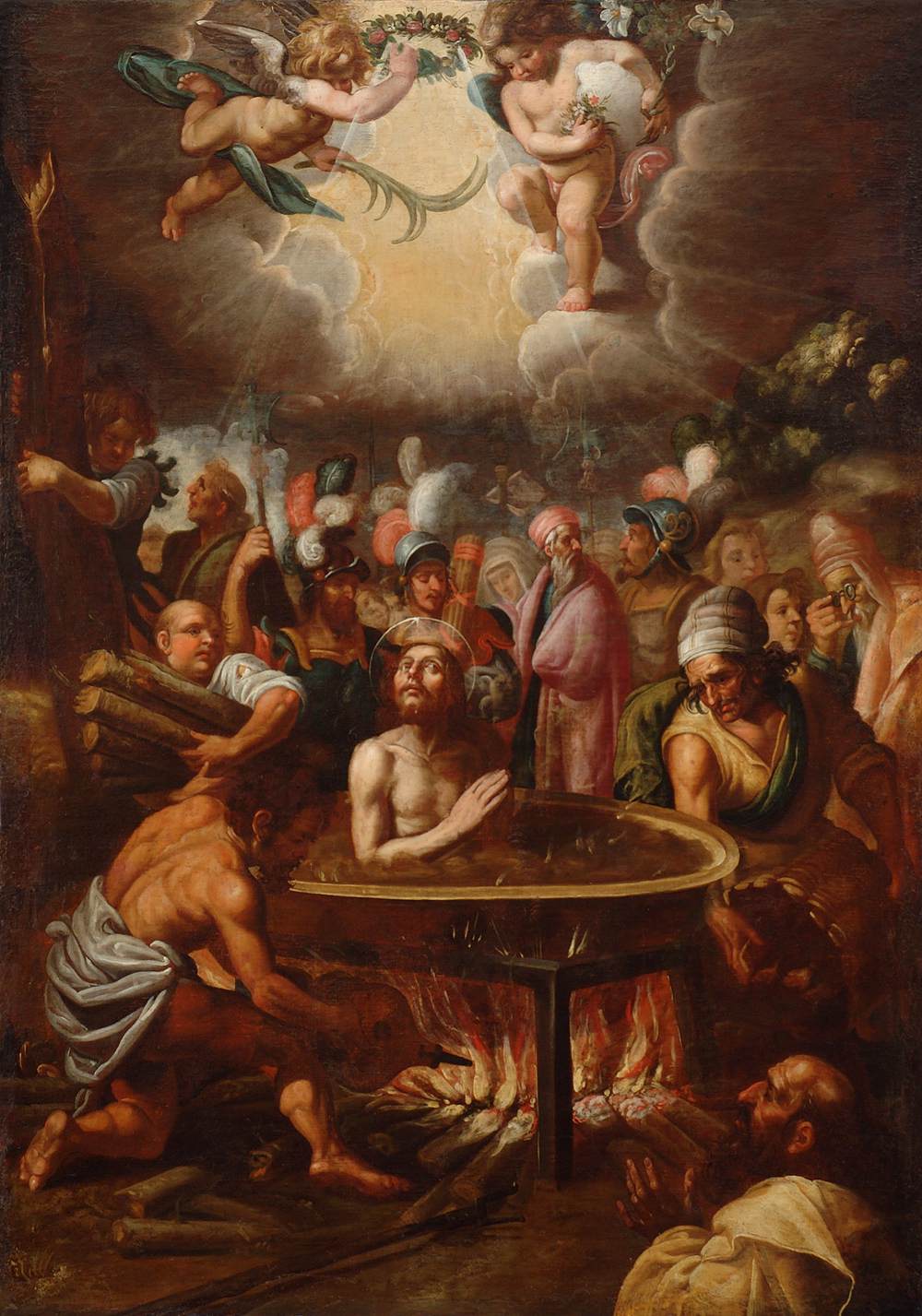
There are scenes in the history of art that are not only contemplated: they are felt. The Martyrdom of Saint John the Evangelist, painted around 1615 by Juan de las Roelas, belongs to that group of works that are moving, not because of explicit violence, but because of the spiritual intensity that manages to transform pain into revelation.
In this painting, Roelas does not merely tell a story. He builds a bridge between two worlds: the human and the divine. Below, the harshness of suffering; above, the promise of eternity.
A scene that burns between the earthly and the heavenly
The depicted moment comes from a deeply symbolic Christian tradition: the attempted martyrdom of Saint John, who according to legend was thrown into a cauldron of boiling oil and miraculously survived. This episode reinforced the idea that the evangelist was directly protected by God, making him a unique figure among the apostles.
Roelas captures the most dramatic instant. Saint John, inside a large vessel over the fire, lifts his gaze toward heaven. His gesture is not one of despair, but of acceptance. It is a body subjected to pain, but a free spirit.
Around him, the soldiers carry out the order with a mixture of routine and brutality. The scene is filled with movement: hands pushing, faces watching, bodies leaning in tension. But all that chaos stops at the center, where the figure of the saint becomes the spiritual axis of the composition.
The Baroque structure: two worlds in a single canvas
One of the most powerful characteristics of Roelas's style is his way of dividing the scene into two planes: the earthly world below and the heavenly world above. This device, inherited from Mannerism and developed toward the Baroque, allows for a simultaneous reading of the visible and the invisible.
In the upper part, two child angels hold a flower crown. This is not a decorative detail: it is a foreshadowing of glory. While the body suffers, the soul is already being acknowledged in heaven.
This duality not only organizes the composition; it also redefines the meaning of martyrdom. Pain is not the end, but the passage.
Color, light, and emotion: Roelas's legacy
Roelas was a key artist in the transition from Mannerism to Baroque in Spain, introducing a more naturalistic and emotional painting. His work combines drama with observation of reality, something visible in the expressive faces and in the everyday details that surround the scene.
In this painting, warm tones dominate: intense reds, deep ochres, vibrant golds. The fire beneath the cauldron not only illuminates, but also acts as a visual symbol of suffering. The light rises, guiding the eye toward the sky, where it becomes softer, almost ethereal.
The contrast between dense shadows and directed light reinforces the drama, an essential characteristic of the early Baroque. The scene seems to emerge from the darkness, as if the viewer were a direct witness to an event taking place at that very moment.
An artist between two worlds
Juan de las Roelas was a key figure in 17th-century Seville painting. Although for a long time he was thought to be Spanish, recent research indicates that he was probably of Flemish origin, which would explain certain characteristics of his style.
His work combines influences from Venetian art—especially in color and theatricality—with a more realistic sensibility typical of Northern Europe. This blending of traditions allowed him to create intense compositions, full of life and deeply narrative.
In addition, Roelas was a pioneer in integrating religious scenes with everyday elements, bringing the divine closer to the ordinary viewer. That ability to humanize the sacred is evident in this work, where the figures seem taken from real life.
Beyond martyrdom: a spiritual reflection
What makes this painting transcend its subject is its message. We are not looking at a depiction of punishment, but of transformation. Saint John does not die; he resists. And in that resistance, he becomes a symbol of absolute faith.
The viewer does not merely observe a historical or religious scene. They are faced with a question: what does suffering really mean when it is tied to a deep conviction?
Roelas does not give a direct answer. But he suggests something powerful: that even in the darkest moment, there is a light that has already begun to shine.
Original dimensions
Oil on canvas, approximately 151 × 107 cm.
KUADROS ©, a famous painting on your wall.
Hand-made oil painting reproductions, with the quality of professional artists and the distinctive seal of KUADROS ©.
Art reproduction service with satisfaction guarantee. If you are not completely satisfied with your painting replica, we will refund 100% of your money.