


Description
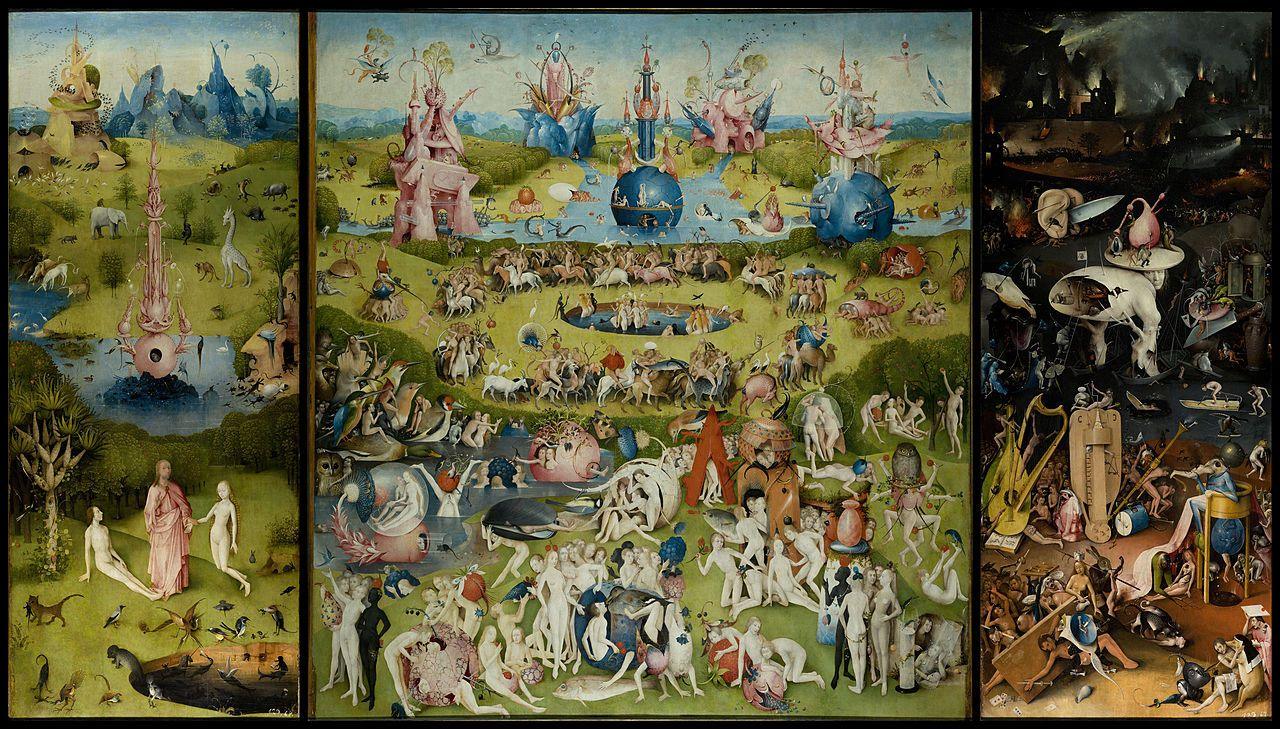
The dominant theme of the painting is carnal pleasure. In one area, a group of naked figures intertwine, nibbling on a gigantic and succulent strawberry.
The panel by Hieronymus Bosch contemplates the dangers of worldly temptation and contains many interesting references. One of the strangest was discovered by a university student in 2014.
In the lower left corner of the work, a musical score can be seen tattooed on someone's back. The musical notes were translated into modern notation and now the tonality can be heard.
Writing about Hieronymus Bosch's triptych is an attempt to describe the indescribable and decipher the undecipherable: an exercise in madness. Nevertheless, there are some points that can be established with certainty.
The painting was first described in 1517 by the Italian chronicler Antonio de Beatis, who saw it in the palace of the counts of Nassau in Brussels. Therefore, it can be considered a commissioned work. The fact that the counts were powerful political actors in the Burgundian Netherlands made the palace a stage for important diplomatic receptions, and the work must have caused quite a sensation among the viewing public, as it was copied, both in painting and tapestries, after the artist's death in 1516.
Therefore, we can assume that the strange lexicon of Bosch's human congress must have had some appeal, or some meaning, for a contemporary audience. In a period marked by religious decline in Europe and, in the Netherlands, the first blush of capitalism after the abolition of guilds, the work has often been interpreted as a warning against carnal and worldly indulgence, but this seems a rather prosaic purpose to assign to a highly symbolic and expressively detailed tour-de-force. And, in fact, there is very little agreement on the precise meaning of the work.
The painting is actually a triptych of creation and condemnation, which begins with Adam and Eve and ends with a highly imaginative kind of hell through the mirror. No one really knows why Bosch imagined the world in this particular way.
There are many conjectures about this original piece as well as about the artist and his motivation for completing a work with a powerful message. Was Hieronymus Bosch an alchemist? Given his references to alchemy, it is estimated that he was at least familiar with the subject. If he were conducting chemical experiments, it might explain, at least in part, the hallucinatory quality of the painting.
It can also be argued that the fruit and the exaggerated consumption of fruits could be a metaphor for sexual acts. Instead of showing direct representations of sex, Bosch painted the insatiable appetites of the naked figures and the fruit instead of "sinful" acts.
The Garden of Earthly Delights ranks no. 81 on the list of paintings famous