

Description
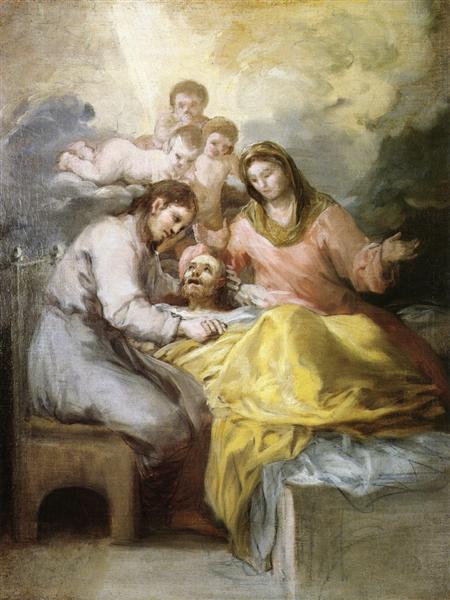
The work "Sketch for the death of San José" by Francisco Goya, made in 1787, is erected as a fascinating testimony of the innovative talent of the Spanish painter, as well as its ability to capture the essence of the human condition through religious art . This sketch is not only a representation of a traditional theme, but also an exploration of the intimacy and pain that surrounds death, an issue that Goya would address with a particular sensitivity that distinguishes it from others masters of his time.
The composition of this painting is remarkable. In it painting, The inert body of San José lies in the center, surrounded by figures that reflect the anguish and reverence before the time of its departure. Goya uses a diagonal disposition that leads the viewer's gaze to the deceased, focusing attention on his figure. The hands of San José, positioned at the top, seem to extend to the viewer, suggesting a connection between the earthly world and the beyond. This type of compositional choice is not accidental; It reveals Goya's predilection for giving his works an emotional burden, beyond mere representation.
The use of color in this work is equally significant. Goya chooses a palette of terrible and gloomy tones, which accentuate the seriousness of the moment. The light seems to seep in an almost faint way, illuminating the face of San José and highlighting the shadows in the surrounding figures, creating a dramatic effect that invites reflection. This contrast between light and shadow is characteristic of Goya's style and establishes an atmosphere of melancholy, evoking in the viewer a deep emotional response.
The characters surrounding San José are represented with an emotional palpability that echoes the chiaroscuro technique, masterfully used to show their expressions of pain and compassion. These faces, although less detailed than the central figure, are equally shocking. Goya achieves, through its skillful management of the brush and texture, transmit the collective regret that aisves those who accompany San José in their last moments.
This sketch is a preparation for what would be a larger work, and its intrinsic quality is such that it transcends its original purpose. Goya, in his search for authenticity and human expression, achieves in this sketch what many artists of his time struggled to achieve: a representation that is both spiritual and deeply human.
In context, "Sketch for the death of San José" can be seen as a manifestation of Goya's personal style, which would develop and become bolder in his subsequent works. Through issues of death, suffering and supernatural, Goya begins to mark a transition to romanticism, where the subjective expression and feelings of the individual are exalted above the classic norms of conventional religious art.
Goya created a series of works in which he explored the duality of life and death, the spiritual and the earthly. Through this sketch, we can glimpse the seeds of an artistic concern that would shape his masterpiece, "the disasters of war", and its evolution towards the use of symbolism and the metaphor that would be reflected during its most mature stage . In this sense, the "sketch for the death of San José" is a crucial link in Goya's work, revealing its ability to confront mortality with unparalleled sensitivity, a feature that will last in its artistic legacy.
KUADROS ©, a famous paint on your wall.
Hand-made oil painting reproductions, with the quality of professional artists and the distinctive seal of KUADROS ©.
Reproduction service paintings With a guarantee of satisfaction. If you are not completely satisfied with the replica of your painting, we refund your money 100%.