

Description
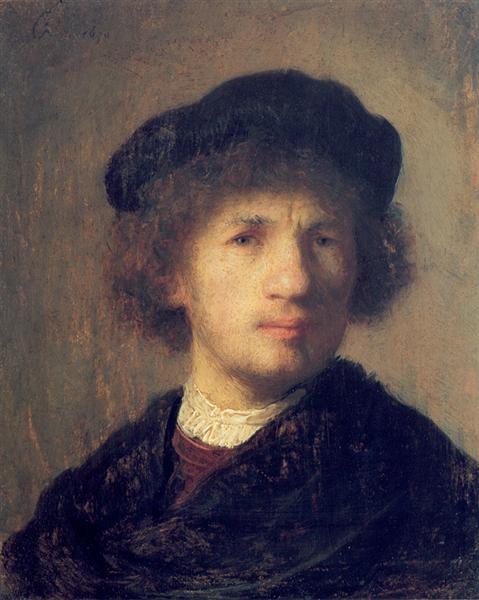
The 1630 Self -portrait of Rembrandt Van Rijn is an emblematic masterpiece that reflects not only the artist's technical mastery, but also a deep psychological introspection that characterizes its portrait approach. In this painting, Rembrandt introduces himself contemplatively, with his face illuminated by a soft glow, which seems to emanate from a dark and almost indefinite background, which enhances the feeling of intimacy in the piece.
The composition reveals careful attention to the position of the subject. Rembrandt is positioned at a slightly turned angle, which generates a dynamic relationship with the viewer. His intense gaze, which seems to cross whoever observes the work, provides a sense of personal connection. This way of relating to the viewer is one of the defining characteristics of Rembrandt's portraits, which is often able to capture not only the physical appearance, but also the emotional essence of its subjects.
The use of color in this self -portrait is notable for its terrous palette and the effective use of chiaroscuro, a technique that Rembrandt dominated as few. The skin of the artist, organized in warm tones, contrasts with the darkness of the background, which helps highlight the factions of his face. The light that bathes its forehead and cheeks adds volume and three -dimensionality to the portrait, while the shadows accentuate wrinkles and nuances that talk about their life and experiences. This game of lights and shadows also suggests a duality that can be interpreted as a representation of the internal struggle and humanity of the artist himself.
In this self -portrait, Rembrandt's image is dressed in a way that seems ceremonial, which can be interpreted as a reflection of the role of the artist in the society of his time. The clothing is rich and textured, imbued with a meaning that can suggest both the social class and the dignity inherent to the creative. The way in which fabrics have been represented is a sample of their ability to capture not only the form, but also the texture and weight of the material, something that can be seen in the folds of the neck of their outfit.
Although the work is a self -portrait, the figure is impregnated with a feeling of universality, opening the door to an exploration of the identity that transcends its creator. In this way, the piece can be seen not only as a representation of Rembrandt, but as a reflection on the human condition, the passage of time and the inevitable scars that it leaves in each of us.
This self -portrait is also inserted in a broader context of Rembrandt's work, who produces numerous self -portraits throughout his life. However, the 1630 work is distinguished by its youth and trust, capturing a time when the artist was still forging his voice in the art world. Unlike other later portraits, which often reveal a feeling of sadness or melancholy, this presents a vital energy and serenity that suggest ambition and appreciation for life.
In conclusion, Rembrandt's self -portrait of 1630 is not only a representation of the artist, but a deep exploration of his being. Through the mastery in technique and an introspective look, the work transcends the personal and becomes a mirror of human experience, a legacy that continues to resonate today. Attention to detail, the masterful management of color and light, together with the bold composition, highlights Rembrandt not only as a portrait of its time, but as an eternal meter of the human condition.
KUADROS ©, a famous paint on your wall.
Hand-made oil painting reproductions, with the quality of professional artists and the distinctive seal of KUADROS ©.
Reproduction service paintings With a guarantee of satisfaction. If you are not completely satisfied with the replica of your painting, we refund your money 100%.