

Description
In the vast pantheon of sacred art, few scenes evoke such tangible humanity in the divine figure as the representation of Jesus in his moments of solitude prior to the Passion. The work in question, commonly identified as Jesus praying in Gethsemane or sometimes associated with the lament over Jerusalem, is inscribed in a pictorial tradition that seeks to bring the viewer closer to the psychology of the Nazarene, moving away from the rigidity of Byzantine icons to embrace an emotional realism characteristic of 19th and early 20th-century religious painting. Upon observing this piece, we do not face a distant deity, but rather a man immersed in profound introspection, captured in a profile that denotes both nobility and an inescapable melancholy.
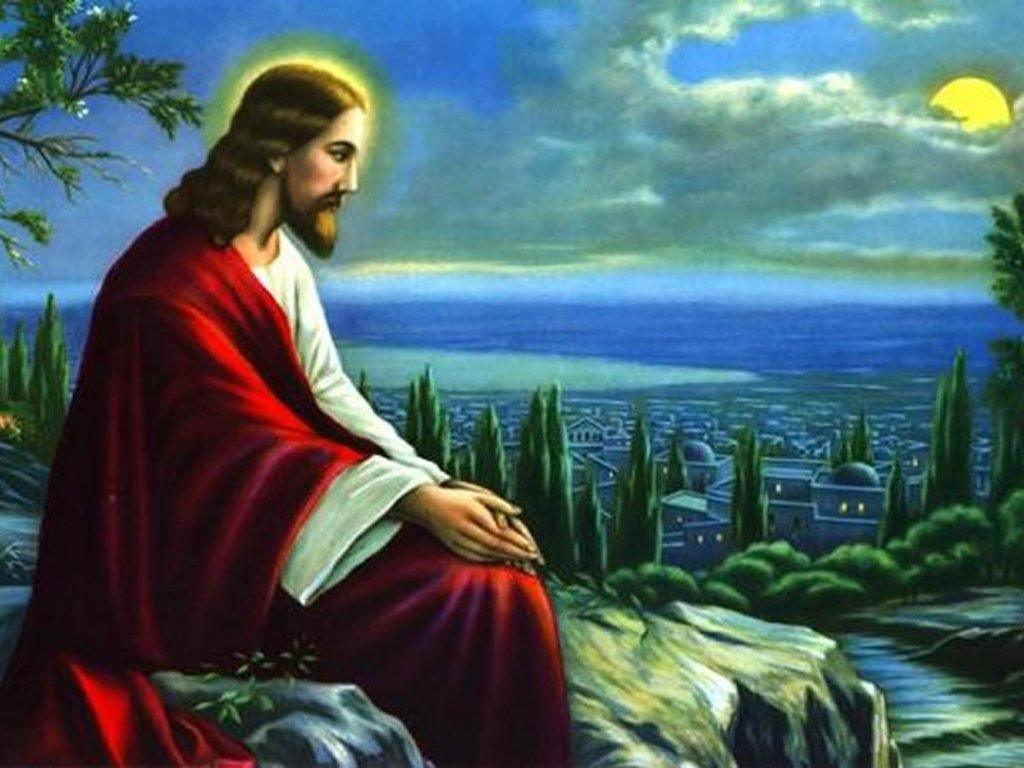
The composition of the work is masterfully orchestrated to highlight the duality between spiritual peace and inner torment. The figure of Christ dominates the foreground, seated on a rocky promontory that elevates him both physically and symbolically above the earthly world that stretches at his feet. The artist has opted for a classical profile, a decision that allows the observer to contemplate the serenity of the face without invading the privacy of his pain. The hands, intertwined on his lap, do not show the desperate tension of other representations of the agony in the garden, but rather a posture of waiting and meditative acceptance, suggesting the moment of calm before the final storm.
The use of color is undoubtedly one of the most eloquent aspects of this painting. The deep crimson cloak that envelops Jesus acts as the undisputed focal point of the work. In traditional Christian iconography, red symbolizes blood, martyrdom, and the humanity of Christ, contrasting vividly with the white tunic peeking out from underneath, symbolizing his purity and divinity. This chromatic interplay is not accidental; it is a visual narrative that reminds the believer of the dual nature of the subject: the God who remains pure and the Man who is about to bleed for humanity. The fall of the folds of the fabric demonstrates a careful study of light and texture, granting weight and volume to the figure.
The lighting plays a crucial role in the atmosphere of the scene. We find ourselves before a nocturnal landscape, bathed in the light of a full moon that breaks through dramatic clouds in the upper right corner. However, the most powerful source of light does not seem to come from the celestial body, but rather emanates from the figure of Christ himself, manifested in the radiant nimbus or halo that surrounds his head. This divine light gently illuminates his face and hands, creating a soft contrast with the shadows that envelop the surrounding vegetation, possibly the characteristic olive and cypress trees of the biblical garden.
The background of the painting deserves detailed attention, as it contextualizes the protagonist's solitude. Below, in the distance, the city of Jerusalem is glimpsed, painted in shades of blue and gray that evoke the silence of the night and the dreams of its inhabitants. The scattered lights of the city create a visual counterpoint with the celestial light of the sky, establishing a separation between the urban world, oblivious to the cosmic drama about to unfold, and the solitary vigil of the Messiah. This elevated perspective, looking towards the walled city, reinforces the narrative of one who watches over his people while they sleep.
Stylistically, the work adheres to an idealized academic realism. The brushstroke is soft, seeking perfection in the forms and avoiding any stridency that distracts from the devotion. This type of representation, which gained immense popularity through lithographs and devotional prints in the last century, aims to inspire piety and silent reflection. The nature surrounding Jesus is treated with naturalistic detail but subordinated; the rocks and plants serve as a frame for the central figure without competing for attention. It is a work that, beyond its technical execution, succeeds in its ability to convey silence, waiting, and the profound gravity of a night that would change the history of Western faith.