

Description
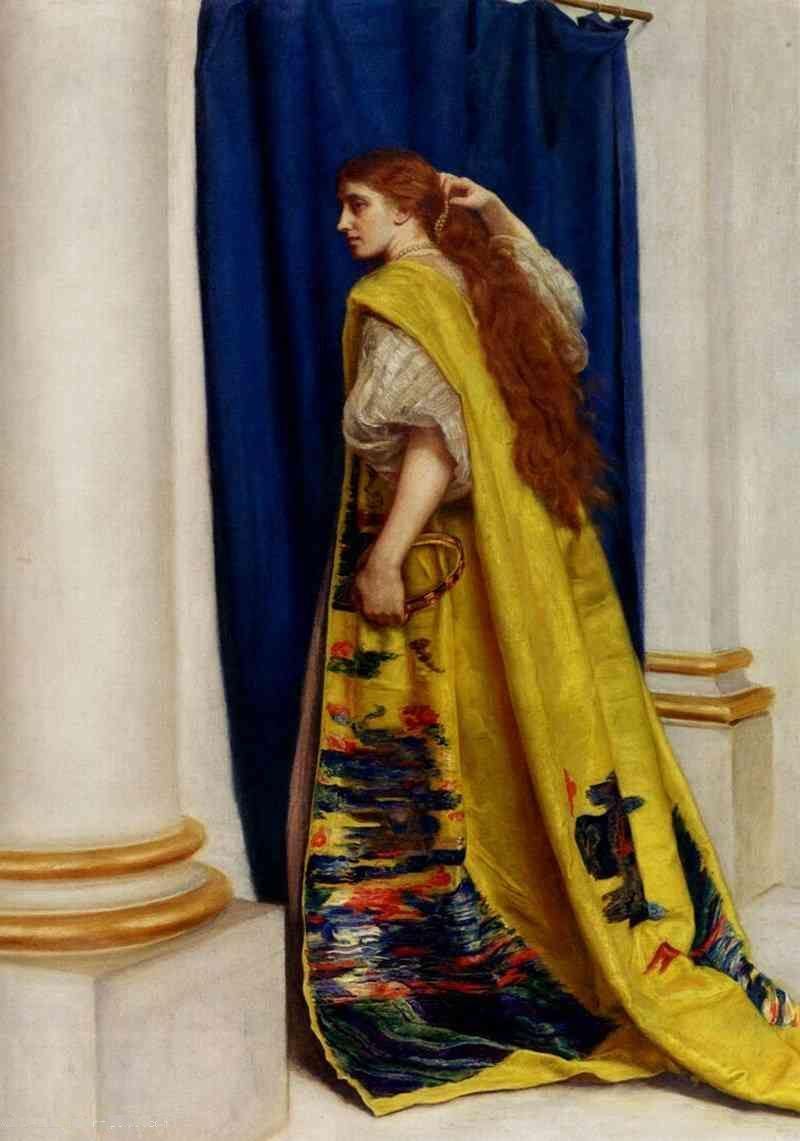
The painting shows Esther standing in profile, isolated within an interior that suggests a palace. The figure fills almost the full height of the composition: her long reddish hair falls down her back while one hand rises to the back of her head and the other holds a small golden object at her hip. A broad, luminous yellow mantle wraps her silhouette and falls to the floor in a monumental sweep. Beneath it appears a skirt or dress with dark bands and multicolored motifs. Behind Esther a large blue curtain forms the central background, framed by pale columns or plinths; at the lower right edge, several stacked books complete the scene.
Esther is the protagonist of the Book of Esther, where she becomes queen of Persia and uses her position to intercede with the king and save the Jews from the threat advanced by Haman. The story combines courtly rank, responsibility and courage: appearing before the monarch unbidden involved considerable risk. The work does not depict a literal, fully narrated scene but concentrates that tension in the presence of its heroine. Her restrained posture and isolation turn Esther into a figure of quiet dignity, poised between the solemnity of ceremonial and the pressure of a decisive choice.
The yellow garment can be read as a sign of wealth and status, and its almost architectural sweep reinforces the regal condition of the figure. Opposite it, the deep blue of the curtain creates a zone of depth and seclusion, as if the character were visually set apart from the surrounding space. The pale columns provide a ceremonial structure, while the books introduce a note of culture and gravity into the setting. They do not function as a specific attribute of the character, but they do enrich the reading of a cultivated, palatial environment. The profile figure, shown in isolation, directs attention toward her psychological concentration rather than toward any explicit action.
The formal construction depends on very precise contrasts. The golden yellow first draws the eye and traces a descending diagonal from the shoulders to the train extended in the lower right corner. The blue of the curtain intensifies that glow and provides a uniform, dark, theatrical backdrop against which the face, hair and folds of the dress stand out. The light surfaces of the architecture balance the central chromatic density and stabilize the base of the scene. The verticality of the figure and the architectural elements contrasts with the undulating movement of the hair, the fabric and the skirt motifs, creating an image that is at once serene and dynamic.
In Esther, John Everett Millais combines intense color, meticulous attention to textures and decorative richness characteristic of the Pre-Raphaelite sensibility. The reddish hair, ornate fabrics, the blue curtain and the clear architecture have an almost tactile visual presence, yet all these details remain subordinate to the central figure. Millais thus transforms Esther into a monumental, silent presence: a woman clothed in courtly splendor, though marked by an inner tension that the decoration does not dissolve. Note how the yellow brings her forward toward the viewer while the profile and the blue background keep her in a reserved space; the narrative force of the work is built between these two impulses.
Do you have questions about our oil-painting reproductions? See our frequently asked questions.