Gustav Klimt, a name synonymous with opulence, sensuality, and Vienna’s Belle Époque. His work, marked by masterful use of gold and an innovative aesthetic, transcends time and continues to fascinate generations. Beyond mere representation, Klimt captured the essence of an era, the aspirations and contradictions of a society in the midst of transformation.
Vienna in the late 19th century was a melting pot of ideas, a hotbed of creativity and, at the same time, a setting for deep contradictions. The Austro-Hungarian Empire, though in decline, radiated an aura of grandeur, and the city stood as a vibrant cultural center. In this context, artistic movements such as Jugendstil (Art Nouveau) and the Vienna Secession flourished, seeking to break with the prevailing academicism and explore new forms of expression. The music of composers such as Gustav Mahler and Richard Strauss resonated in the theaters, while the theories of Sigmund Freud revolutionized the understanding of the human psyche. However, this cultural effervescence coexisted with a rigid social structure and a growing sense of uncertainty about the future. Klimt, as an artist sensitive to his surroundings, absorbed these influences and reflected them in his work, capturing the beauty and decadence of an era.
The Vienna Secession, founded in 1897, was a key movement in Klimt’s artistic development. This group of artists, architects, and designers, led by Klimt himself, rebelled against the conservative Academy of Fine Arts and sought to create a total work of art that integrated all disciplines. The Secession promoted experimentation, creative freedom, and collaboration among artists, and its magazine, "Ver Sacrum" ("Sacred Spring"), became an important forum for discussion and the spread of new ideas. Klimt found in the Secession a space to develop his own style, freeing himself from academic conventions and exploring new techniques and themes. The influence of the Secession is evident in Klimt’s preference for ornamentation, the stylization of forms, and the symbolic use of color, elements that characterize his later work. This movement provided him with a platform to exhibit his work and achieve international recognition, consolidating his position as one of the most important artists of his time.

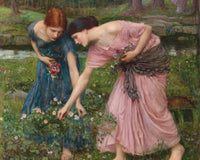
Springtime Idyll - Klimt
Klimt's early works, created in the 1880s, show a solid academic training and remarkable technical skill. Along with his brother Ernst and his friend Franz Matsch, he founded the "Artists' Company," which was dedicated to creating wall decorations and portraits for public and private buildings. These early works, although still conventional in style, reveal precocious talent and a strong ability for realistic representation. However, Klimt soon began to experiment with new forms of expression, influenced by Symbolism and Art Nouveau. His search for his own style led him to explore themes such as love, death, sexuality, and the human condition, represented through an increasingly personal and symbolic visual language. An example of this transition is his work "Spring Idyl" (1890), which already anticipates some of the characteristic elements of his later style, such as the stylization of figures and the use of ornamental motifs. The death of his brother Ernst in 1892 was a traumatic event that marked a turning point in his career, driving him to delve deeper into the exploration of existential themes and to develop an even more personal and expressive style.

The Kiss: An Icon of Love and Ornament
"The Kiss" (1907-1908), perhaps Klimt's most iconic work, is a celebration of love and union in a context of exuberant ornamentation. The composition depicts an embraced couple, enveloped in a halo of golden radiance. The man, in geometric and angular robes, leans in to kiss the woman, whose dress is adorned with floral and circular motifs. This dichotomy between masculine and feminine forms, between rigidity and fluidity, is a key element of the composition. Symbolism is omnipresent: gold represents divinity and the eternity of love, while the floral motifs symbolize fertility and life. Klimt's pictorial technique is a combination of oil painting and gold leaf, creating an effect of luminosity and visual richness. The surface of the painting is covered with meticulous details that invite the viewer to lose themselves in contemplation of the work. The choice of warm and vibrant colors, such as gold, red, and orange, helps create an atmosphere of sensuality and passion.
The use of gold leaf is one of the most distinctive features of Klimt’s work, especially in his so-called “golden period.” Inspired by the Byzantine mosaics he saw on his trips to Italy, Klimt incorporated gold leaf into his paintings to create an effect of opulence and transcendence. Gold leaf not only adds luminosity and brilliance to the work, but also gives the figures an almost sacred quality. In “The Kiss,” the gold leaf envelops the couple in a halo of divine light, elevating the act of love to a spiritual plane. Applying gold leaf requires a precise and careful technique, which Klimt mastered to perfection. Each sheet of gold is adhered to the surface of the painting with a special adhesive and then polished to enhance its shine. The result is a rich, textured surface that catches the light differently depending on the viewing angle. The use of gold leaf is not only an aesthetic device, but also a symbolic element that reinforces the central theme of the work: the eternity and transcendence of love.
Despite its boldness and originality, Klimt’s work was not always well received by critics. Some critics considered his paintings too sensual and decorative, while others praised his innovation and his ability to capture the spirit of the era. “The Kiss,” in particular, sparked controversy for its explicit portrayal of love and sexuality. However, over time, Klimt’s work has become increasingly valued and appreciated, and “The Kiss” has become a universal symbol of romantic love. Its image has been reproduced countless times on posters, postcards, and merchandise items, transcending the realm of art to become an icon of popular culture. Klimt’s legacy extends beyond his individual work. His influence can be seen in the work of numerous contemporary artists, who have adopted his ornamental style and his exploration of themes such as love, sexuality, and identity. Tamara de Lempicka, for example, is an artist who, decades later, also combined glamour and sensuality in her portraits, although in a different style, influenced by Art Deco. Klimt’s impact on twentieth-century art and culture is undeniable, and his work continues to inspire and fascinate people around the world. Additionally, buying reproductions of artworks is an excellent way to keep Klimt’s legacy alive, allowing his art to continue inspiring new generations.

Adele Bloch-Bauer I: The Golden Portrait That Sparked Passion
The portrait of Adele Bloch-Bauer I (1907), often referred to as “The Lady in Gold,” is one of Klimt’s most iconic works and a paradigmatic example of his Golden Period. Adele Bloch-Bauer, wife of industrialist Ferdinand Bloch-Bauer, was a prominent figure in Viennese society and a great admirer of Klimt’s art. Ferdinand commissioned the portrait in 1903, and Klimt devoted four years to its creation, producing a work of unprecedented opulence and sophistication. The relationship between Klimt and Adele has been the subject of speculation, and some art historians suggest that there may have been a romantic connection between them. However, there is no definitive proof to confirm this hypothesis. What is certain is that Klimt and Adele shared a deep intellectual and artistic affinity, and that she was one of the main patrons and champions of his work. The portrait of Adele Bloch-Bauer I is not only a representation of her physical beauty, but also a reflection of her personality and social status.
The creative process behind the portrait of Adele Bloch-Bauer I was long and laborious. Klimt made numerous sketches and preparatory studies before beginning the final painting. The work was created using a combination of oil paint and gold leaf, and its surface is covered with meticulous details. Adele’s dress is adorned with geometric and floral motifs inspired by Egyptian and Byzantine art, reflecting Klimt’s interest in ancient cultures. The choice of these motifs is no coincidence: Egyptian art symbolizes eternity and regeneration, while Byzantine art represents divinity and power. Klimt used these symbols to enhance Adele’s beauty and status, elevating her to the category of a goddess or queen. Adele’s face is rendered with great realism, but her body is stylized and almost integrated into the golden background. This combination of realism and abstraction is one of the most distinctive features of Klimt’s style.
The history of the portrait of Adele Bloch-Bauer I is marked by controversy and tragedy. During World War II, the work was confiscated by the Nazis and became part of the collection of the Belvedere Museum in Vienna. After years of litigation, Maria Altmann, Adele Bloch-Bauer’s niece, succeeded in recovering the work in 2006, in a case that set an important precedent in the restitution of artworks stolen by the Nazis. The story of Maria Altmann and her fight to recover Klimt’s paintings has been adapted into the film "The Lady in Gold" (2015), which has helped bring attention to the story of Adele Bloch-Bauer and the importance of restituting cultural heritage stolen during the war. After its restitution, the portrait of Adele Bloch-Bauer I was sold to businessman Ronald Lauder for the record sum of 135 million dollars, becoming the most expensive painting ever sold at that time. Today, the work is in the collection of the Neue Galerie in New York, where it can be admired by the public.

Judith I: Femme Fatale and the Power of Seduction
In "Judith I" (1901), Klimt explores the archetype of the *femme fatale*, presenting Judith, the biblical heroine who saved her people by beheading General Holofernes, as a seductive and powerful woman. Unlike traditional depictions of Judith as a virtuous and pious figure, Klimt portrays her as a sensual and dominant woman, whose face radiates a mixture of pleasure and satisfaction. Her defiant gaze and slightly parted lips suggest unwavering confidence and determination. Judith’s body is covered in jewels and ornaments that enhance her beauty and status. Holofernes’s head, barely visible at the bottom of the painting, is a symbol of the destructive power of the *femme fatale*. Judith represents a woman’s ability to subvert the patriarchal order and exercise her own will, using her allure and intelligence as weapons. In Klimt’s work, Judith is not simply a victim of circumstances, but an active agent of her own destiny.
One of the most striking aspects of "Judith I" is the contrast between beauty and violence. The exquisiteness of the details, the richness of the colors, and the elegance of the composition stand in stark contrast to the brutality of the act Judith has just committed. Holofernes’s head, though barely visible, is a constant reminder of the violence underlying the work. Klimt uses this contrast to explore the complexity of human nature and the ambiguity of morality. Judith is at once a heroine and a murderer, a figure of beauty and terror. This ambivalence is what makes the character so fascinating and unsettling. Klimt’s work invites us to reflect on the relationship between beauty and violence, and on the ability of art to represent the complexity of human experience. The delicacy of the strokes and the sumptuousness of the ornamentation do not conceal the harshness of the subject; rather, they heighten it, creating a visual tension that keeps the viewer captivated.
The creation of the character of Judith in Klimt’s work is influenced by mythology and symbolism. In addition to the biblical story of Judith and Holofernes, Klimt drew inspiration from other female figures in mythology, such as Salome and Lilith, who also represent the archetype of the *femme fatale*. These figures share common traits such as beauty, seduction, and destructive power. Klimt used symbolism to enrich the interpretation of the character of Judith. The ornaments and jewels Judith wears are not mere decorative elements, but carry symbolic meaning. For example, the snake necklace Judith wears is a symbol of sin and temptation, while the gold represents wealth and power. The choice of these symbols helps create a complex and ambivalent image of Judith, one that goes beyond the simple representation of a biblical heroine. Bosch, centuries earlier, had already explored the complexity of the human condition and the ambiguity of morality in works such as "The Garden of Earthly Delights," where symbolism plays a fundamental role in conveying the message. Klimt, like Bosch, uses symbolism to deepen the exploration of the human psyche and the complexity of human relationships.
Klimtian Landscapes: An Intimate Look at Nature
While Gustav Klimt is world-renowned for his dazzling portraits, adorned with gold leaf and ornamental motifs, his side as a landscape painter reveals a profound sensitivity and an intimate connection with Austrian nature. Unlike his female figures, his landscapes offer contemplative serenity, inviting the viewer to immerse themselves in the beauty of the countryside. This lesser-explored facet of Klimt shows an evolution throughout his career. Initially, his landscapes reflected a more traditional style, influenced by late Impressionism. However, over time, his approach became more abstract and decorative, merging precise observation of nature with his characteristic ornamental language. The serene lakes, lush forests, and blooming gardens of Austria became the protagonists of his canvases, captured with a vibrant color palette and a loose, expressive brushstroke.
A notable example is his series of paintings of Lake Attersee, a place Klimt visited regularly. In these works, the lake becomes a mirror reflecting the sky and the surrounding landscape, capturing the changing light and atmosphere of the place. The repetition of the theme over several years makes it possible to appreciate the evolution of his style and his growing interest in abstraction. Rather than simply depicting reality, Klimt sought to capture the essence of nature, conveying a sense of peace and harmony.
Klimt manipulated perspective and composition to create lyrical, enveloping atmospheres in his landscapes. He often chose elevated viewpoints that allowed him to take in wide stretches of land, immersing the viewer in the immensity of the landscape. He also used the technique of "horror vacui," filling the canvas with meticulous details and creating a sense of exuberance and vitality. This technique, which consists of filling the entire space with forms and patterns, is particularly evident in his depictions of gardens and forests, where vegetation intertwines and multiplies to infinity.
His compositional approach often challenged traditional conventions. For example, he could truncate trees or buildings, leaving the viewer to complete the image in their mind. He also played with symmetry and asymmetry, creating a dynamic and appealing visual balance. A clear example of this is his painting "The Avenue of Kammer Castle on Lake Attersee," where the line of trees divides the canvas into two nearly symmetrical halves, creating a sense of calm and order. However, the subtle variation in the color and texture of each half prevents the image from becoming static or monotonous.
Although Klimt developed an unmistakably personal style, the influence of Impressionism and Post-Impressionism is evident in his landscapes. He shared with the Impressionists an interest in capturing the effects of light and color in nature, as well as the loose, expressive brushstroke. However, unlike the Impressionists, Klimt did not limit himself to recording the superficial appearance of reality, but sought to convey a deeper emotional and sensory experience. Like Monet , studied light and its impact on color, but took it one step further by incorporating decorative and symbolist elements.
From Post-Impressionism, Klimt adopted greater creative freedom and a tendency toward abstraction. Like Van Gogh or Gauguin, he experimented with intense, contrasting colors and simplified forms to express emotions and moods. An example of this can be seen in his use of bright, saturated colors to depict the flowers in his gardens, or in the simplification of the shapes of trees and mountains to create a decorative effect. The influence of artists such as Renoir can also be seen in the atmosphere of serenity and sensuality that permeates many of his landscapes.

Beethoven Frieze: A Visual Symphony of Hope and Redemption
The Beethoven Frieze, a monumental work by Gustav Klimt, stands as an artistic and philosophical manifesto of the Vienna Secession. Created in 1902 for the 14th exhibition of this artistic movement, the frieze decorated a room dedicated to a statue of Beethoven made by Max Klinger. The Vienna Secession, founded in 1897, represented a break with the prevailing academicism and sought to explore new forms of artistic expression, embracing innovation and creative freedom. The Beethoven Frieze, with its symbolic language and avant-garde aesthetic, embodied the ideals of this movement, which sought to integrate the arts and elevate aesthetic experience to a spiritual level.
The frieze was not only a decorative work, but also a visual interpretation of Beethoven's Ninth Symphony, particularly the fourth movement, the "Ode to Joy." Klimt sought to translate music into images, exploring themes such as the struggle against adversity, the search for happiness, and redemption through love and art. The historical and conceptual context of the Beethoven Frieze is crucial to understanding its deeper meaning and its impact on the history of art. It represented the search for a new form of expression that would break with the conventions of the past and embrace the future.
The Beethoven Frieze is divided into three main sections that narrate an allegory of the search for happiness. The first section, "The Hostile Powers," represents the forces of evil that threaten humanity: illness, madness, and death. These grotesque and threatening figures contrast with the idealized beauty of the figures that will appear later. The second section, "The Longing for Happiness," shows humanity suffering and seeking redemption. Nude, tormented figures symbolize the struggle against suffering and the search for comfort. Finally, the third section, "The Ode to Joy," represents the culmination of the search, victory over adversity, and union through love and art.
In this final section, the figures embrace and kiss, celebrating joy and harmony. The Knight in Golden Armor, who represents the artist, guides humanity toward redemption. The use of gold leaf and ornamental motifs in this section reinforces the sense of celebration and transcendence. Every detail of the frieze, from the posture of the figures to the choice of colors, is laden with symbolism and contributes to the allegorical narrative.
Throughout its history, the Beethoven Frieze has suffered various setbacks, including damage during World War II. Fortunately, it was meticulously restored at the beginning of the 21st century, recovering its original splendor. The restoration made it possible to appreciate once again Klimt's technical mastery and the richness of his details. Today, the frieze is housed in the Secession Building in Vienna, where it is admired by thousands of visitors each year.
The Beethoven Frieze is considered a masterpiece of Art Nouveau, an artistic movement that flourished in the late 19th and early 20th centuries, characterized by its ornamental aesthetic, its inspiration from nature, and its search for beauty in everyday life. The frieze embodies the ideals of Art Nouveau by merging the arts, integrating decoration with architecture, and celebrating human creativity. Its importance lies not only in its aesthetic value, but also in its message of hope and redemption, which continues to resonate in the 21st century.
More than a century after its creation, Gustav Klimt's influence remains palpable in contemporary art, fashion, and design. His distinctive style, characterized by the use of gold, ornamental patterns, and sensual figures, has inspired generations of artists and designers. In fashion, Klimt's designs have been reinterpreted in dresses, prints, and accessories, evoking an aura of luxury and sophistication. Designers such as Valentino and Alexander McQueen have incorporated Klimt-inspired elements into their collections, paying tribute to his opulent and decadent aesthetic. Beyond fashion, Klimt's iconography has also been adapted in interior design, advertising, and illustration, demonstrating its versatility and timeless appeal.
Although Klimt is best known for his portraits and allegorical works, his landscapes reveal a different facet of his artistic genius. These often-overlooked works offer an intimate view of his connection to nature and his ability to capture the fleeting beauty of the world around him.
Klimt's landscapes evolved throughout his career, from more realistic depictions to increasingly stylized and abstract compositions. His love for the Austrian landscape, particularly for Lake Attersee, is reflected in most of his landscapes. Klimt spent long summers in the region, painting outdoors and capturing the unique atmosphere of this natural setting.
Klimt used perspective and composition in innovative ways to create lyrical and evocative atmospheres in his landscapes. He often employed an elevated viewpoint, which made it possible to take in a broad stretch of the landscape and create a sense of immersion. He also experimented with composition, using repetitive patterns and decorative elements to add visual interest and depth to his works. This approach contributes to the sense of serenity and harmony that characterizes his landscapes.
The influence of Impressionism and Post-Impressionism is evident in Klimt’s landscapes. His palette of bright colors and loose brushwork recall the French Impressionists, while his use of decorative patterns and his tendency toward stylization resemble the style of the Post-Impressionists. However, Klimt developed a style of his own that is unmistakable, combining elements of these artistic movements with his own sensitivity and creative vision.
For Gustav Klimt, drawing was not simply a preliminary step toward painting, but a means of exploration and expression in its own right. His drawings reveal a deep understanding of form and a constant search for idealized beauty. Klimt used drawing to sketch out ideas, study anatomy, and experiment with different compositions before transferring them to canvas. This methodical process allowed him to refine his vision and ensure that each work reflected his meticulous artistic approach. A clear example of this can be seen in the numerous preparatory sketches he made for "The Kiss," where his deliberation is evident in the pose of the figures and the ornamentation of the background.
Drawing also served as a tool for him to capture the essence of his models, often women from Viennese high society. Through quick strokes and fluid lines, Klimt managed to convey the personality and character of his sitters, adding a psychological dimension to his representations. This approach, which prioritized expressiveness over photographic accuracy, is a distinctive feature of his style. Failing to appreciate the importance of drawing in Klimt’s work means missing a fundamental part of his creative process and the richness of his artistic vision.
Although Klimt’s style is known for its ornamentation and symbolism, his drawings demonstrate a profound knowledge of human anatomy. His early works, especially the academic drawings, reveal a rigorous study of the body, with a focus on the accuracy of proportions and musculature. This anatomical knowledge underlies his later works, allowing him to distort and stylize the human figure without losing credibility. For example, in his depictions of nude female figures, Klimt plays with curves and contours to create a sense of sensuality and mystery, while always maintaining a solid anatomical foundation. Without this foundation, his figures could easily fall into caricature or a lack of realism.
Klimt’s approach to anatomy was not purely scientific; he was also interested in expressing emotions through the body. In his drawings, the poses and gestures of the figures communicate a wide range of feelings, from joy and love to sadness and despair. This expressive use of the body is one of the most distinctive features of his work, and it sets him apart from other artists of his time. One of the biggest mistakes one can make when analyzing Klimt’s drawings is to focus solely on ornamentation, ignoring the profound understanding of anatomy and the expressiveness of the human body that underlies his style.
Klimt’s female drawings are perhaps the most recognized and celebrated works in his oeuvre. In them, the artist explores sensuality and femininity with a freedom and boldness that were unusual for his time. His drawings often depict nude or semi-nude women, in provocative poses and with expressions that suggest a mix of pleasure, languor, and melancholy. These representations were not simply erotic; they were also a way of celebrating the beauty and power of women. Klimt saw women as a source of inspiration and creativity, and his drawings are a testament to his admiration for the female gender.
However, it is important to note that the representation of women in Klimt’s work is not without controversy. Some critics have argued that his drawings fetishize and objectify women, reducing them to mere objects of desire. Others, by contrast, maintain that Klimt was simply expressing his own vision of beauty and sensuality, and that his drawings are a way of challenging the social and moral conventions of his time. Regardless of interpretation, it is undeniable that Klimt’s female drawings are a fundamental part of his artistic legacy, and that they continue to provoke debate and admiration to this day. To fully understand Klimt’s work, it is crucial to consider the historical and cultural context in which it was created, as well as the artist’s own intentions and motivations.

Adele Bloch-Bauer II
In the final years of his life, Klimt continued experimenting with new techniques and styles, moving away from Symbolism and Art Nouveau to explore a more personal and expressive visual language. His landscapes, painted during his summer stays at Lake Attersee, reflect a new concern with light and color, and show greater freedom in his use of brushwork. His portraits, such as “Portrait of Adele Bloch-Bauer II” (1912), reveal greater attention to the psychology of the figures and a greater sophistication in the depiction of the human form. Although gold leaf remained an important element in his work, Klimt began to use it more subtly and selectively, integrating it into more complex and abstract compositions. The influence of Fauvism and Expressionism, with their emphasis on emotional intensity and creative freedom, became increasingly evident in his later works. Despite his success and recognition, Klimt never stopped seeking new forms of expression, demonstrating insatiable curiosity and unwavering commitment to art. Even in his unfinished works, one can appreciate the creative energy and passion that drove him throughout his life. His legacy endures as a testament to art’s ability to transcend time and connect with the deepest emotions of the human being.
The life and work of Gustav Klimt invite us to explore a world of beauty, passion, and symbolism, a world where art becomes a mirror of the human soul. His legacy continues to inspire artists and art lovers around the world, and his masterpieces continue to fascinate and move contemporary audiences.
If you are looking for a way to bring the magic of Klimt into your home, explore the paintings oil reproductions available at kuadros.com. You can find the perfect replica for your space, allowing you to enjoy the beauty and splendor of Klimt's masterpieces every day.
KUADROS ©, a famous painting on your wall. Hand-made oil painting reproductions, with the quality of professional artists and the distinctive seal of KUADROS ©. paintings reproduction service with satisfaction guarantee. If you are not completely satisfied with your painting replica, we will refund 100% of your money.