

Description
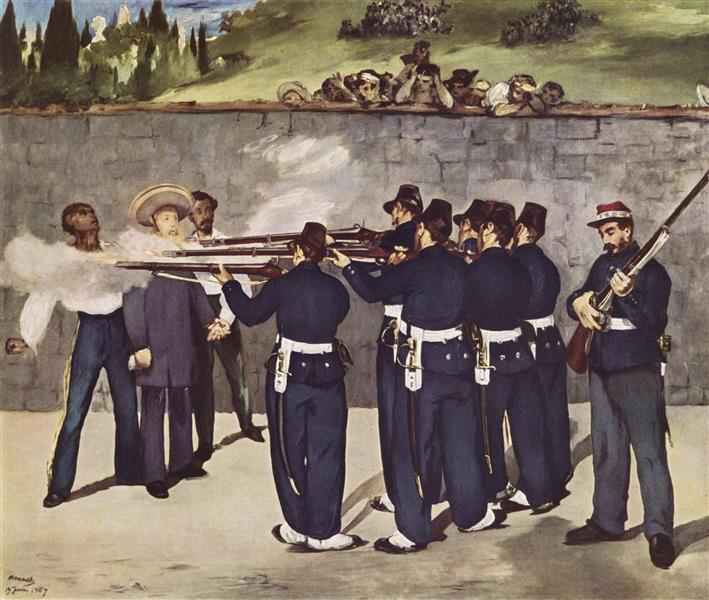
The painting "The execution of Emperor Maximiliano de México", created by Édouard Manet in 1868, is one of the most significant works of modern art, presenting a cross between historical representation and contemporary context. This work is part of the concerns that Manet had about the relationship between art, politics and morals, as well as his desire to break with the academic conventions that dominated the painting of his time. The work is inspired by the events that surrounded the execution of Emperor Maximiliano I of Mexico, an event that would resonate in the political conscience of Europe and America.
From the first glance, the composition determines a dramaturgical space loaded with tension. Manet chooses a disposition that does not follow the traditional sequential narrative of other representations of the same subject; Instead of an expanded scene that presents different characters in the execution, it is concentrated at a precise and heartbreaking moment. In the background you can distinguish a structure that suggests the presence of a firing squad, while Maximiliano, in the center of the composition, is in a position that radiates resignation. The figure of the emperor, with his visible white uniform, highlights in contrast to the darkest tones that surround the scene. This chromatic choice not only creates a visual focus, but also causes a sense of tragedy and isolation.
The use of color is essential to convey the emotion of the work. Manet applies a palette that oscillates between gray and neutral tones, with touches of light that accentuate certain areas, such as Maximilian's face, whose expression reflects a mixture of determination and hopelessness. The treatment of light is bold; You can see how the figure of the emperor stands out right at the moment he faces his destiny, suggesting the use of a chiaroscuro that evokes the masters of the Renaissance, but also the influence of impressionism that began to take shape.
The attention to the characters surrounding Maximiliano is captivating. The figure of the soldier who faces it is almost imposing, but lacks face, which dehumanizes the executor and, consequently, provides an air of anonymity to the violence that is being carried out. This enigma of the executing character is revealed as a violent criticism of the depersonalization of war and execution. Around it, other soldiers seem to be in a kind of lethargy, indifferent to the act that takes place.
In addition to its visual aspects, the work carries with it a deep political and social burden. Manet is interested in representing a historical fact that not only affected Mexico, but also involved Europe, thus connecting issues of imperialism and power. Manet's choice by choosing such a controversial issue for his time demonstrates his courage as an artist and his desire to cause dialogue on complex issues of justice and legitimacy in art.
In its historical context, this work is also registered within the production of Manet in a period in which it rebelled against academic norms. You can see a parallel with other contemporary works that addressed the theme of war and violence, such as "the executions of May Tres" by Goya. However, Manet achieves a more focused on the emotional immediacy of the moment, reducing drama in favor of a crude and less idealized representativeness.
"The execution of Emperor Maximiliano de México" transcends his status as a mere historical document to become an artistic reflection on morality, war and national identity. This bold approach, this choice of such a dark and at the same time deeply human subject, exhibits the role of art in society as a mirror of our most pressing concerns and dilemmas. Manet, with his unquestionable technical domain and his innovative vision, invites us to contemplate not only the image itself, but the implications and resonances that persist over time.
KUADROS ©, a famous paint on your wall.
Hand-made oil painting reproductions, with the quality of professional artists and the distinctive seal of KUADROS ©.
Reproduction service paintings With a guarantee of satisfaction. If you are not completely satisfied with the replica of your painting, we refund your money 100%.