

Description
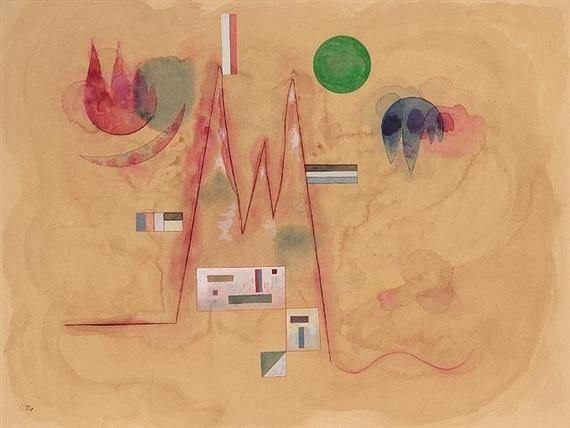
The painting presents an abstract composition spread across a lightly textured beige field, where a network of red lines cuts through the space in diagonals, peaks and sharp turns. Curved and pointed forms in red, blue and gray cluster along the upper band, alongside a vivid green circle that stands out as an isolated focal point. On the right, overlapping ovals and arcs in dark blue, violet, gray and pink create a denser mass of color. Small rectangles, squares and colored bars are distributed between the center and the lower area, like geometric markers accompanying the lines’ path.
As an abstract painting, Zigzag in Softness does not present a figurative narrative or a recognizable episode. Its content arises from the autonomous relationship between lines, shapes, color, rhythm and surface. The title offers a particularly fruitful way into the work: the zigzag describes the broken path that organizes much of the composition, while the softness emerges in the beige background, the translucent glazes and the organic contours that temper the energy of the red strokes. The composition thus belongs to a modern tradition that understands painting as a visual language independent of representation.
The red line functions as a rhythmic, directional axis. Its changes of course lead the eye from the upper area toward the center and then down to the lower edge, creating a sense of contained movement. Against this active structure, the green circle acts as a calm, concentrated counterpoint. The overlapping forms in the upper left and right add density, while the rectangular modules introduce brief pauses, almost like units of measure within a more fluid field. The tension between geometry and organic form turns each element into part of a visual conversation about order, impulse and balance.
The horizontal, asymmetrical composition keeps the eye from settling on a single focal point. The beige background opens up a subtle atmospheric depth, created through patches, transparencies, and variations in tone rather than traditional perspective. Across this surface, the red forms a precise, restless structure, while the blues, violets, pinks, and grays create groupings of varying visual weight. The green circle draws the eye through chromatic contrast, and the small bars of color modulate the rhythm with compact accents. The work thus alternates areas of greater intensity with zones of visual breathing space, making the surface seem to extend beyond its edges.
In the context of Wassily Kandinsky’s work, this painting can be viewed through a conception of abstraction in which lines, geometric shapes, and contrasting colors take on an expressive quality of their own. Here, that sensibility is expressed through the meeting of a highly dynamic linear construction and a delicate, almost suspended atmosphere. The result depends not on recognizing an object, but on following the correspondences between direction, color, and pause. Notice how the red zigzag animates the entire field and how, around it, the green circle, curved forms, and small color modules balance the tension with moments of lightness.
Have questions about our oil painting reproductions? See our frequently asked questions.