

Description
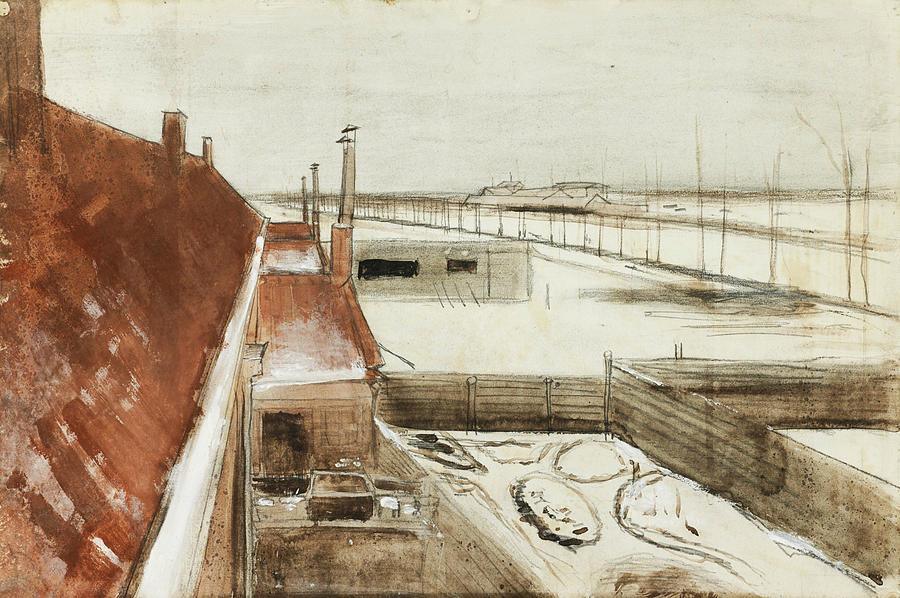
The painting shows an elevated view of urban and industrial rooftops, seen from Vincent’s studio in winter. A large, sloping reddish roof marked by variations in texture fills the left side, while a series of flat roofs, walls and parapets stretches across the center and right. Chimneys, ducts and small vertical structures break up the continuity of the surfaces, while several fences and railings divide the foreground into overlapping bands. Beyond them, low buildings extend to an open horizon beneath a broad, pale cream-colored sky. The scene needs no human figures to convey the city’s subdued activity: its traces are found in the structures, poles, wires and chimneys.
The subject belongs to the realm of the cityscape, understood not as a simple architectural depiction but as a close observation of an everyday setting. The elevated perspective makes the rooftops the true focus and suggests a view from a window toward the nearby buildings. Winter is evoked by the diffused light, clear sky and restrained palette of ochres, browns, grays and off-whites, without relying on explicit seasonal signs. Within Vincent van Gogh’s widely recognized interest in landscapes and ordinary surroundings, this view transforms an apparently humble area into a subject of intense visual organization.
The chimneys and flues serve as vertical accents within a panorama dominated by horizontal and sloping planes. Their presence reinforces the domestic and industrial character of the place and establishes an irregular rhythm that guides the eye from one roof to another. Fences, railings and parapets create successive divisions: they not only mark out spaces but also reveal the layered depth of the built environment. The large reddish roof can be read as a dominant mass that brings the city closer to the viewer, while the light-colored surfaces in the middle distance and on the horizon provide a visual pause. In this way, the everyday takes on an almost meditative quality, sustained by the silence and expansiveness of the sky.
The composition is structured around a strong contrast between the dark diagonal of the roof on the left and the horizontal lines crossing the center and right. This interplay of directions keeps the scene from feeling static: the diagonals lead into the distance, while the parapets and fences create rhythmic breaks in the foreground. The earthy palette unifies the variety of materials—tiles, brick, metal, stone and plaster—and the pale light softens their differences without erasing their textures. The carefully dispersed vertical elements balance the visual weight of the roofs and draw the eye upward to the sky. The result is a depth built up in layers, more geometric than panoramic, in which every roof forms part of the same spatial structure.
The work can be linked to Vincent van Gogh’s interest in depicting landscapes and everyday scenes through expressive color contrasts, linear rhythms, and close attention to the structure of the subject. Here, the pictorial tension arises from seemingly simple elements: a reddish roof, a network of fences, several chimneys, and a low horizon. It is worth noting how the city is arranged between solidity and openness, between the density of the nearby rooftops and the brightness of the sky. The view from the studio turns this urban fragment into an experience of contemplation: the architecture does not serve as a backdrop, but as a complete landscape whose geometry sustains the stillness of winter.
Have questions about our oil painting reproductions? See our frequently asked questions.