

Description
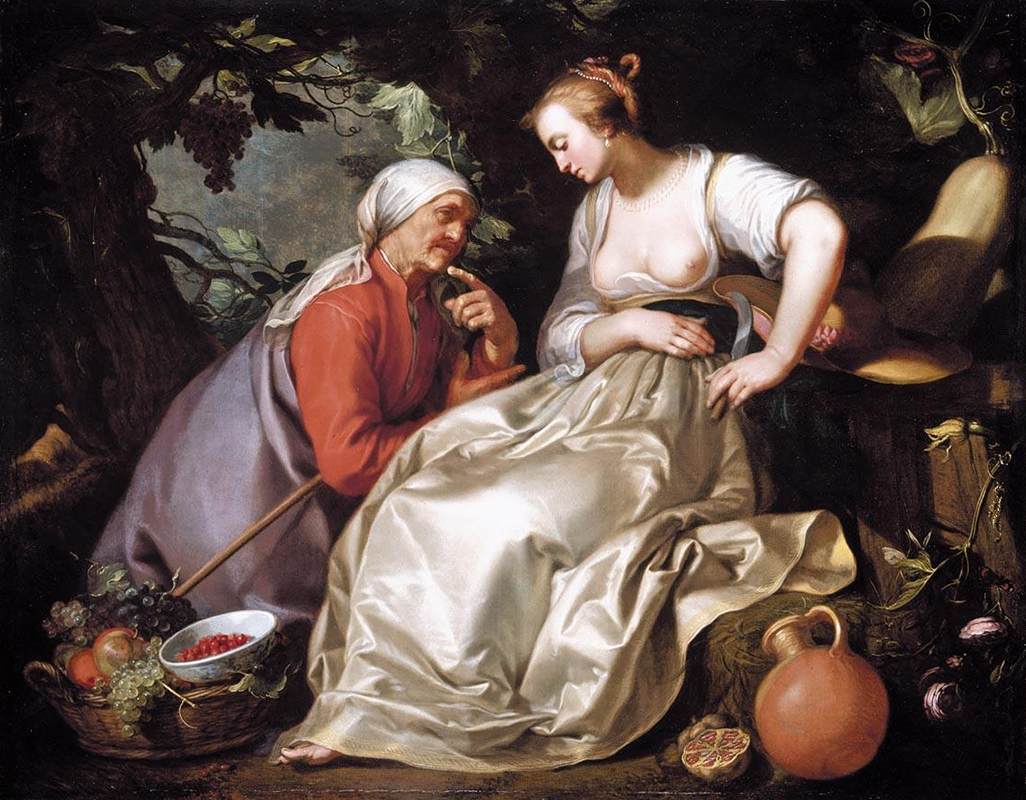
The painting depicts Vertumnus and Pomona in the heart of a wooded garden, as the protagonists of an intimate, carefully staged encounter. On the left, Vertumnus appears disguised as an old woman, wearing a white headscarf, a reddish blouse and a lilac skirt, and leaning towards the young woman. Pomona occupies the centre and right side of the composition: she wears a white blouse and a full, pale skirt, and gazes downwards in a contemplative pose. Around her is an array of fruit and objects associated with cultivation and harvesting: a basket of grapes and assorted fruit, a white bowl filled with small red berries, a terracotta ceramic jug and an opened pomegranate. The trunks and branches form a protective canopy, while an opening in the foliage offers a glimpse of the landscape in the background.
The scene is drawn from Ovid’s Metamorphoses . Pomona is the Roman goddess associated with fruit, fruit trees and gardens; her realm is embodied here in the abundance of vegetation surrounding her. Vertumnus, a god associated with change, the seasons and transformation, takes on the appearance of an old woman to approach her. The disguise explains why the two figures are depicted as women and focuses the narrative on the gesture of approach: the older figure leans towards Pomona, while the young woman seems to listen or remain absorbed in her thoughts. Love’s persuasion thus becomes the silent centre of the scene.
The fruits are not merely a decorative inventory. The grapes, the opened pomegranate and the basket make visible Pomona’s dominion over the fertility of the gardens and the cycles of nature’s ripening. The abundance brings together sensuality, fullness and promise, while the utensils and containers connect the myth to the tangible experience of harvesting and tending. The pomegranate, opened in the foreground, also introduces an intense note of color and texture. Opposite it, Vertumnus’s leaning posture creates a line of persuasion that cuts across the scene. The dense foliage serves as a refuge for this amorous exchange, setting it apart from the open space glimpsed in the background.
Bloemaert organizes the horizontal composition around a frame of dark, brown-toned foliage that draws the eye toward the figures. Pomona’s light-colored skirt forms the main area of brightness in the foreground and contrasts with the dark canopy, making the young woman the painting’s visual focal point. Brick reds, lilacs, olive greens, ochres and terracottas create a rich, warm palette, punctuated by the whites of the clothing, the bowl and a few highlights. The basket and pitcher balance the lower corners, while the branches and vines create an enveloping rhythm that guides the eye from the objects to the figures. Depth arises from the contrast between the densely rendered nearby vegetation and the atmospheric opening onto the landscape beyond.
The work is consistent with Abraham Bloemaert’s interest in mythological scenes, the elaborate construction of landscape, and the interplay of figures and nature through a rich, contrasting palette. In Vertumnus and Pomona, the narrative is inseparable from its setting: the god’s transformation, Pomona’s reserve, and the promise of union are integrated into a space where every fruit, branch, and vessel reinforces the narrative tension. Note how the light concentrated on the young woman and the objects in the foreground makes the garden’s abundance seem to prolong the encounter between the two characters. Nature is not a passive backdrop, but the visual language that turns desire and transformation into a palpable experience.
Have questions about our oil painting reproductions? See our frequently asked questions.