

Description
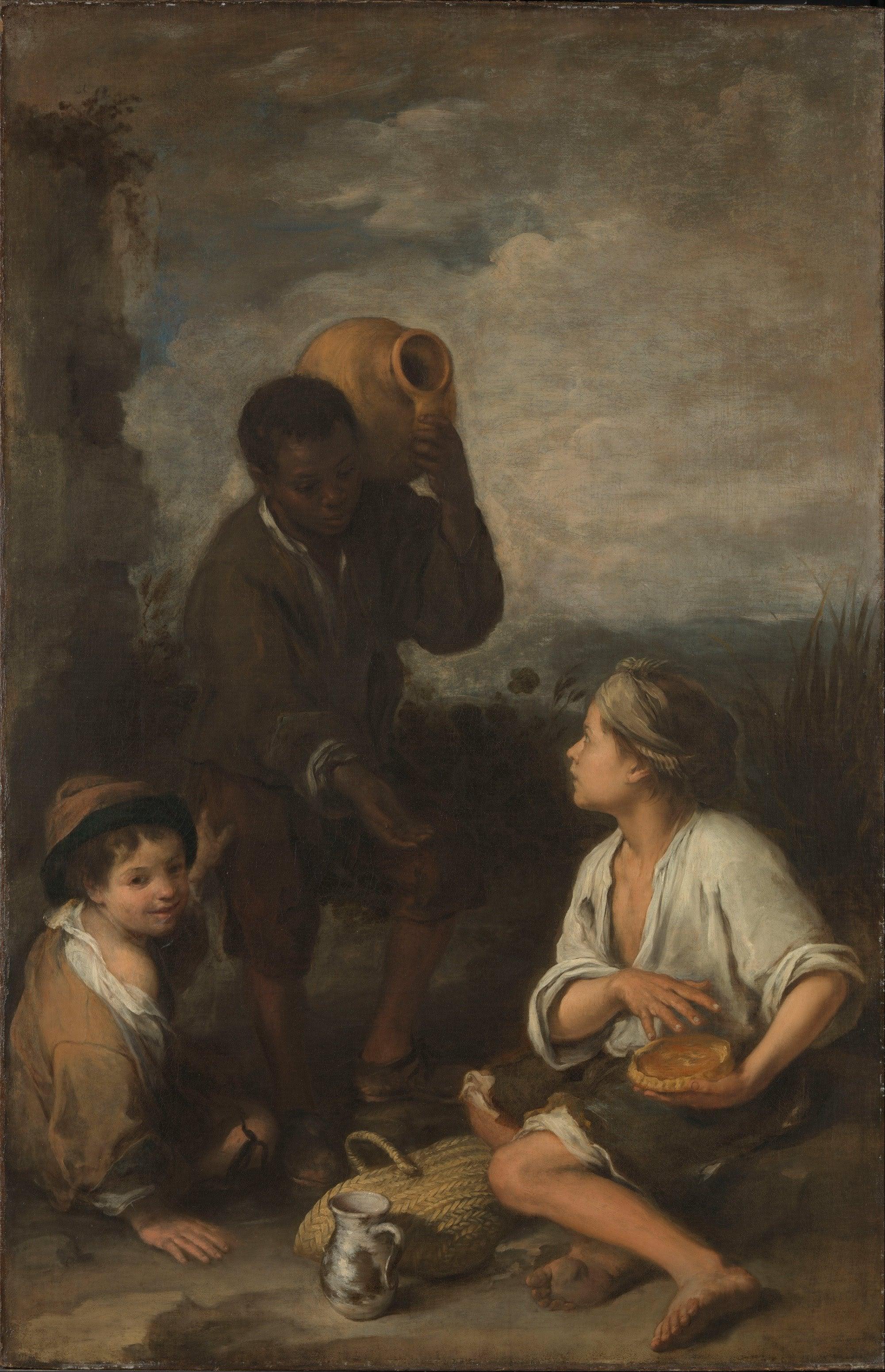
The painting depicts a gathering of humble figures in an open landscape, arranged around a central figure holding a large earthenware vessel above their head. Other figures are positioned around them: a boy seated in the lower-left corner, a woman in the foreground holding a circular, golden-toned object, and a person reclining on the ground, partly covered by a light-colored cloth. The woven basket and small metal jug occupy the foreground as everyday objects, while the overcast sky, dark vegetation and a vertical form resembling a wall or ruin enclose the space. The group seems to share a moment of pause, work and companionship.
Rather than recounting a specific historical or religious episode, Three Boys belongs to the tradition of genre painting: a form of art attentive to ordinary life and the presence of people of humble means. The work makes a simple activity—carrying, storing or distributing goods—the focus of a composition of great dignity. The figures do not appear isolated, but are connected by their physical closeness and by the objects passed among them. This concentration gives the scene an open-ended narrative quality, as if the viewer has arrived in the middle of an everyday moment that continues beyond the painting.
The large vessel balanced on the woman’s head introduces a powerful image of effort, balance, and practical work. Beside it, the basket and jug create a small material vocabulary of transport, sustenance, and exchange. The round object held by the woman provides a warm, domestic focal point against the starkness of the landscape. The relationship between these utensils and the figures gives humble objects a central visual importance: they are not accessories, but the elements that shape the group’s activity. The light-colored cloth over the reclining figure and the raised gesture of the person carrying the vessel add pauses and contrasts to a scene dominated by austerity.
Murillo organizes the composition around a vertical axis defined by the central figure and the vessel, silhouetted against the sky and drawing the eye first. The boy on the left balances this axis from a low, shadowed area, while the woman on the right introduces a light-toned mass and a golden accent in the foreground. The basket and jug serve as spatial anchors: they bring the scene closer to the viewer and reinforce its depth. The palette of browns, ochres, bluish grays, and muted greens unifies the figures and landscape; against it, the whites of the clothing and metallic reflections produce subtle glints. The diffuse light, filtered through the clouds, avoids stark contrasts and models the bodies with a solemn softness.
In this widely recognized facet of Bartolomé Esteban Murillo’s work, the naturalistic observation of humble figures is combined with atmospheric light and an earthy palette of meditative tones. The painting needs no dramatic action to hold our attention: its strength comes from the group’s human depth, the tangible weight of the objects, and the relationship between the foreground and the open horizon. Notice how the vessel lifts the gaze toward the sky, while the basket and jug draw it back to the ground; between these two movements, the figures transform an everyday scene into an image of poetic solemnity.
Have questions about our oil painting reproductions? See our frequently asked questions.