

Description
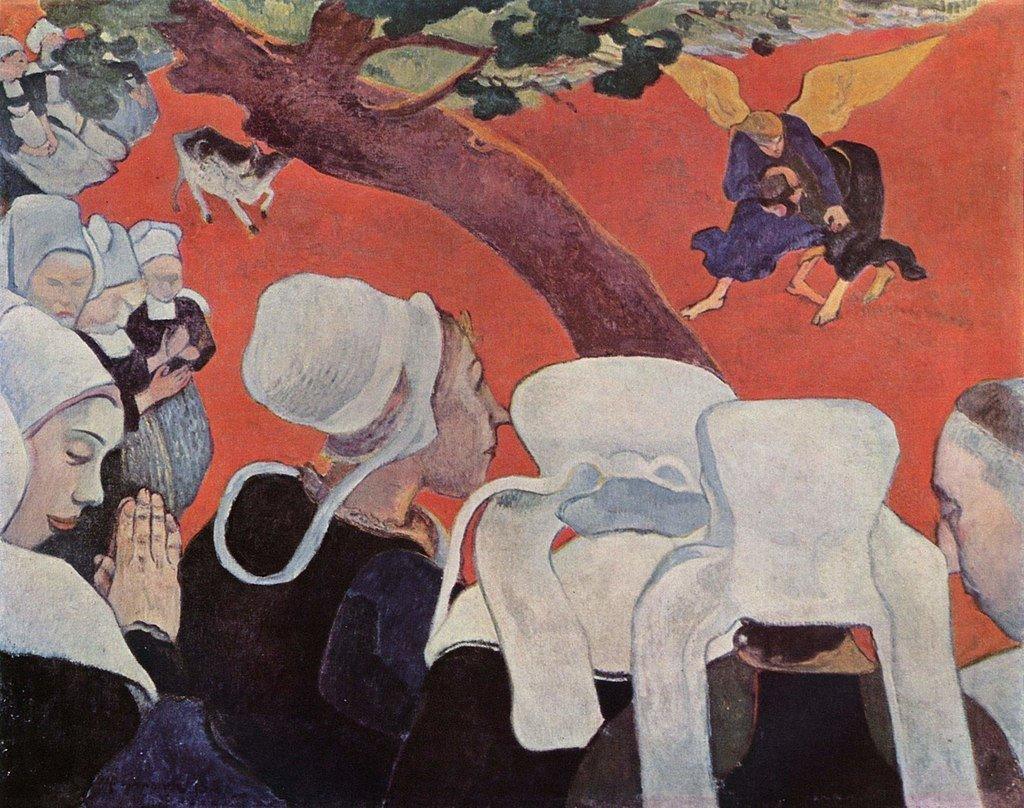
The painting shows a group of women gathered in prayer and contemplation, kneeling or bending forward in a densely populated foreground. The figures overlap one another: some clasp their hands before their faces, others bow their heads, and a large white garment occupies the center as a dominant form. A dark, twisted, branching tree limb stretches above them, while in the upper right a figure dressed in blue sits or kneels, accompanied by figurative forms that condense the visionary scene. The orange-red field envelops the entire composition, transforming the gathering into an intense experience suspended between landscape and imagination. In this work by Paul Gauguin, the community listening and contemplating carries as much weight as the biblical episode unfolding before them.
The scene depicts a group of Breton women after hearing a sermon, as they imagine the episode of Jacob wrestling with the angel. The story comes from Genesis and portrays Jacob confronting a celestial figure in a struggle traditionally associated with spiritual trial, transformation, and perseverance. Gauguin does not present this story as a conventional narrative illustration, with a clear separation between spectators and protagonists. The vision arises within the women’s collective experience: their concentration, their composed gestures, and the direction of their bodies make visible an inward response to the religious word. The sermon thus serves as the starting point for a shared mental image.
The clasped hands, bowed heads, and closeness of the figures reinforce an interpretation of prayer, devout listening, and contemplation. The dark branch running across the composition acts as a visual threshold between the community and the imagined vision, while also dividing the space along a powerful diagonal. At the top, the grouping of figures condenses the confrontation between Jacob and the angel without turning it into a descriptive combat scene. The absolute red of the background heightens the emotional and symbolic character of the episode: it is not a naturalistic ground, but a mental space that separates religious experience from everyday appearances. The relationship between the nearby figures and the distant vision transforms the landscape into a representation of collective consciousness.
The horizontal composition is organized around stark contrasts. The women’s white and cream garments stand out against the red, while black, violet, and blue cloaks introduce dark interruptions that give rhythm to the group. The foreground figures form a compact, tiered mass; their inclinations lead the eye upward, toward the branch and the blue figure. The branch creates a diagonal line that traverses and structures the pictorial field, preventing the red surface from being perceived as a passive background. The green foliage along the upper strip adds a note of depth, although the scene retains a pronounced flatness. The defined contours, simplified forms, and opposition between areas of color make each silhouette function as a sign rather than as a detailed optical study.
The work exemplifies traits widely associated with Paul Gauguin and Synthetism: intense, non-naturalistic fields of color, simplified forms, firm outlines, and a symbolic composition that gives priority to inner experience. The painting does not lead the eye toward a realistic reconstruction of the landscape, but toward the connection between those who listen, the image they imagine, and the spiritual drama contained within that image. Notice how the white robes visually bring the women together, while the red separates them from the everyday world and the branch opens up the space of the vision. The power of Vision After the Sermon: a scene of devotion transformed into a mental image, in which the form itself makes visible the passage from listening to revelation.
Have questions about our oil painting reproductions? See our frequently asked questions.