

Description
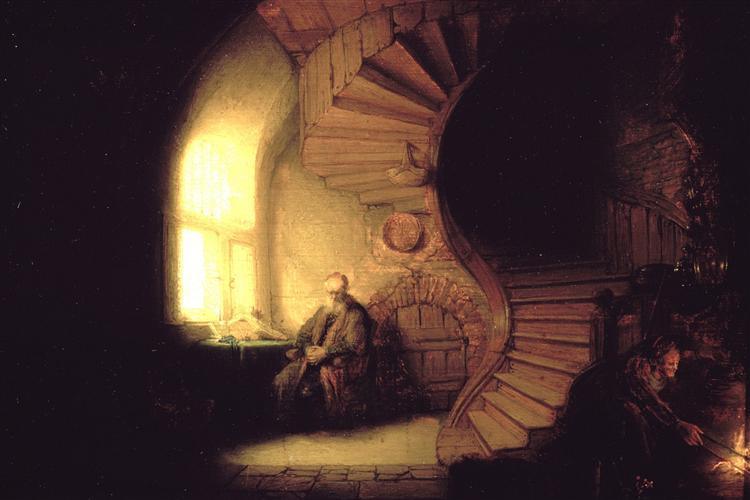
The painting shows a philosopher absorbed in thought inside the austere interior of an old building. The central figure, seated or leaning beside a large wooden barrel, commands attention with clasped hands and dark clothing. On the right, another figure crouches beneath the staircase, partly lost in the gloom. The masonry walls, beams and floor of planks or stone slabs create a humble, enclosed and tangible space. A tall window breaks into the left side with intense brightness, while a small warm light accents the lower right corner.
Philosopher in Meditation belongs to a visual tradition that links thought with retreat, study and inner life. The scene does not present reflection as a grandiose activity, but as a quiet state within an austere domestic setting. The enclosed architecture separates the figure from the outside world and turns the room into a space for concentration. In this setting, the central figure embodies the withdrawn thinker, absorbed in an intellectual experience expressed through bodily stillness and restrained gestures.
Everyday objects thus take on a symbolic dimension. The barrel, wood and stone underscore the material simplicity of the retreat, while the staircase introduces an image of ascent and passage within a space that is essentially still. The luminous window creates a tension between the radiant exterior and the philosopher’s shadowy interiority. This contrast establishes a divide between the visible world and mental life, between the light arriving from outside and the concentrated attention unfolding in silence. The second figure reinforces the human scale and intimacy of the scene without displacing its contemplative center.
Formally, the composition is structured around a large, curved diagonal. The staircase rises from the foreground and turns toward the upper part of the scene, guiding the eye along the steps, beams, and wooden surfaces. In contrast to this movement, the central figure serves as a point of stillness. The bright rectangle of the window balances the dark mass on the right and outlines the architectural profiles in an almost theatrical light. Charcoal blacks, deep browns, ochres, and ambers create a warm, restrained palette; golden reflections on the stone and wood ensure that the gloom retains volume and depth.
In this work by Rembrandt, chiaroscuro is not merely a means of modeling forms: it shapes the psychological experience of the scene. The selective lighting focuses attention on the absorbed figure, allowing the rest of the interior to emerge gradually from the shadows. This interest in warm atmospheres and in creating inner states through lighting is one of the most recognizable features of the artist’s style. When viewing the painting, it is worth following the path from the window to the staircase, and from the staircase to the philosopher: along this route, architecture, light, and silence transform a humble space into an image of concentration.
Have questions about our oil painting reproductions? See our frequently asked questions.