

Description
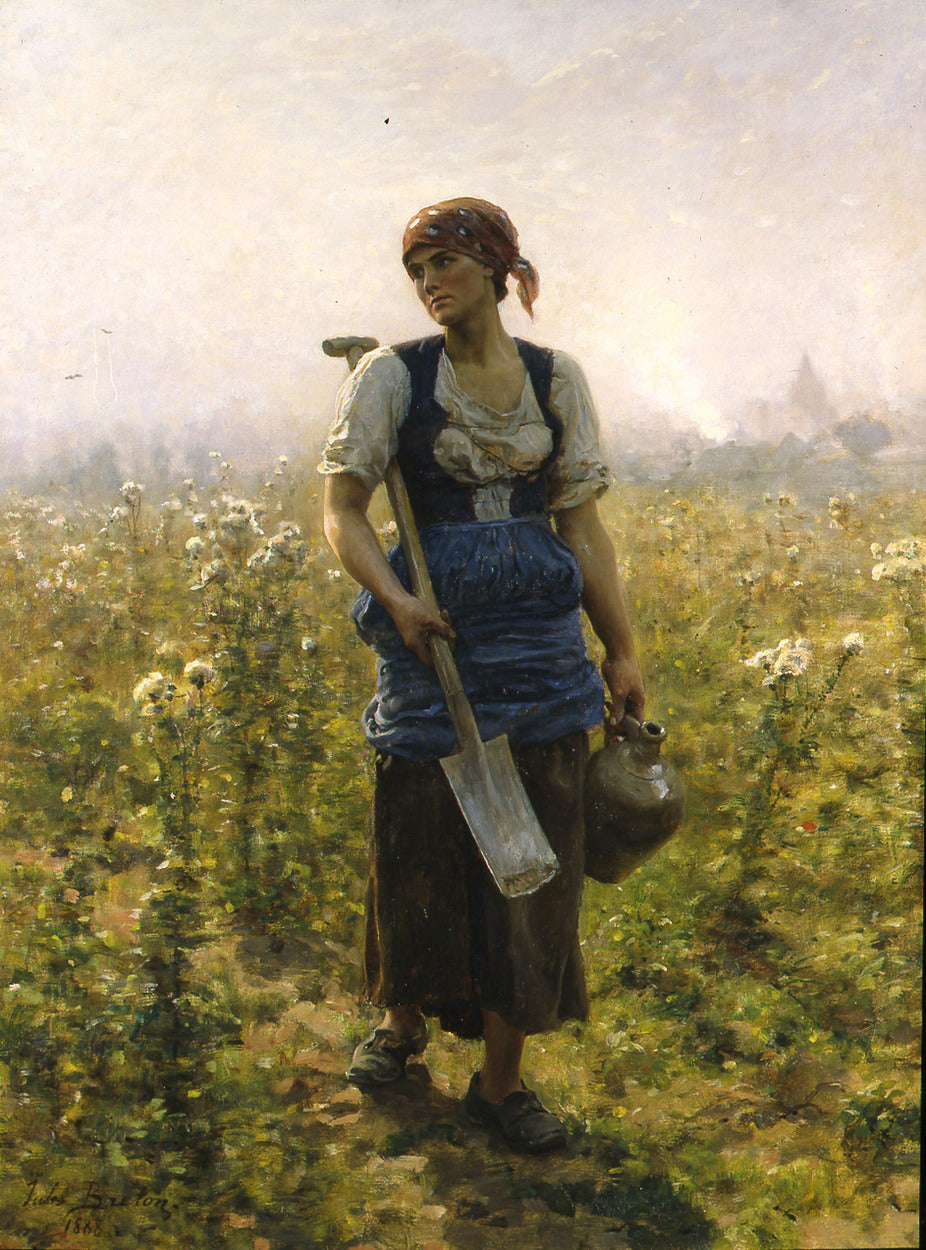
The painting shows a peasant woman standing in the middle of a field covered with small white flowers. Her figure occupies the center and stands out clearly against a broad, luminous sky veiled in mist. She wears a reddish headscarf, a light blouse with puffed sleeves, a blue bodice or apron, and a long, dark skirt. In one hand, she holds a long-handled spade, angled diagonally toward the ground; beside her other hand rests a dark vessel with a side handle. The path opening beneath her feet connects her directly to the land she is working, while the horizon of indistinct vegetation extends the scene into a tranquil rural landscape.
In The Morning, Jules Breton presents a scene of outdoor farm labor in the calm light of the start of the day. This is not an action portrayed dramatically, but a moment of pause and presence: the woman stands upright, her head turned to one side, as if she has just stopped between one task and another. The spade and vessel place the experience in the tangible realm of fieldwork, while the expanse of sky and the delicacy of the landscape elevate this everyday activity into a contemplative image. The woman does not appear separate from her surroundings; she is part of a balance between body, earth, vegetation, and light.
The tools serve as signs of a life bound to manual labor. The shovel introduces a firm, practical line into a composition dominated by the softness of the flowers and the atmosphere; the vessel, more compact and rounded, provides a visual counterpoint on the other side of her body. The flower-filled field softens the harshness of the work and turns the ground into a place of fertility, continuity, and rootedness. The figure, dressed in distinctly recognizable peasant clothing, embodies a quiet dignity: she needs no grand gesture to command attention. The morning light envelops these elements in a sense of calm, as though the start of the day momentarily suspended the rhythm of work.
The formal composition guides the eye from the clear sky to the figure and then along the diagonal of the shovel to the foreground. This line organizes the space and keeps the central frontal pose from seeming static. The cream, light gray, and pink tones of the sky contrast with the olive and yellowish greens of the field, while the dark blue of the bodice and skirt concentrates the color weight in the lower center. White flowers create a delicate, repeated rhythm around the protagonist, integrating her into the surface of the ground. In the background, masses of vegetation dissolve into hazy brushstrokes, so that depth arises more from atmosphere than from clearly defined contours. The result is an open, quiet, and spacious scene.
The work is associated with the naturalistic sensibility for which Jules Breton is widely recognized: scenes of peasants and rural workers in which the human figure retains its presence within a landscape attuned to atmospheric light. In this painting, that perspective transforms an ordinary task into an image of quiet contemplation. Note how the woman’s upright posture, the diagonal of the tool, and the diffuse glow on the horizon support one another. The painting does not separate work from beauty: it brings agricultural labor, the flower-filled countryside, and the brightness of morning together in a single visual experience, quiet and deeply rooted.
Have questions about our oil painting reproductions? See our frequently asked questions.