

Description
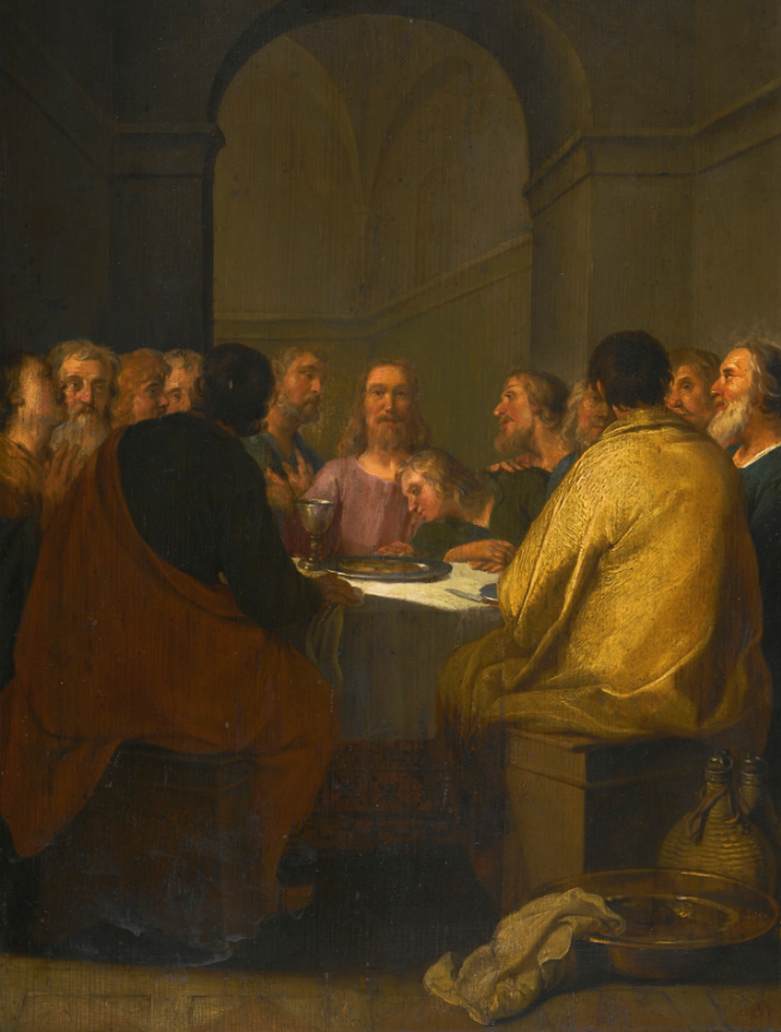
The painting shows Christ and his disciples gathered around a table in a striking architectural interior. The central figure, bearded and dressed in shades of pink and violet, occupies the composition’s central axis and draws attention to the heart of the gathering. Numerous men are grouped around him, some in profile, others leaning toward the table, and two with their backs to the viewer in the foreground, their dark and gold garments serving as a visual frame. On the light-colored tablecloth are a metal cup or chalice and a platter of food; on the floor, a jug, a round dish, and a fallen cloth extend the activity at the table into the viewer’s space. The arch in the background and the pilasters at the sides make the gathering a monumental scene.
The Last Supper depicts Jesus’s final meal with his disciples before his arrest and crucifixion. In Christian tradition, the episode brings together farewell, announcement, and foreboding: during the meal, Jesus revealed that one of those present would betray him. The table is also associated with the institution of the Eucharist, linked to bread and wine. Bloemaert does not present the story as an isolated moment, but as a gathering charged with conversation and anticipation. The figures’ varied poses suggest that the news disrupts the apparent harmony and turns the banquet into a moment of shared tension.
The visible objects support this iconographic reading without separating it from the scene’s tangible reality. The cup embodies the sacramental significance of the wine, while the plate and the covered table recall that the episode begins with a shared meal. Christ’s frontal position establishes him as the spiritual and compositional center, even as the group retains a striking diversity of reactions. The disciples draw closer, turn away, or partially conceal themselves behind one another; this interplay of gazes and profiles transforms the biblical narrative into a choral drama. The figures seen from behind, especially the golden silhouette on the right, lead the eye toward Christ and emphasize the distance between the viewer and the event.
The vertical composition is densely arranged yet remains easy to read, thanks to its central axis and the architectural arch in the background. Browns, blacks, and ochres envelop the scene, while golds, reds, and pinks highlight faces, garments, and objects. Warm light is concentrated on the table and the central figures, creating a visual path that leads from the vessels in the foreground toward the group of disciples. The fabrics and metals create contrasts in texture: the light-colored cloth softens the surface of the table, while the vessels on the floor introduce reflections and depth. The architecture stabilizes the composition, while the overlapping bodies maintain a rhythm of conversation and restrained movement.
In this work, Abraham Bloemaert combines the complexity of his religious compositions with rich colouring and a theatricality poised between Mannerism and the early Baroque. The scene gains force from the contrast between the enveloping darkness and the luminous accents of the table, the garments and the faces. The result is a Last Supper conceived as a solemn theatre of glances, objects and omens. It is worth observing how each foreground element—the cup, the dish, the fabric and the figures seen from behind—contributes to the composition’s focal point: our attention returns again and again to Christ, while the group around him transforms the silence before the Passion into visible tension.
Have questions about our oil painting reproductions? See our frequently asked questions.