

Description
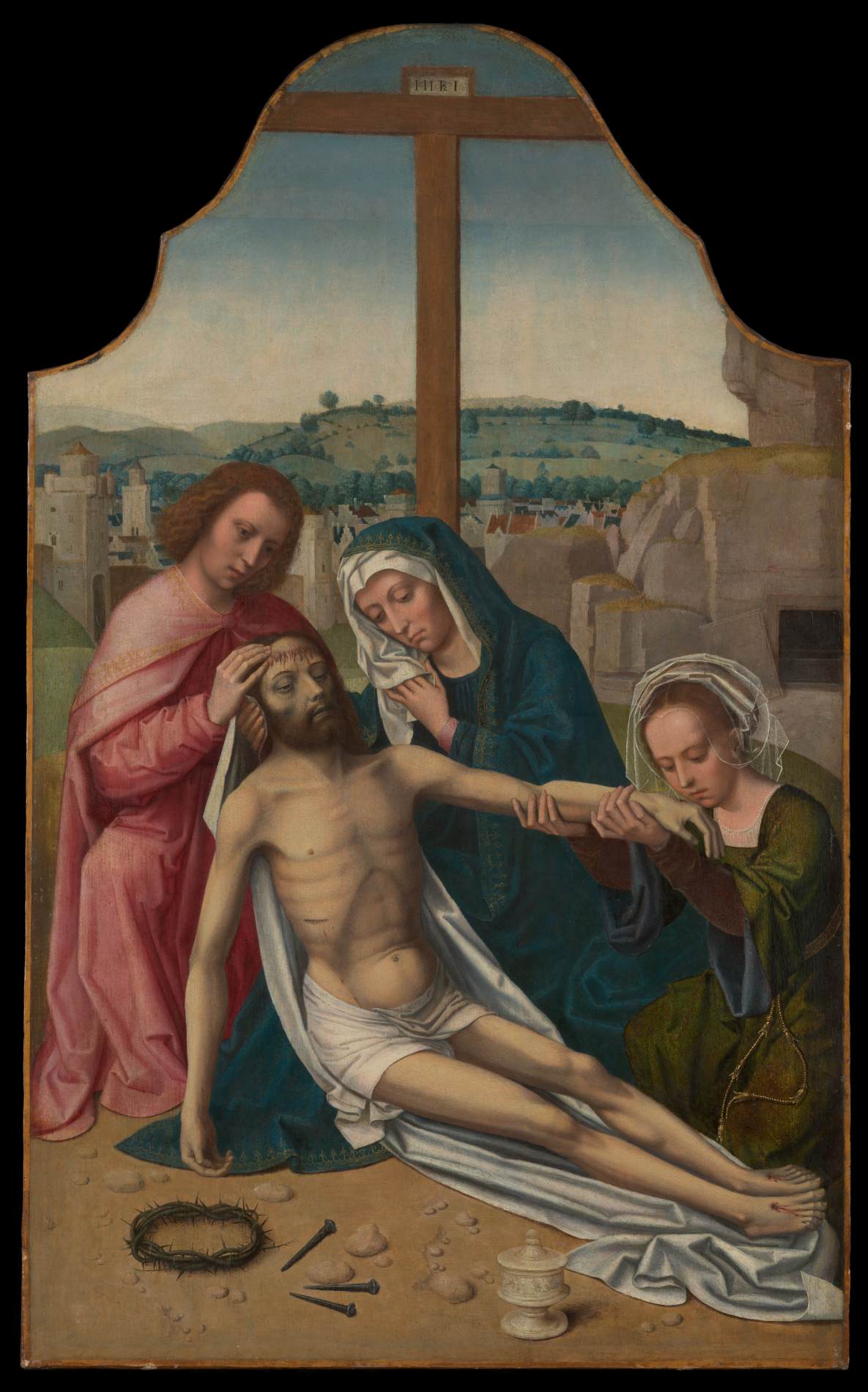
The painting depicts The Lamentation as a scene of mourning centred on the body of Christ. In the centre of the foreground, the half-naked, bearded man crowned with thorns appears seated or reclining on a broad white cloth, supported by three clothed figures. A woman in a pink tunic cradles his head; behind her, another figure, veiled in a light-coloured cloth and wearing a blue-green cloak, supports his torso and one of his arms; to the right, a third figure in a green dress tends to his hand and forearm. A large wooden cross rises behind the group, while the background opens onto a walled city, green hills and a pale sky. On the rocky ground in the foreground lie the crown of thorns, several nails and a small vessel, objects that extend the story of the Passion beyond the figures.
The scene depicts the moment after Christ was taken down from the cross, when those close to him gather around and support his body before the burial. The Lamentation belongs to the narrative core of the Passion of Christ and centres its power on mourning, physical contact and contemplation of the sacrifice. The cross remains behind the figures as an immediate reminder of the torment, while the body’s horizontal pose introduces a solemn pause between death and the funeral rite. The white cloth reinforces this transition: it serves both as a visible support for the body and as an allusion to the passage towards burial. The landscape and city place the event in a recognisable world, although the serenity of the horizon contrasts with the emotional intensity of the foreground.
The Instruments of the Passion take on an almost tangible presence here. The crown of thorns and the nails, separated from the body and placed on the ground, appear as material traces of the Crucifixion. The plaque above the cross completes the symbolic axis that identifies the episode, without competing with the figures’ silent expressions. Their gestures of supporting, leaning over and accompanying Christ create a network of care around him: the lamentation is expressed not through dramatic action, but through the closeness of their hands and the shared weight of his body. The contrast between these restrained gestures and the serene expansiveness of the landscape turns grief into a meditative experience, inviting contemplation.
The composition is clearly organized around the cross’s vertical post. This axis divides and structures the background, while the human group forms a denser, diagonal mass in the lower area. Christ’s body introduces a horizontal line that balances the cross’s verticality and leads the eye toward the cloth, the nails and the stones on the ground. The blue-green, olive green, muted pink, brown and ochre hues shape the garments and landscape in a restrained palette, punctuated by the ivory white of the fabric and some of the veils. The soft light of the sky and the meticulous definition of faces, hands, hair and folds encourage a leisurely reading. Depth is created through the succession of terrain, figures, city and hills, allowing the narrative to unfold without losing its center.
In this work attributed to Ambrosius Benson, devotional intensity arises from the union of geometric order and human contact. The cross draws the eye upward, the landscape carries it into the distance, and Christ’s body brings it back to the foreground, where every object contributes to the memory of the sacrifice. It is worth noting in particular how the hands of the three figures form a protective circle around the body, while the nails and the crown disturb the calm of the earth. This tension between care and violence, between the serene horizon and immediate grief, sustains the visual power of The Lamentation.
Have questions about our oil painting reproductions? See our frequently asked questions.