

Description
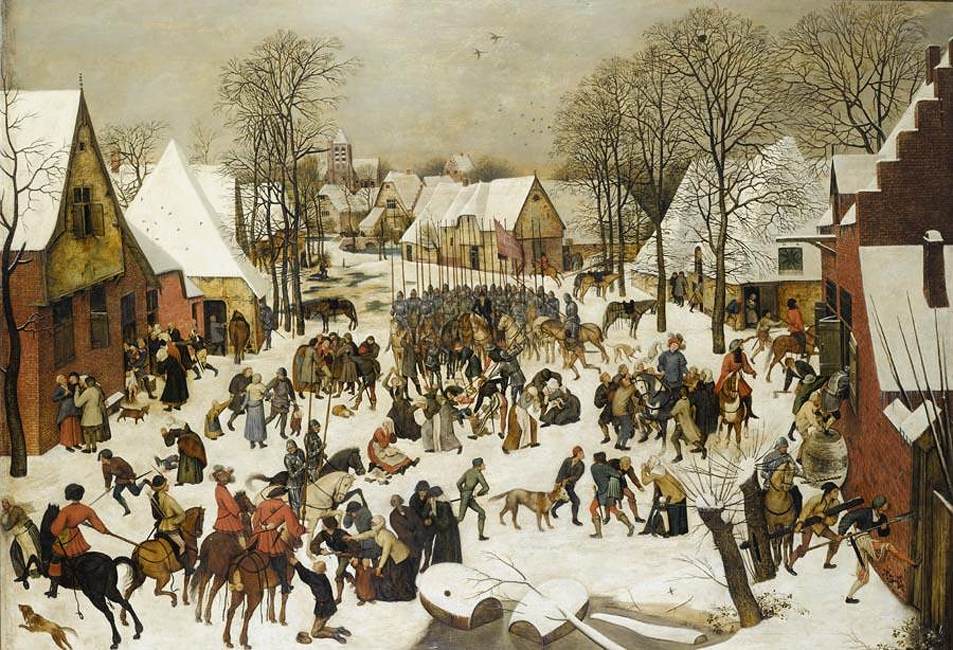
The Massacre of the Innocents is presented as a sweeping winter village scene. Snow-covered country houses and brick buildings surround an expanse of ice dotted with villagers. Figures walk, skate, converse and ride horses, while various animals accompany the activity: saddled or draft horses, dogs and small birds in the sky. On the left, a narrow tower rises behind the bare trees; on the right, the buildings and activity gathered beside them extend the scene to the edges. The composition does not focus on a single protagonist, but rather on a network of groups that turns the entire village into a narrative setting.
The title refers to the episode from Christ’s childhood in which Herod orders the deaths of the male children of Bethlehem, fearing the arrival of the prophesied king. Christian tradition honors these victims as the Holy Innocents and commemorates the episode in its liturgical calendar. Here, the biblical subject is set within a densely populated settlement, where the architecture, animals and movements of people create a collective narrative. The gravity of the story contrasts with the activity visible in the landscape: the ice serves as a place of passage and encounter, and community life extends across the entire snow-covered expanse.
The contrast between the everyday and the tragic dimension associated with the title accounts for much of the work’s iconographic power. The crowd and horsemen suggest an event affecting the entire community, while the scattered figures invite the viewer to examine the scene closely. The horses, dogs, and means of transport introduce rhythms of movement and concrete references to the village’s material life. Snow and leafless trees envelop these details in a sober atmosphere, heightening by contrast the gravity of the biblical episode. The settlement’s broad expanse turns sacred history into a collective experience, unfolding among houses, roads, and icy surfaces.
The panoramic composition guides the eye from the groups in the foreground to the open center and then to the houses and tower in the distance. The diagonals formed by the horses, tracks across the ice, and rows of trees create depth without disrupting the density of the painted surface. The palette of whites, grays, earth tones, muted greens, and dark reds produces a cold, even light in which each figure stands out through its silhouette and clothing. The alternation between open spaces and clusters of people creates a visual rhythm resembling a narrative composed of multiple simultaneous episodes.
The work reflects Pieter Brueghel the Younger’s interest in densely populated narrative compositions, scenes of village life, and close observation of groups of people, animals, and landscapes. Its power does not depend on a single action, but on an accumulation of details that transforms a snow-covered village into a historical and spiritual setting. The tower, trees, and façades frame the central movement, while each small group extends the narrative beyond any individual figure. Thus, the everyday expansiveness of the village and the gravity of The Massacre of the Innocents remain bound together in a single visual composition, inviting viewers to discover the narrative through a leisurely journey across the painted surface.
Have questions about our oil painting reproductions? See our frequently asked questions.