

Description
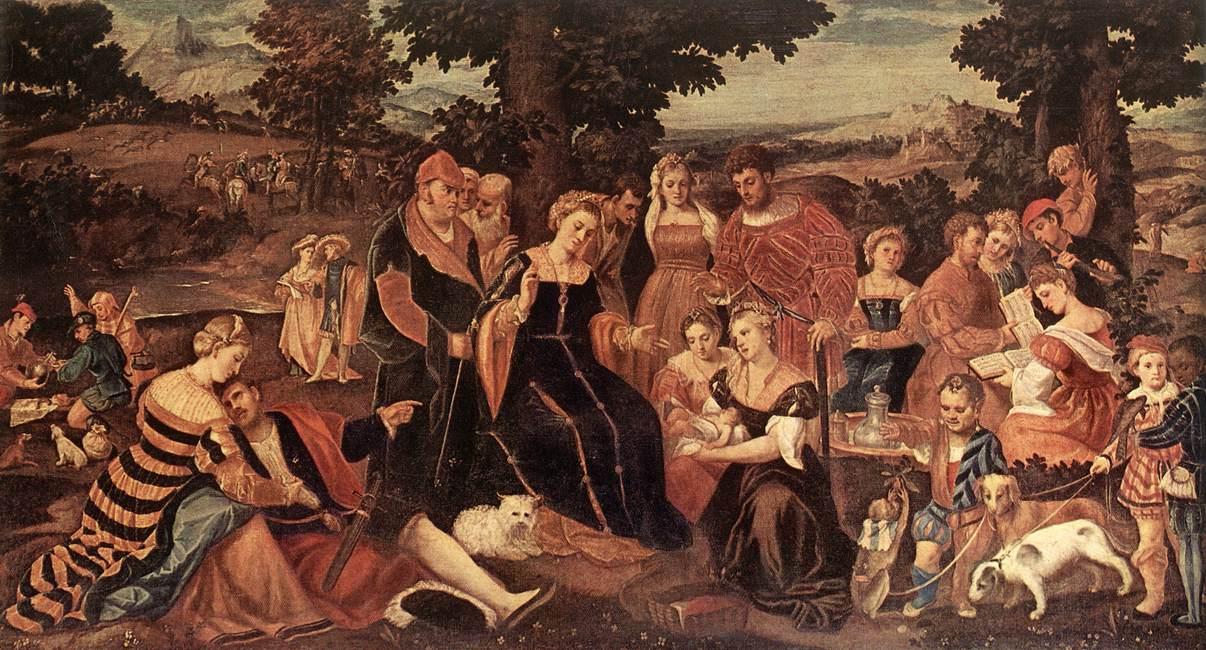
The painting presents The Finding of Moses as a spacious, densely populated pastoral scene. At the center, a seated woman in a dark dress and necklace draws the eye, surrounded by men and women dressed in cloaks, headdresses, and ornate costumes. Conversations, reading, tasks, and encounters unfold around her: one figure holds an open book, while others gather beside a low table with vessels, goblets, and food; in the background, several figures congregate near horses. A light-colored dog remains beneath the central group, and a pig rests in the right foreground. Trees at either side frame hills, paths, and distant buildings, turning the episode into an inhabited, theatrical landscape.
The subject comes from the Book of Exodus. To save the child from the persecution of newborn Hebrew boys, Moses was placed in a basket and set adrift on the Nile; the pharaoh’s daughter found him and took him under her protection. The work transforms this central narrative into a spacious scene of encounter, in which the central female figure may be read as the pharaoh’s daughter and those surrounding her as attendants and witnesses. Rather than isolating the protagonists, the composition expands the episode into a social vision in which the biblical event coexists with everyday life, animals, and landscape.
The iconography is structured around the gathering and the act of recognition. The central woman’s prominent position, dark clothing, and necklace give her a visual authority that organizes the surrounding groups. The open books introduce an element of reading and learning, while the vessels, food, and textiles bring the sacred narrative closer to the lived experience of a community. The domestic animals lend the scene a familiar, earthly scale; they are not mere accessories, but elements that make the world in which the story unfolds more tangible. The hills and architecture on the horizon extend the meaning of the episode, opening the scene onto a landscape far broader than the immediate encounter.
The horizontal format allows the action to unfold as a sequence of connected focal points. The greatest concentration of figures occupies the central and lower areas, while the tree crowns form a dark canopy that draws the eye toward the bright landscape in the background. The palette of browns, olive greens, ochres, earthy reds, and creams unifies the different groups and sets off the light-colored garments, reddish headdresses, and book pages. The figures overlap at varying scales: the foreground presents nearby objects and animals, the center brings together the main narrative, and the left slope creates depth through horses and tiny figures. The alternating rhythm of poses, fabrics, and gestures prevents rigidity and turns the gaze into a continuous journey.
In Bonifacio Veronese’s work, this composition is associated with 16th-century Venetian painting: color, sumptuous clothing and densely populated biblical compositions come together with a landscape that serves a narrative purpose. The work does not reduce the episode to an isolated scene, but presents it as an event surrounded by relationships, activities and everyday nuances. When viewing it, it is worth following the path from the central woman toward the books, the table, the animals and the distant groups: this movement reveals how the story of Moses becomes a collective vision, in which the central figure remains at the heart of the scene while the whole world seems to take part in the discovery.
Have questions about our oil painting reproductions? See our frequently asked questions.