

Description
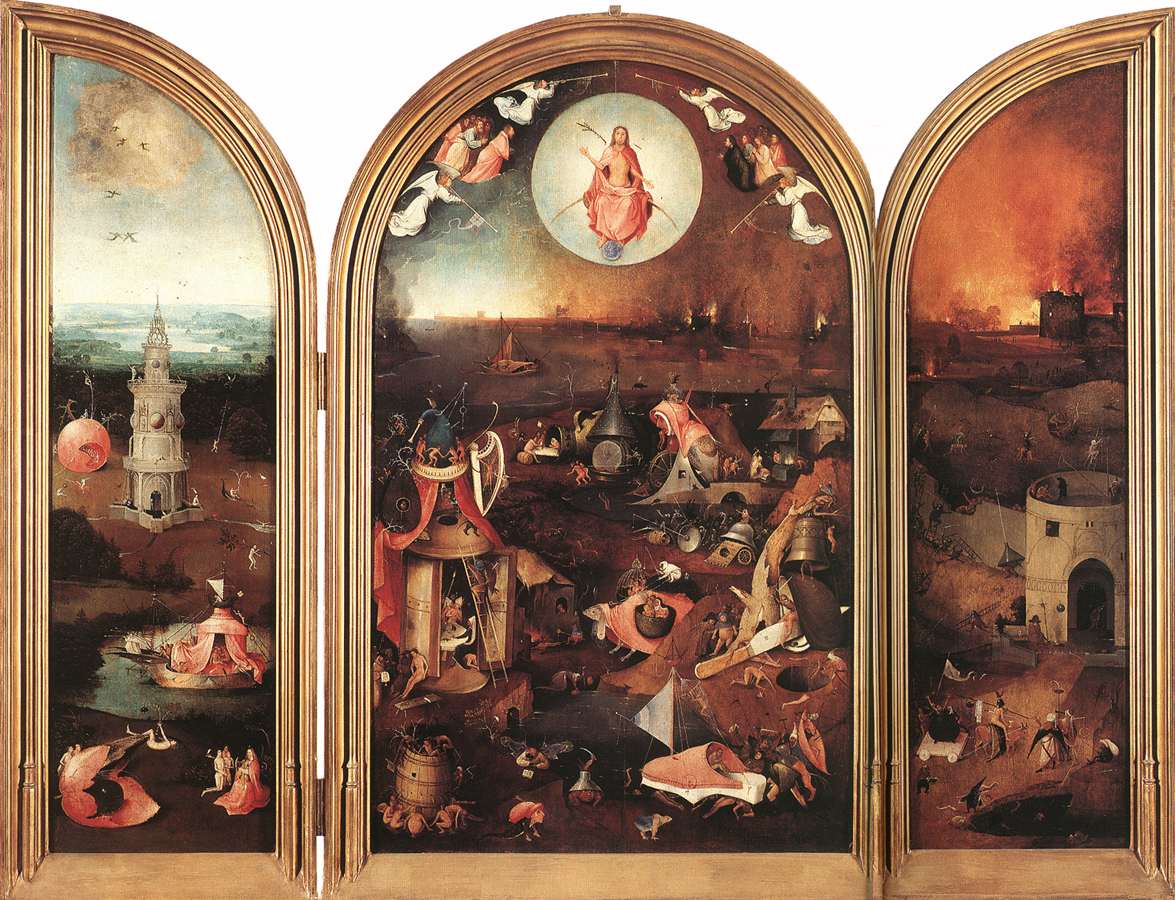
The painting depicts The Last Judgment as an overwhelming and meticulous vision of human destiny. The triptych is arranged in three vertical panels topped with golden arches. At the top of the central panel, Christ as judge appears within a large luminous circle, accompanied by winged beings dressed in light colors. Beneath this celestial sphere stretches a dark, reddish landscape, densely populated with human figures, fantastical creatures, boats, vessels, wheels, mechanisms and unusual structures. The side panels expand the scene with towers, fortified buildings, waters, vegetation, groups of people and small birds crossing the sky.
The subject belongs to the core of Christian eschatology: the moment of humanity’s final judgment, when the ultimate consequences of human actions become visible. Christ’s elevated position establishes a clear hierarchy between the celestial realm and the earthly world, depicted below as a territory subject to disorder, threat and destruction. The winged beings surrounding him introduce a sense of assistance and solemnity, while the multitude spread across the landscape turns the religious episode into a collective scene. This is not an intimate event, but a revelation encompassing bodies, cities, animals and objects.
The iconography gains force through accumulation. The hybrid creatures and scattered animals intensify the sense of a morally distorted world; the vessels, wheels, and contraptions turn everyday life into a strange, almost theatrical repertory. The reddish landscape, dark masses, and isolated structures evoke punishment, devastation, and a loss of stability. Against this lower world, the luminous circle serves as a center of order and authority. The opposition between light and darkness, height and depth, celestial stillness and earthly movement shapes an interpretation in which every scene seems to take part in the same eschatological reckoning.
In formal terms, the composition guides the eye from the broad central panel to the side panels and back to the upper focal point. The vertical lines of the towers, buildings, and golden frames contrast with the horizontally extended terrain, while the arches repeat an encompassing shape that unifies the three compartments. The palette of browns, blacks, earthy reds, muted greens, and ochres creates a dense surface, interrupted only slightly by the white garments and the central luminosity. The figures’ uneven scale creates depth and compels the viewer to look in layers: first at the celestial figure, then at the crowd, and finally at the small episodes that populate the landscape.
In this work by Hieronymus Bosch, fantastical imagination is combined with a religious narrative of great visual intensity. The profusion of creatures, simultaneous scenes, and complex architecture recalls the visual language associated with Bosch: meticulous, unsettling drawing that transforms Christian morality into a universe full of visual enigmas. The triptych should be viewed as a whole, but also as the sum of its details: the true tension arises from perceiving how each strange object, each human group, and each structure is subordinated to the luminous circle at the top. There, between the celestial order and the chaos of the earth, the painting turns judgment into a panoramic, theatrical experience.
Have questions about our oil painting reproductions? See our frequently asked questions.