

Description
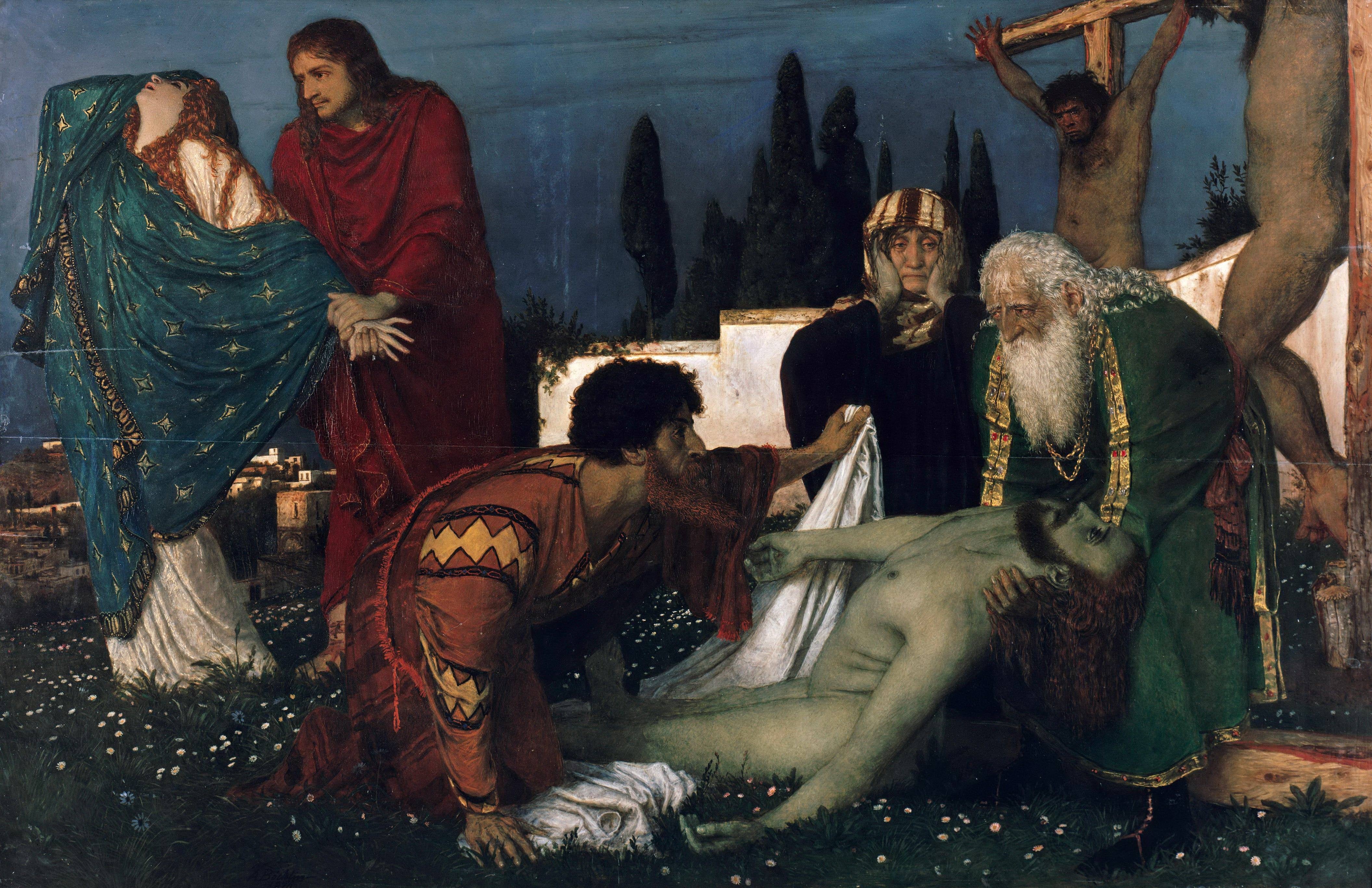
The painting depicts the Deposition of Christ in a nocturnal landscape, surrounded by a group of figures gathered around his body, which lies on the ground. In the foreground, the naked body rests diagonally on a white cloth, while a kneeling figure supports it or arranges the fabric beneath it. On the left, a woman draped in a voluminous blue-green cloak covered with golden stars leans toward the scene, beside a man dressed in red. On the right, an old man with a white beard and an ornamented green robe stands with the body, behind a veiled woman. In the background, a cross bearing the crucified figure visually links the immediate episode of the Passion with the moment depicted. Pale walls, dark trees, and a stretch of grass dotted with flowers complete the setting.
In Christian tradition, the Deposition represents the moment after the crucifixion when Christ’s body is taken down from the cross. The scene brings together those who take part in this gesture of mourning, care, and preparation for burial. The cross in the distance does not depict a separate episode; rather, it serves as an immediate reminder of the death that has just occurred. The white cloth, placed at the center of the composition, alludes to handling the body and to funeral rites. Thus, the religious narrative is presented as a solemn pause: the violence of the crucifixion is over, but the grief of those who remain beside Christ still shapes every gesture.
The iconographic elements gain force through contrast. The star-studded blue mantle introduces an exceptional note of solemnity against the earthy reds, deep greens, and pallor of the body. The small flowers covering the foreground establish an elegiac connection between the vitality of nature and the death of the central figure. The cypresses and distant architecture reinforce the funerary dimension, while the dark sky compresses the space and draws attention to the group. The crucified figure, elevated above the others, turns the scene into a visual meditation on the before and after of the Passion: above, the sign of the torment remains; below, the community in mourning.
The horizontal composition is densely structured by diagonals. The outstretched body leads the eye from the center toward the right, while the white cloth creates a luminous surface separating the body from the dark vegetation. The figures form an irregular arc around it, their leaning, kneeling, or huddled postures creating a rhythm of focus and attendance. In contrast, the cross introduces a firm vertical at the upper right and organizes the depth of the landscape. The vivid colors of the garments make the figures emerge from the twilight; the golden edges and stars serve as small points of light. The brushwork and color treatment emphasize the symbolic presence of the fabrics, faces, and body over a naturalistic description of the surroundings.
In Arnold Böcklin’s work, this scene can be associated with a sensibility shaped by twilight landscapes, intense color, and a theatrical composition in which nature and figures take on symbolic resonance. The work transforms a familiar episode into a nocturnal, silent, deeply dramatic vision: the landscape is not a neutral backdrop, but a space that extends the mourning. It is worth noting how the brightness of the cloth and the body’s skin contrast with the blue mass of the night, and how each figure directs the gaze toward the center. In this tension between death, flowering, architecture, and the cross, the painting turns the deposition into an image of transition, where human suffering hangs suspended between the earth and the promise of the sacred.
Have questions about our oil painting reproductions? See our frequently asked questions.