

Description
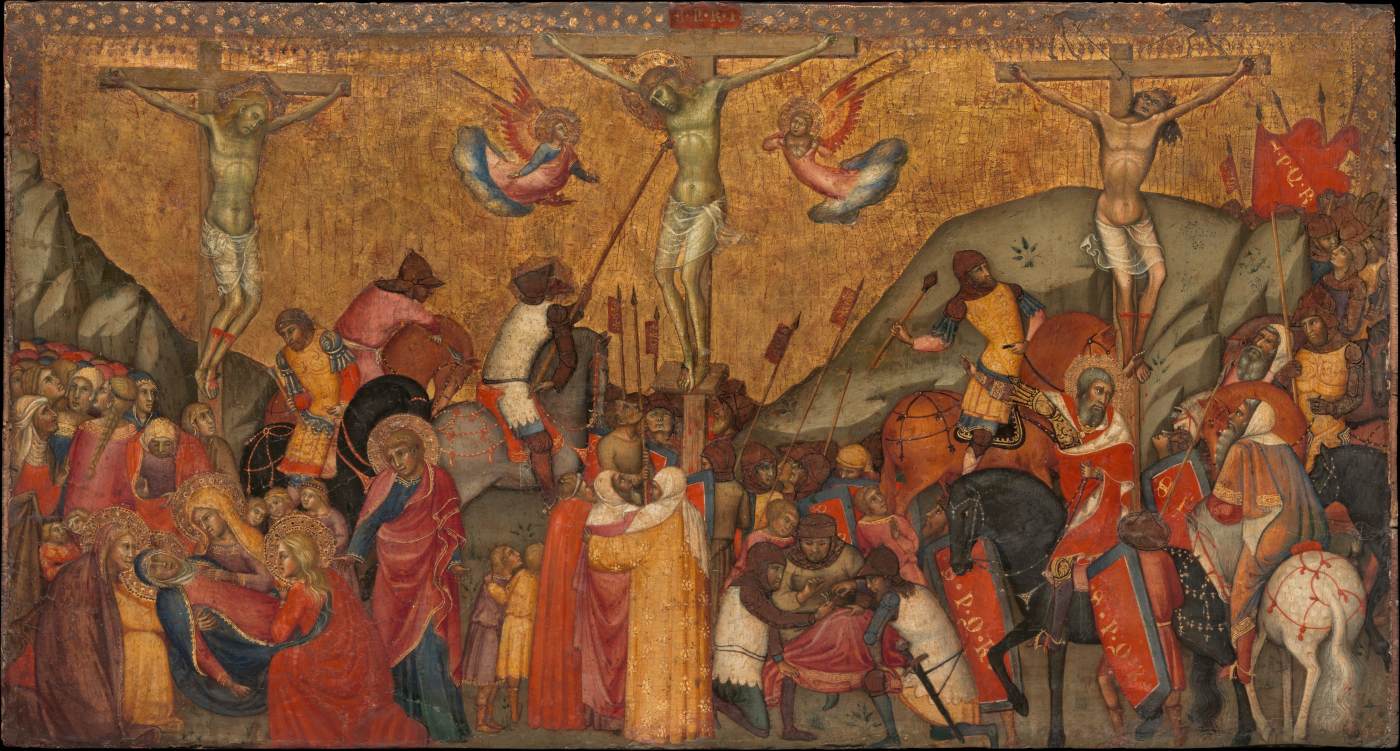
The painting depicts The Crucifixion as a panoramic, densely populated and ceremonial scene. Three wooden crosses rise in the upper third: the dominant central cross bears Christ, identified by his halo and the light cloth around his waist; on either side are the crucified figures who complete the traditional composition of the episode. Below them, two winged, haloed figures seem to guard the sacred axis, while a crowd stretches across the ochre ground. Soldiers with armour, spears, swords, shields and banners mingle with kneeling figures, people wrapped in light-coloured cloaks and onlookers directing their attention toward the event. On the right, a bearded rider on a brown horse adds a note of movement, balanced by the partial presence of another white horse at the lower edge.
The work depicts the Crucifixion of Christ, the central episode of the Christian Passion and an event traditionally set on Calvary. The arrangement of the three crosses places Christ at the centre of the visual narrative, between the two condemned men who share the place of execution. The presence of soldiers, followers and onlookers turns the torment into a public event observed by a diverse community. In this version, the scene is not limited to the intimate moment of sacrifice: horses, weapons, military formations and banners unfold before the viewer a collective vision of the Passion, charged with human presence and ceremonial resonance.
The iconographic elements organize distinct levels of meaning. Christ’s halo concentrates the sacred dimension at the center, while the winged figures extend the scene into a celestial realm. The halos of the other figures create a visual distinction between those who belong to the devotional sphere and the soldiers’ earthly activity. Spears, shields, and banners introduce tension, discipline, and visual commotion around an immobile central figure. The horseman and horses, together with the crowd gathered among the rocks, reinforce the sense of an episode witnessed by many. In this way, the image brings sacrifice, contemplation, and public spectacle together within a single narrative space.
The horizontal composition is built on a contrast between the verticality of the crosses and the tumultuous spread of the lower band. The central cross serves as an axis and first draws the eye; then the gaze descends toward the kneeling groups and moves laterally among weapons, horses, and overlapping figures. Golden ochres and browns unify the terrain and background, while vermilion, dark blue, muted green, and cream white distinguish the figures and their ranks. The rock formations create limited depth, more narrative than naturalistic, and the figures’ defined outlines encourage an almost sequential reading. The result is a rhythm of repetitions—crosses, halos, spears, and shields—interrupted by inclined gestures and kneeling bodies.
Associated with Andrea Di Bartolo, the painting is linked to the Gothic tradition of the Sienese school, evident here in the devotional clarity of the narrative, the linear elegance of the figures, the vivid colors, and the ornamental detail. The scene combines a rigorous structure with a multitude of secondary episodes: each group contributes to the breadth of the narrative without shifting the focus away from Christ. Notice how the serene verticality of the central cross is set against the fragmented movement of soldiers, horsemen, and onlookers. In this tension between stillness and agitation, the work turns the Crucifixion into an all-encompassing vision of the Passion: a sacred center surrounded by a world that watches, participates, and gathers around it.
Have questions about our oil painting reproductions? See our frequently asked questions.