

Description
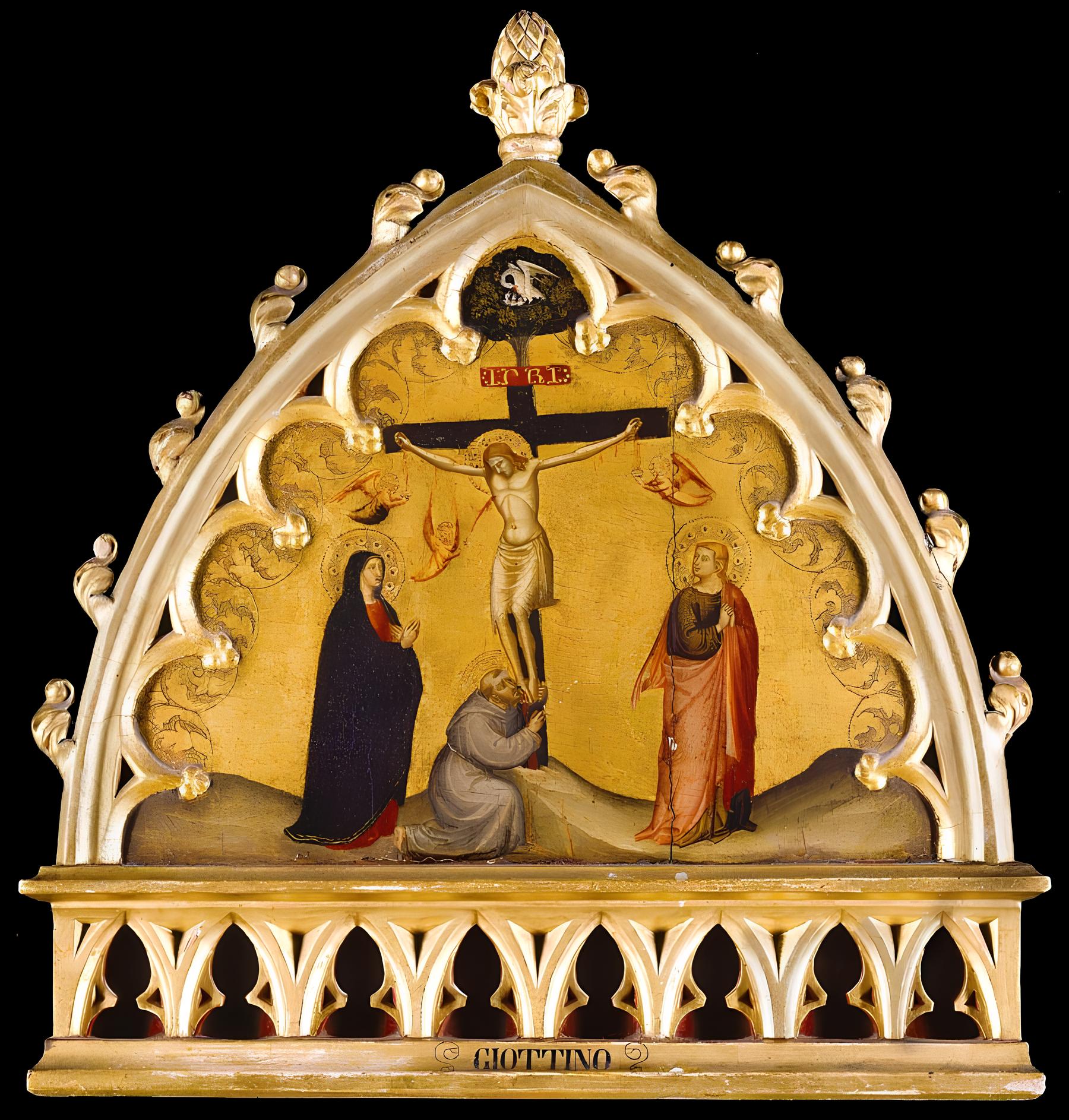
The work presents The Crucifixion as the focal point of a gilded altarpiece with a Gothic structure. Christ occupies the center, fastened to a dark cross beneath the inscription “INRI,” with his arms outstretched and a light-colored cloth around his waist. Two haloed figures stand on either side: one wrapped in blue and dark tones, the other dressed in red and orange, with hands clasped before the chest. At the foot of the cross, a kneeling figure bends forward and holds it with both hands. Above the scene, a white bird appears inside a dark medallion; around it, tracery, scrollwork, curved finials, and small spheres make the architecture an essential part of the composition.
The scene brings together the central elements of the Passion of Christ, a pivotal episode in the Christian tradition in which Jesus dies on the cross in the sorrowful presence of his followers and loved ones. The formula “INRI,” placed above the crossbeam, conventionally identifies Jesus as “King of the Jews.” The figures at the sides may be understood as part of the customary group of sacred witnesses to the Crucifixion, while the kneeling figure embodies grief, veneration, and penitential piety. The gilded background and altarpiece frame place the event in a devotional space, removed from everyday life and transformed into a sacred vision.
The iconography rests on a constant contrast between human suffering and celestial order. The vertical cross organizes all the gazes, while the halos of the figures at the sides echo the golden radiance of the background. The inscription above the crossbeam serves as a narrative and doctrinal sign, and the white bird in the upper medallion adds a celestial note to the highest part of the composition. The kneeling figure offers a physical response to the sacrifice: in contrast to the solemn frontality of Christ and his companions, the figure’s bent posture expresses closeness, sorrow, and veneration.
Formally, the composition is frontal, symmetrical, and ascending. The crucified figure forms the vertical axis; the two standing figures balance the sides, while the kneeling figure anchors the lower center, creating a visual sequence that leads from the pointed niches at the base to the uppermost pinnacle. Gold unifies the painting and architecture, while black, red, dark blue, and gray clearly define the figures. The pointed arch and tracery multiply the lines framing the scene, and the curved finials add ornamental rhythm without competing with the cross. The depth is restrained: the space does not seek naturalistic illusion, but ceremonial stability and immediate legibility.
This work by Lorenzo Di Bicci reflects the late Florentine Gothic tradition as applied to religious altarpiece imagery, with solemn figures and a close integration of painting, gilding, and architectural structure. Narrative clarity combines with a visually rich surface, where each frieze, niche, and section of tracery extends the devotional meaning of the scene. It is worth observing how the figures’ grief is ordered by the geometry of the altarpiece: the cross concentrates the tragedy, the gold elevates it to a sacred dimension, and the architecture transforms the whole into an image for ceremonial contemplation.
Have questions about our oil painting reproductions? See our frequently asked questions.