

Description
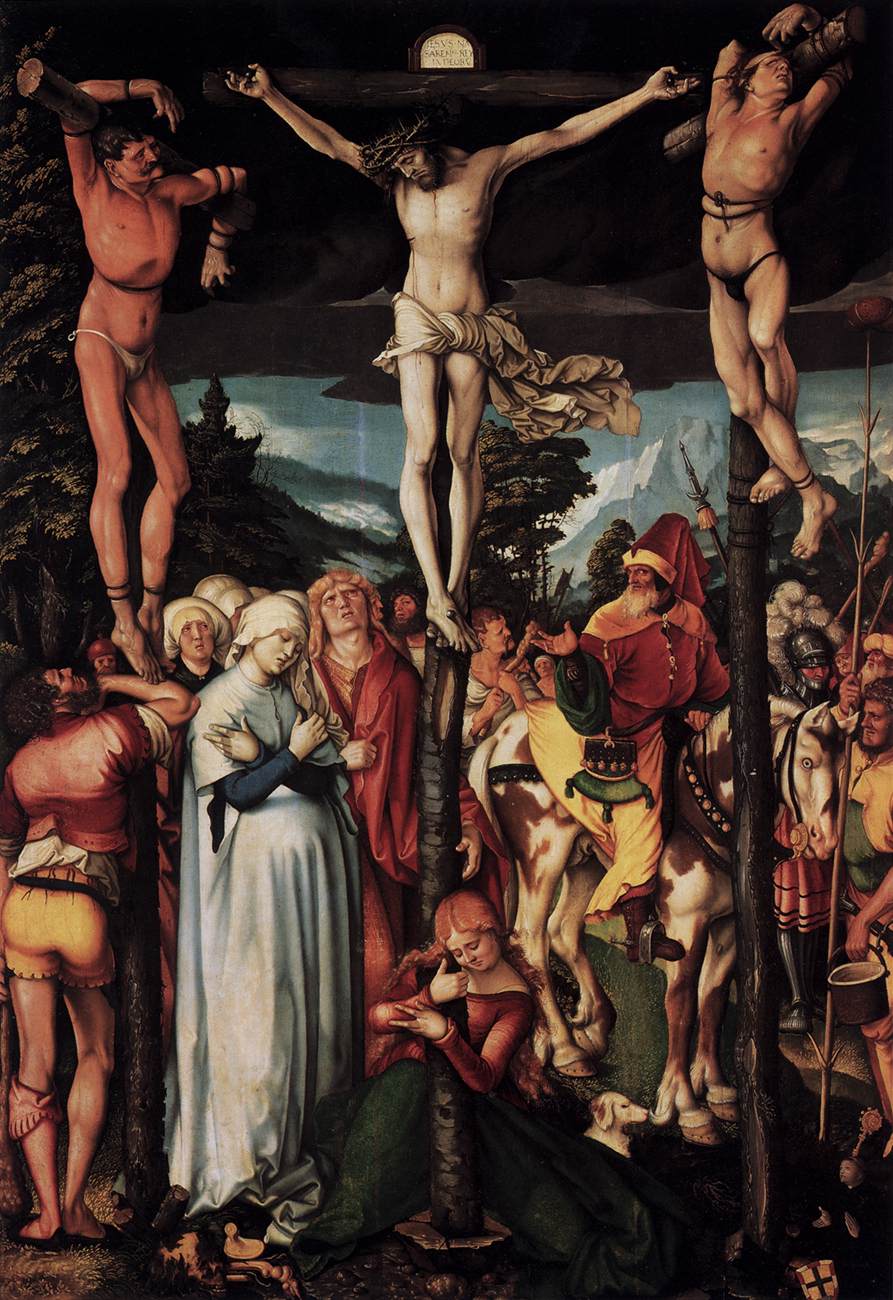
The painting depicts the Crucifixion as an event of great human and dramatic intensity. Christ occupies the central axis, raised on the main crossbeam, with his arms outstretched, his head bowed, the crown of thorns, and the light loincloth contrasting with the surrounding darkness. On either side stand the two crucified men, forming with him a triangular composition of striking visual presence. At the foot of the crosses gathers a crowd of veiled women, men in robes and headdresses, armed figures, and soldiers. A spear, a sword, and a partially visible horse introduce unmistakable signs of authority and violence on the right. Beyond the group, dark trees, rocks, water, and mountains extend the scene into an open, somber landscape.
The episode belongs to the cycle of the Passion of Christ and depicts the moment of his execution at Calvary. Christian tradition places Jesus on the central cross, accompanied by the two crucified men and observed by numerous witnesses. The crown of thorns emphasizes the protagonist’s suffering and humiliation, while the plaque fixed above the crossbeam serves as a conventional attribute of the Crucifixion. The presence of followers, onlookers, and armed men makes the event a public scene: the religious sacrifice unfolds before a community that watches, takes part, or maintains an attitude of tension around the crosses.
The iconography is structured around contrasts. Christ’s pale body stands out against the tree trunks, sky, and dark vegetation, drawing the eye before leading it down to the crowd below. The veiled women and the figures who raise their faces express grief and reverence, while the weapons and armor introduce the weight of earthly power. The horse adds a note of movement within the gathered group. Nature is not merely a backdrop: the blue-tinged mountains, water, and deep-shadowed trees broaden the scope of the episode and turn the landscape into a space of spiritual resonance, where the pain in the foreground seems to extend toward the horizon.
The vertical composition is precisely arranged around the central cross, which spans the painting and creates a line of tension between the sky, Christ’s body, and the rocky ground. The two flanking figures balance the axis, though their leaning poses and contorted bodies prevent a rigid symmetry. In the lower area, the overlapping heads, fabrics, weapons, and gestures create a compact, almost tumultuous rhythm that contrasts with the relative stillness of the crosses. The reds, ochres, and yellows of the garments stand out against greens, browns, and grayish blues. This palette, together with the chiaroscuro and the imposing scale of the elevated figures, directs attention from the collective drama toward the central figure.
In the Northern Renaissance, Hans Baldung Grien is associated with expressive drawing, a vivid imagination, and highly dramatic religious compositions. This work brings these qualities together in a scene where the throng of figures, the color contrasts, and the unsettling landscape intensify the devotional experience. The vertical structure does not isolate Christ but visually connects him to every surrounding element: gazes rise upward, weapons disrupt the space, fabrics add color, and the horizon opens onto a solemn sense of depth. Thus, The Crucifixion is perceived simultaneously as a narrative event, an image of sacrifice, and a visual construction of extraordinary tension, centered on the contrast between the luminous figure at the center and the dark crowd stirring at his feet.
Have questions about our oil painting reproductions? See our frequently asked questions.