

Description
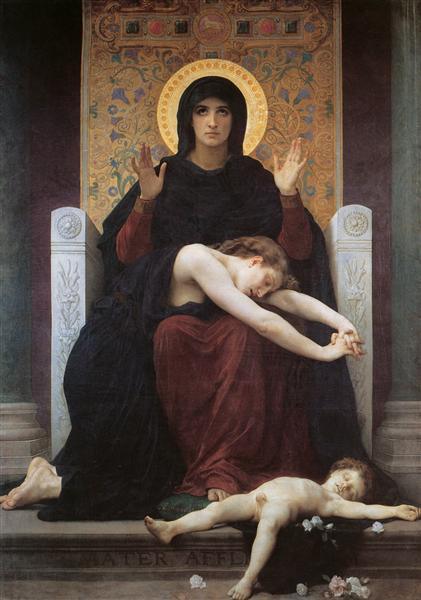
The painting presents the Virgin Mary seated frontally on a monumental throne, with a golden halo drawing the eye to her face. She wears a dark robe with reddish sleeves and raises both hands in an open, solemn, protective gesture. A child rests crosswise on her lap, while another lies naked in the foreground, surrounded by small pale flowers. The white, ornamented sides of the seat, the decorative panel in the background, and the stepped base create a ceremonial, almost architectural space in which each figure occupies a carefully balanced position.
In Christian tradition, the Virgin Mary is the mother of Jesus and one of the central figures of Marian devotion. The image of the Virgin with a child directly expresses sacred motherhood, care, and welcome. In The Virgin of Consolation, this maternal dimension expands into a scene of compassion: the child sheltered on her lap establishes a bond of protection, while the presence of the second infant body introduces a note of suffering and mourning. The enthroned figure thus appears as someone to whom human affliction is directed and from whom comfort is expected.
The circular golden halo identifies the central figure within a religious context and elevates her presence above the earthly scene. The raised hands combine authority, supplication, and openness, so that the Virgin does not remain distant but seems to welcome the sorrow unfolding before her. The child on her lap focuses the theme of maternal protection; the other, lying on the ground, makes vulnerability and loss visible. The pale flowers scattered around the latter add a delicate note of tenderness and remembrance, in contrast with the solemnity of the composition.
The vertical, symmetrical structure organizes the work around a central axis formed by the halo, the Virgin’s figure, and the ornamental panel behind her. Against this stability, the reclining child introduces a horizontal line across her lap, softening the throne’s rigid frontal aspect. The second child extends the scene into the foreground and establishes a more immediate connection with the viewer. The black and reddish tones of the garments heighten the dramatic character, while the gold of the halo and the ivory tones of the architecture serve as points of light. The precise drawing, crisp contours, and polished finish invite a measured reading of the gestures, bodies, and decorative reliefs.
The work is consistent with the academic style of William-Adolphe Bouguereau, characterized by idealized figures, formal clarity, meticulous finish, and compositions with a strong ceremonial presence. Here, that precision sustains a moving tension between the solemnity of the throne and the children’s vulnerability. The architecture orders the space, the halo establishes the sacred hierarchy, and the contrast between the resting figures turns the scene into a visual meditation on care and loss. It is worth observing how the gaze moves from the Virgin’s serene face to the child on her lap, then descends to the outstretched body: this progression brings maternal protection and grief together in a single structure of consolation.
Have questions about our oil painting reproductions? See our frequently asked questions.