

Description
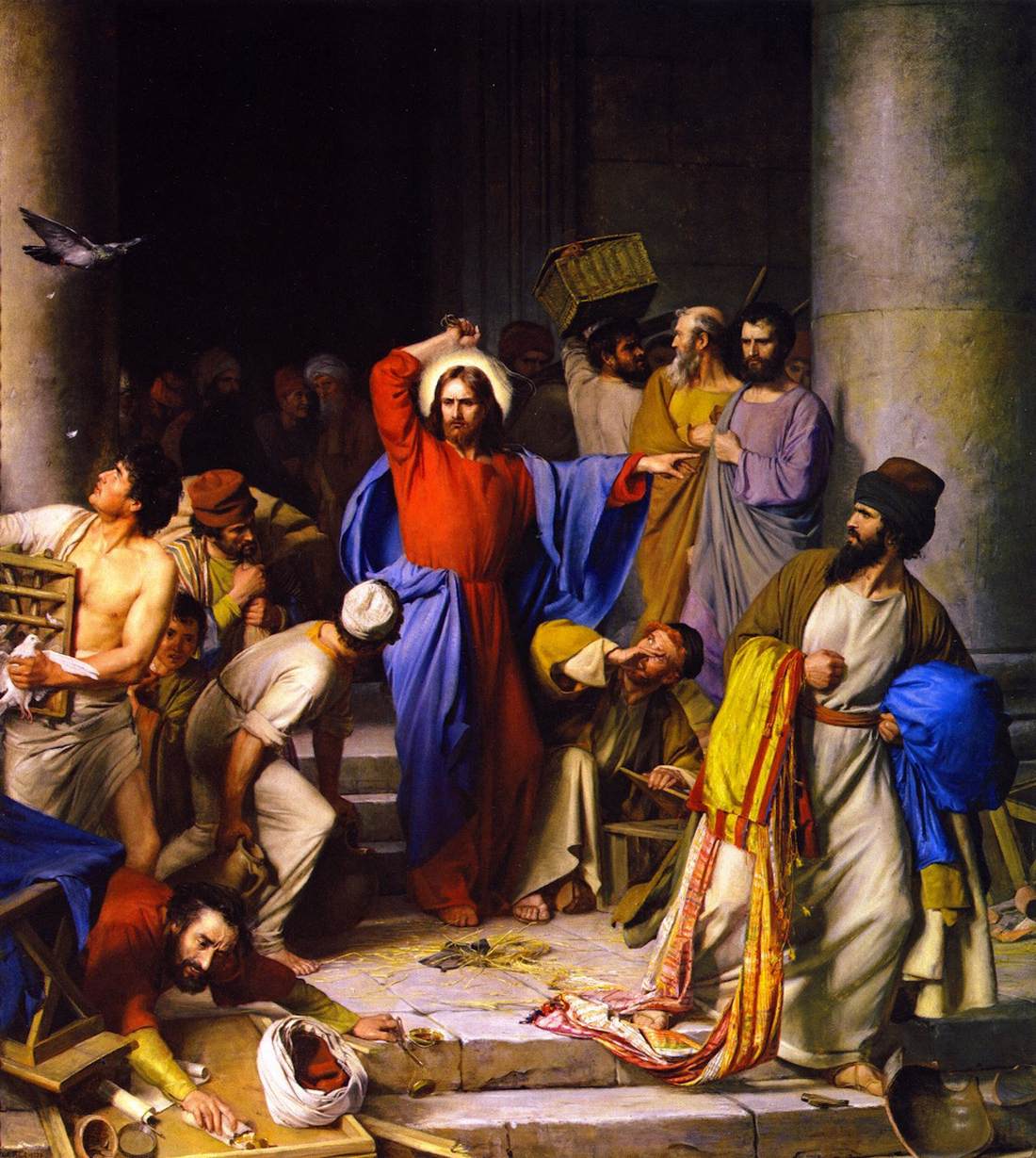
The painting shows Christ driving the merchants from the Temple in a scene of intense dramatic focus. The central figure, bearded and dressed in red and blue, stretches out his arms as a circular glow surrounds his head. A large group of men in tunics, cloaks and head coverings crowds around him, some standing and others bent over the steps. Colorful fabrics, containers, scattered small objects and a chest held above one figure’s head turn the foreground into a scene of interrupted activity. The large columns on either side and the stone staircase place the episode in a monumental, deep and theatrical interior.
The scene depicts the cleansing or purification of the Temple, an episode from the public life of Jesus recounted in the Gospels. According to the account, Christ drives merchants and money changers from the precincts, condemning the transformation of a sacred place into a setting for commerce. The painting focuses on the confrontation at its most turbulent moment: the figures seem to recoil, gather their belongings or move aside before the authority of the central figure. More than a simple scene of disorder, the episode asserts the Temple’s role as a place of prayer and establishes a contrast between the spiritual nature of the space and the commercial activity that has invaded it.
The radiance around Christ’s head serves as a visual sign of holiness and guides the reading of the entire composition. His outstretched arms reinforce his authority and act as an axis that separates and orders the surrounding turmoil. The fabrics, vessels, and goods scattered across the steps make the disruption of commercial activity visible; their displacement conveys the movement of the expulsion without depicting a single, frozen action. The architectural gloom, by contrast, lends the interior an almost ceremonial gravity. The contrast between the luminous figure and the dark surroundings turns the confrontation into a reflection on the proper use of sacred space.
Formally, the work is organized around a vertical, densely populated structure. The columns form a rigid frame on either side, while the arms, leaning bodies, and diagonals of the garments draw the eye toward the center. The red and blue of Christ’s robes stand out against the muted browns, grays, and greens of the architecture; the yellows and oranges of the fabrics introduce warm focal points that visually extend his presence into the foreground. The staircase creates successive planes and allows the figures to be arranged in depth, although the accumulation of figures keeps the composition tightly tense. The contrast between Christ’s frontal stillness and the broken rhythm of those around him sustains the narrative energy.
In this work, Carl Bloch combines narrative religious painting with dramatic lighting and meticulous attention to the figures, their garments, and the historical setting. The scene thus takes on an almost theatrical intensity: every gesture, garment, and object contributes to the sense that the everyday order has been disrupted. It is worth noting how the diagonals formed by the fabrics and objects on the floor do not scatter the composition, but continually lead the eye back to Christ. Following this visual path reveals the work’s power: spiritual authority is expressed simultaneously through the Gospel narrative, the radiance of the central figure, and an architectural setting that transforms the conflict into a monumental image.
Have questions about our oil painting reproductions? See our frequently asked questions.