

Description
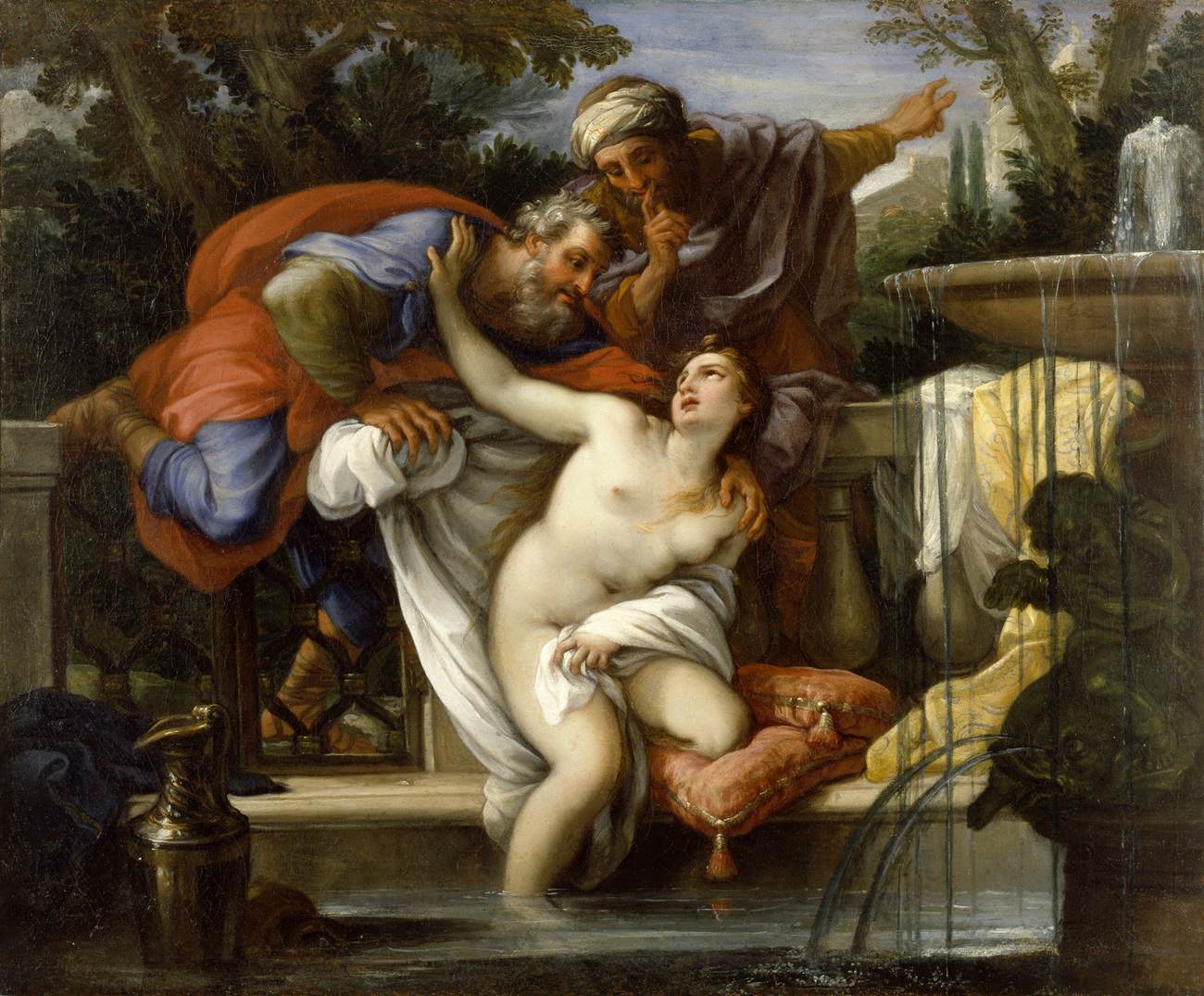
The painting depicts Susanna and the Elders in a lush garden, beside a stone fountain whose stream flows into a shallow pool. The woman occupies the lower center of the composition, reclining diagonally and partially covered by white and gray fabrics as she raises one arm in a gesture of alarm and resistance. Beside her, a bearded man in red, blue and green garments leans over her; behind them, another elder, wearing a light-colored turban and a sober tunic, raises his arm and points toward the background. The stone steps, reddish cushions, spread-out fabrics and metal vessel in the foreground make the garden a tangible, intimate and theatrical space.
The episode comes from the Book of Daniel and recounts how Susanna is surprised while bathing by two elders who desire her. When she rejects their advances, they falsely accuse her of adultery, setting an unjust condemnation in motion. Daniel intervenes, separates their testimonies and exposes their contradictions, restoring Susanna’s innocence. The scene thus brings together the woman’s vulnerability in the garden, the pressure exerted by the elders and the threat of an accusation that turns a private situation into a moral conflict.
The running water and bathing fabrics establish the episode’s iconographic setting, while Susanna’s partially veiled nudity focuses attention on her exposure before those watching her. The physical proximity of the two men heightens the sense of surveillance and harassment; the pointing gesture of the elder in the background introduces an element of accusation and dramatic pressure. In response, Susanna’s raised arm expresses her resistance through her body. The dense vegetation and partially enclosed garden shield the scene from outside view, but also heighten its claustrophobic quality: a place of intimacy becomes a setting for judgment and threat.
The composition is structured around a diagonal that rises from Susanna’s body toward the male figures and continues along the elderly man’s outstretched arm. This path connects bodies, fabrics, and gestures, guiding the eye toward the heart of the narrative. The garden’s dark greens and browns form an enveloping backdrop that sets off the warm tones of the garments, the white drapery, and the water’s muted sheen. The fountain and pond balance the visual weight of the figures on the right, while the steps and vessel in the foreground anchor the scene in depth. Warm light falling on the bodies contrasts with the shadow of the foliage and heightens the theatrical effect of an interrupted revelation.
In Giuseppe Bartolomeo Chiari’s work, this composition combines the elegance of late Baroque Italian painting with a religious figurative treatment rich in theatricality and expressive gestures. The work’s power depends not only on Susanna’s nude figure: it emerges from the contrast between the water, associated with bathing and intimacy, and the physical pressure exerted by the two elders surrounding her. The diagonal formed by the figures leads from the protagonist’s vulnerability to the accusatory gesture in the background, while the garden serves simultaneously as refuge and enclosure. The enduring meaning of the work lies in this tension between scenic beauty and moral violence.
Have questions about our oil painting reproductions? See our frequently asked questions.