

Description
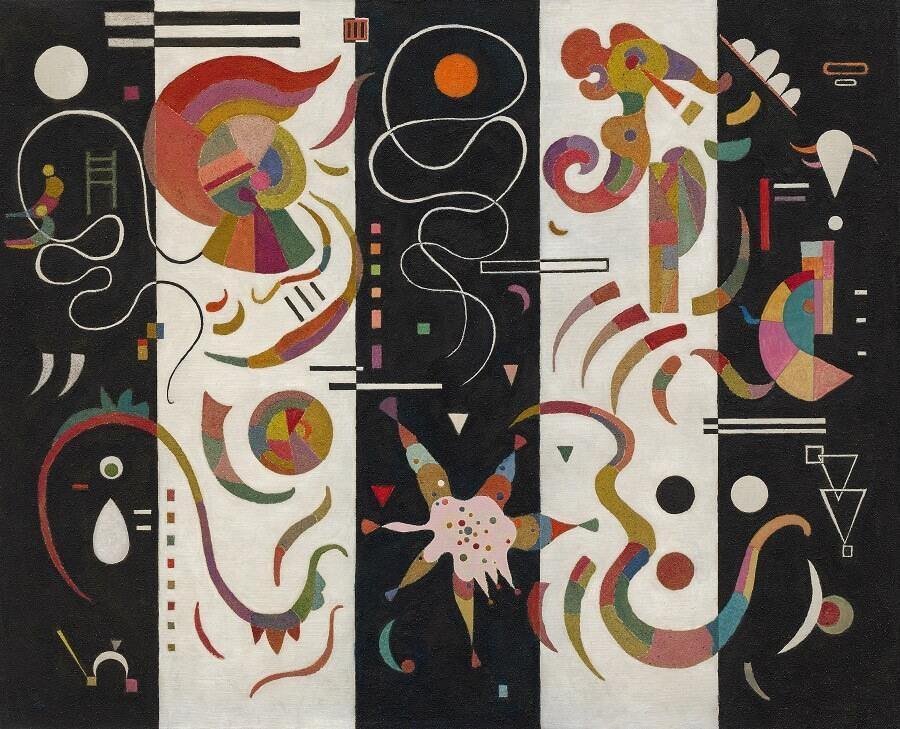
Wassily Kandinsky’s painting presents an abstract field organized into five alternating vertical black and white bands that run from top to bottom across the surface. Spirals, waves, loops, circles, bars, triangles and small geometric modules appear over this structure. The curved and segmented forms, rendered in red, yellow, green, blue, pink, orange and purple, introduce intense chromatic energy. Some arrangements evoke anthropomorphic presences, while others recall flowers, emblems, discs or independent signs. No single element completely dominates: the composition invites the viewer to move from one band to another, following the tension between vertical order and the proliferation of forms.
Rather than depicting a scene or a narrative episode, the work is structured as an abstract composition based on rhythm, contrast and linear movement. The stripes function as a visual grid that contains and separates the colored signs while also activating them. In this context, the forms need not be identified as concrete objects to acquire a presence; they operate as units in a kind of visual language. The relationship between light and dark fields, fine lines and saturated patches produces a dynamic reading in which the viewer’s gaze constantly shifts in scale and direction.
The vertical stripes can be read as a rhythmic, almost musical structure that organizes the abundance of motifs and establishes a steady cadence. Against this regularity, the spirals and sinuous lines bring fluidity, expansion, and a sense of continuous movement. The multicolored elements act as accents, interrupting the monochrome alternation with small concentrations of energy. The configurations with a partly anthropomorphic appearance suggest abstract presences, yet remain integrated into the overall system of signs. The large floral or star-shaped form in the lower area and the segmented circles broaden the impression of an open symbolic repertoire, in which each figure contributes chiefly through its rhythm, color, and position.
Formally, the composition rests on a highly effective contrast between verticality and curve. The five bands provide stability and a clear reading direction, while the white outlines against black and the dark marks against white create visual inversions that keep the surface active. The asymmetry prevents the whole from feeling static: some areas concentrate interlocking lines, while others accumulate arcs, disks, or blocks of color. The chromatic contrast directs attention to different focal points without establishing a single center. Depth depends not on traditional perspective but on overlapping, the relative scale of the signs, and the alternation between open spaces and dense groupings.
The work is consistent with a widely recognizable strand of Wassily Kandinsky’s abstract visual language, in which color, line, geometry, and rhythm can relate to one another autonomously, without relying on naturalistic representation. Here, simple vertical stripes become an active field of tensions: geometry provides structure, curves guide the eye, and colors introduce shifts in intensity. Notice how each band transforms the one before it, and how the small marks gain strength through their relationship with the black and white. The result is a vibrant painting, built between structure and movement.
Have questions about our oil painting reproductions? See our frequently asked questions.