

Description
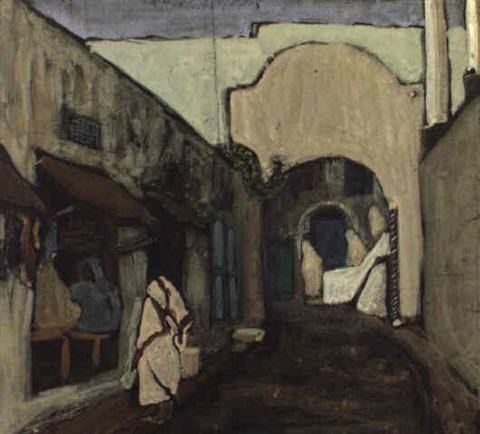
The painting Street in Tunis presents a narrow, paved urban passage dominated by aging buildings, arches and covered corridors. The perspective draws the eye toward a dark arch in the background, while a figure in light-colored clothing occupies the foreground and establishes the human scale of the scene. Beside the figure is a light-colored vessel or bundle, part of the alley’s everyday surroundings. Other figures are distributed throughout the space: one appears behind the main figure, another stands beneath the side structure on the left, and a third is silhouetted within the arched passageway. The high walls, balconies and shadowy openings make the architecture the enclosing body of the composition.
The title places the scene in Tunis, within the cultural and geographical context of North Africa. Rather than depicting a recognizable monument, the work offers a glimpse of everyday life in an urban street or courtyard, where the inhabitants are woven into a network of passageways and thresholds. Narrow streets, courtyards and arcaded corridors are characteristic elements of traditional North African urban architecture, and here they form a dense, sheltered and labyrinthine setting. The scene does not depend on an explicit anecdote: its interest arises from the interplay of human movement, worn surfaces and successive spaces that open and close before the viewer’s gaze.
The arch in the background shapes the experience of the place as a threshold. Its darkness concentrates the depth and turns the visual journey into an invitation to enter a partially concealed space. The figures, dressed in light and dark tones, introduce an everyday human scale and keep the composition from becoming an uninhabited architectural scene. Their presence brings the passageways to life and makes the rhythm of urban life perceptible. The contrast between the ochre façades and the shadowed openings reinforces a sense of quiet contemplation: the street seems silent, but not empty. The figure in the foreground serves as a narrative anchor, while the secondary figures draw the gaze farther inward and suggest continuity beyond the arch.
Formally, Kandinsky constructs the scene through a diagonal perspective that progressively narrows the space. The architectural volumes occupy almost the entire frame, creating vertical lines, sloping planes and successive frames around the figures. The palette of yellowish ochres, browns, slate grays, muted greens and creamy whites creates a subdued light, without fully separating illuminated areas from the shadows. The light-colored figure in the foreground stands out against the dark background, guiding the viewer’s attention before returning it to the central arch. The treatment of the weathered surfaces suggests a dense accumulation of wall, plaster and stone, giving the architectural matter an almost tactile weight. The balance between stillness and movement arises from the contrast between the large, motionless walls and the small figures arranged in depth.
Within Wassily Kandinsky’s representational work, this painting is associated with an early period attentive to landscapes and urban scenes, in which expressive simplification of forms coexists with a marked sensitivity to color and compositional structure. In Street in Tunis, this way of seeing turns an apparently everyday scene into an experience of passage, silence, and depth. The light-colored figure in the foreground does not compete with the architecture, but rather provides a measure of it; beyond it, the corridor of shadows draws the eye toward the arch, where the street takes on an almost labyrinthine quality. The subject, figures, and geometric arrangement work together to make visible a city experienced from its thresholds.
Have questions about our oil painting reproductions? See our frequently asked questions.