

Description
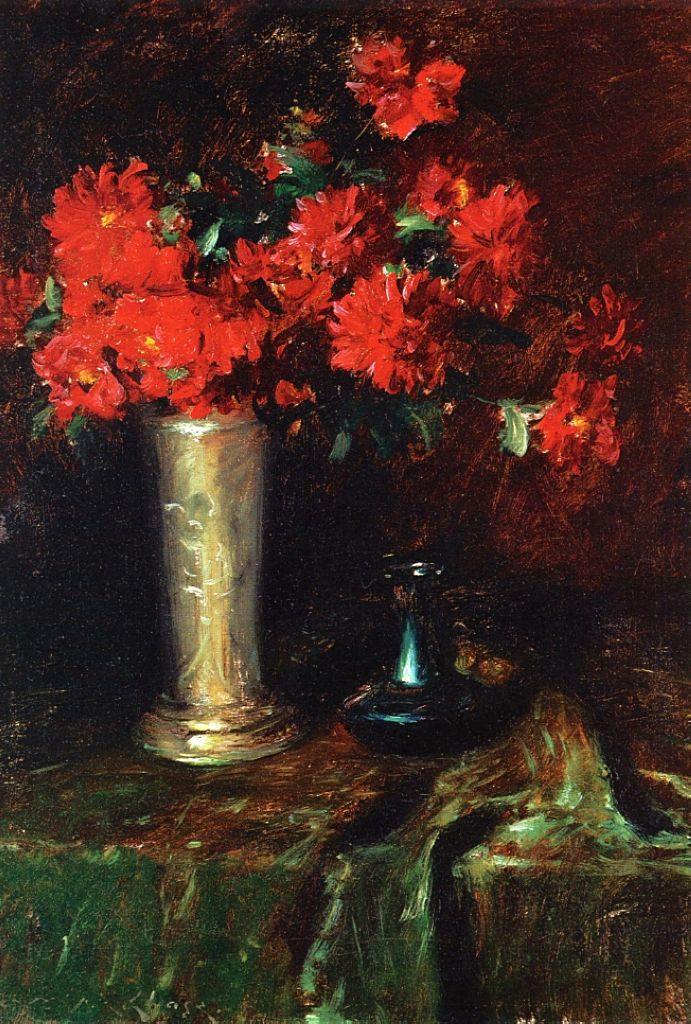
The painting depicts a floral still life with a strong, concentrated presence. A generous bouquet of red flowers spreads across the upper half, forming a compact mass of petals and green leaves that extends from left to right. Beneath it, a tall, narrow metal vase anchors the composition just left of center, its gold finish catching the light on its body and flared base. The scene is arranged on a dark table, accompanied by a small rounded vessel and bright reflections in the foreground. The nearly black background sets off each element and makes the bouquet the immediate focus of the viewer’s gaze.
As a still life, the work does not develop a figurative narrative; instead, it brings together motionless objects to make an experience of color, material, and light visible. The floral still life belongs to a genre especially well suited to observing the relationship between the natural and the constructed: the flowers bring irregularity, volume, and vitality, while the vase introduces a stable form and a surface capable of reflecting its surroundings. Arranging these everyday elements on a table transforms them into a subject for focused contemplation. The bouquet functions not merely as a botanical depiction, but as a pictorial structure in which every color and reflection contributes to the overall balance.
The red flowers concentrate the scene’s visual energy and evoke beauty, abundance, and temporal fragility. Their profusion creates a sense of richness that contrasts with the surrounding gloom, making the bouquet’s vitality seem even more intense. The golden vase acts as a counterpoint: its gleam introduces an air of understated luxury while also providing vertical support for the flowers’ horizontal spread. In the lower area, the blue-green and golden reflections broaden the palette and prevent the composition from being reduced to a simple opposition between red and black. The darkness serves as a space of concentration, intensifying the physical presence of each object.
The vertical composition leads the eye from the metal base up to the bouquet, although the flowers’ breadth then draws attention back toward the sides. This alternating movement between axis and expansion lends rhythm to an essentially still scene. The dark background establishes a contained depth: rather than depicting a spacious setting, it brings the objects closer to the picture plane and reinforces their material density. Light is concentrated on the petals, leaves, and reflective areas of the vase, shaping the forms through strong contrasts. The green and golden accents in the foreground visually connect the vessel to the table, allowing the stillness of the composition to retain a painterly vibrancy.
In this work by William Merritt Chase, the Impressionist sensitivity to color, light, and brushwork is evident in the way the objects take on an atmospheric as well as descriptive presence. The main focus is on transforming a bouquet of red flowers into a source of chromatic energy, setting it against the half-light, the vase’s golden gleam, and the shifting reflections on the surface. The painting holds together the exuberant and the restrained: the mass of flowers captivates with its intensity, while the darkness and metallic tones organize the scene with precision. In this way, the simple subject of a still life becomes an immersive study of the tension between abundance, materiality, and light, drawing the eye to the red radiance that dominates the composition.
Have questions about our oil painting reproductions? See our frequently asked questions.