

Description
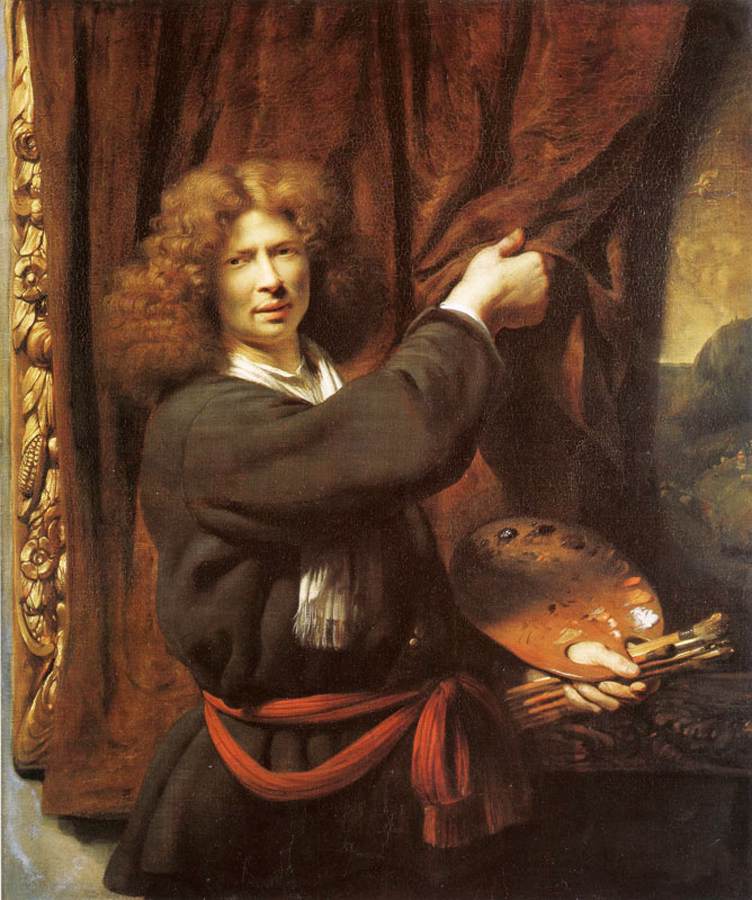
The work presents Bisschop’s Self-Portrait, conceived as a theatrical entrance onto the stage. The figure occupies the center of the composition, standing upright and facing forward, with abundant curly hair framing the face. The figure wears a dark garment with a light-colored collar and cuffs, cinched with a red sash that adds an intense accent at the waist. One hand holds an oval palette covered with dabs of color and several brushes; with the other, the figure draws aside a heavy reddish-brown curtain. Drapery, shadows and an ornamental gilded edge unfold around the figure, while an opening to one side reveals an outdoor landscape.
As a genre, the self-portrait makes the painter’s own figure the subject of the artwork. Here, the artist’s professional identity is made visible through the tools of the trade, presented as clearly as the face and body. The scene does not show the artist engaged in an everyday activity, but rather presenting himself to the viewer: he appears between the interior of the studio and the open space beyond, as if raising the curtain to reveal both his person and his profession at once. The palette and brushes thus serve as conventional attributes of the painter and establish the subject of the work from the outset.
The drawn-back curtain adds a decisive theatrical dimension. Its volume and folds turn the artist’s appearance into a carefully orchestrated presentation, while the gilded edge reinforces the impression of a frame or solemn threshold. The narrow opening onto the landscape expands the meaning of the interior: the artist is not isolated in a closed room, but placed in a visual relationship with the outside world. The contrast between the tools, close to the viewer, and the distant landscape shapes an interpretation in which the practice of painting acts as a mediator between the intimate experience of the studio and the breadth of what can be seen.
The vertical composition focuses attention on the central figure and distributes movement along the diagonals formed by the arms. One leads toward the raised curtain; the other descends to the palette and brushes, establishing a visual path between gesture, identity, and craft. The reddish browns and blacks of the interior create a dense, enveloping space, interrupted by the whites of the collar and cuffs, the red sash, and the ornamental gold. Against this warm darkness, the sky and landscape at the far right introduce a luminous breath of air. The depth arises precisely from this contrast between the foreground, the fabrics, and the distant opening.
The interest of this Self-Portrait lies in how Bisschop transforms simple attributes into a complex visual statement. The palette and brushes identify the painter; the curtain frames his appearance; the landscape opens the scene onto a broader realm. The contrasting light and accumulation of materials create an almost theatrical effect without diminishing the direct presence of the face. Notice how the hand holding the curtain and the hand holding the palette balance two dimensions of the artist: the one who reveals the space and the one who interprets it through painting. The work’s power lies in this tension between spectacle, studio, and the outside world.
Have questions about our oil painting reproductions? See our frequently asked questions.