

Description
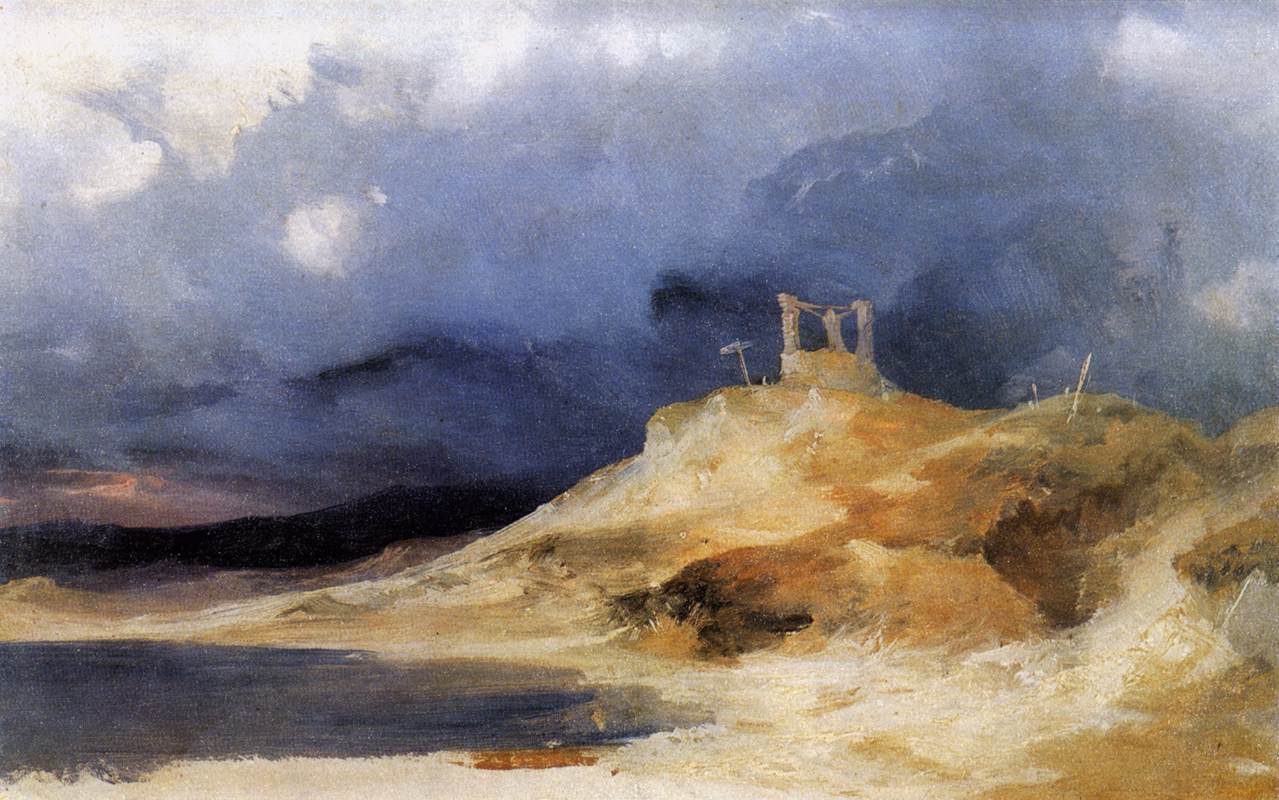
The painting depicts a coastal landscape beneath a stormy sky. A broad hill with sandy, rocky slopes rises from the water’s edge to fill the center and right of the composition. An open scaffold or structure stands silhouetted on its summit against the sky, while a few dark patches of vegetation interrupt the golden sweep of the slope. In the foreground, a surface of dark blue water stretches toward a clear, open shore; in the distance, a low strip of land partially closes off the horizon. No human figures compete with the scale of the landscape: the entire scene is organized around the relationship between the land, the water and that solitary architectural presence.
As a landscape, Scaffolding in a Storm does not recount a specific historical episode, but instead creates a sense of isolation and atmospheric change. Its central motif is the contrast between a fragile human intervention and a vast natural setting. The structure high above suggests a trace of activity or abandonment in an almost uninhabited place, and its dominant position makes it the narrative focal point of the scene. The coast, water and hill are more than mere backdrop: together, they establish a scale against which any construction seems provisional in the face of the sky’s force and the expanse of the land.
The visual meaning emerges from several contrasts. Reduced to a few vertical lines and a central opening, the scaffolding conveys a sense of precariousness, suspension, and transformation. Its isolation on the summit heightens the impression of a human presence exposed to the elements. In contrast, the dense, luminous clouds form a shifting mass that suggests instability and imminent change. The dark water and pale shore heighten the sense of spatial depth and distinguish two states of matter: a contained, almost silent surface and an open expanse of land receiving the light. Thus, the storm creates tension between apparent stillness and latent energy.
The horizontal composition devotes most of its surface to the sky, whose visual weight dominates the scene from the outset. The low horizon allows the clouds to spread expansively, while the hill rises diagonally, guiding the eye toward the structure at its summit. The slope’s golden ochres and beiges stand out against the sky’s grayish blues and the water’s deep tones. This chromatic contrast concentrates the light on the terrain, leaving the atmospheric background in a cooler palette. The water’s horizontal bands lend stability, but the hill’s sloping profile and the surface’s irregular patches introduce rhythm and movement. Small in relation to the landscape, the architecture serves as a point of reference and a geometric interruption within nature’s shifting contours.
In this work by Karl Blechen, the sensibility of the Romantic landscape is evident in the importance given to atmospheric effects, contrasts of light, and the emotional relationship between sky and land. The scene does not depend on any visible action: its intensity comes from the way filtered light transforms the hill and turns the sky into an enveloping force. The eye moves from the dark water toward the shore, climbs the illuminated slope, and ends at the scaffolding silhouetted against the clouds. This journey brings together the essential elements of the painting: a vulnerable human structure, land momentarily set aglow, and a sky that suggests the landscape’s balance could shift at any moment.
Have questions about our oil painting reproductions? See our frequently asked questions.