

Description
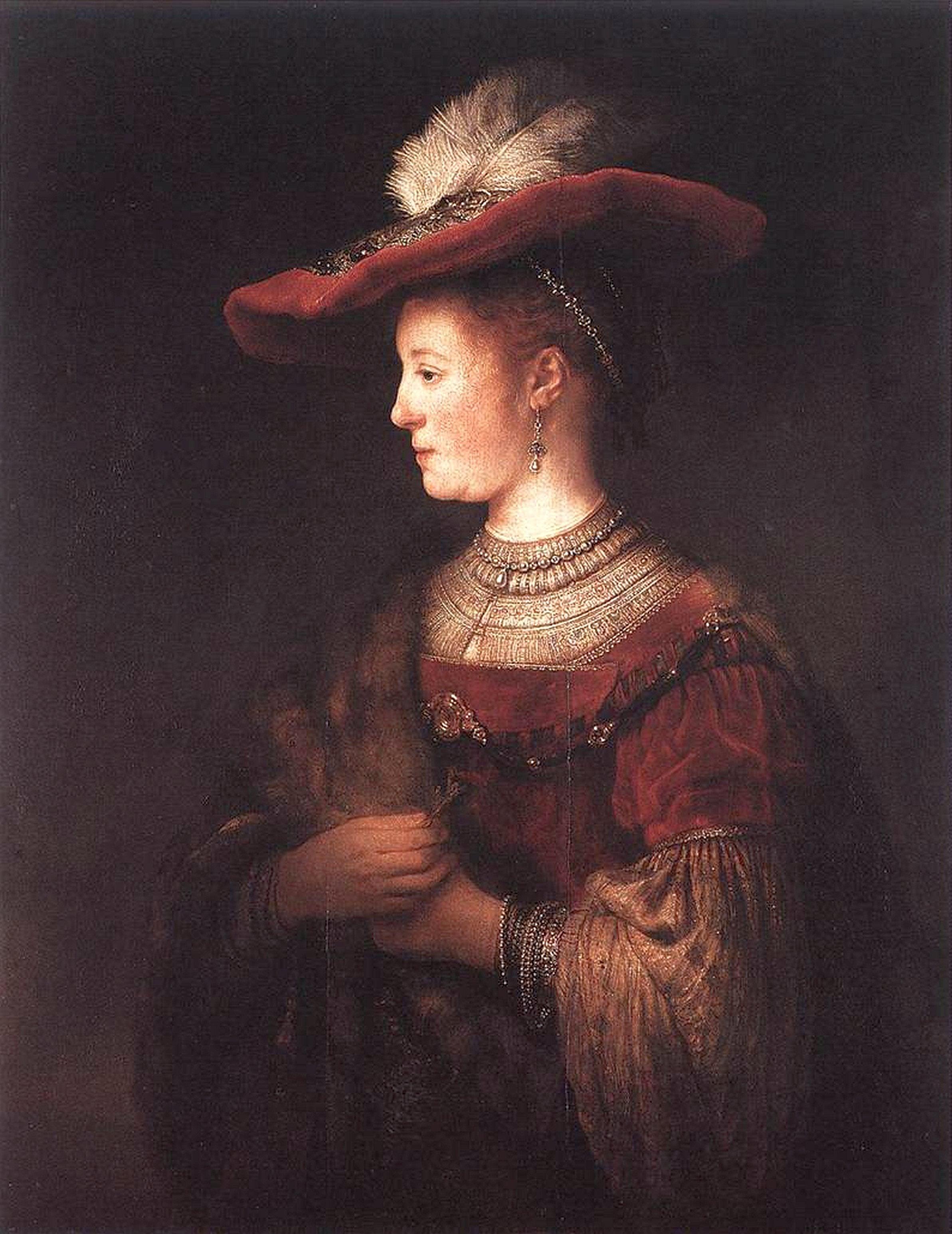
The painting shows Saskia van Uylenburgh in a half-length portrait, in left-facing profile, set against an almost black background. Her warmly illuminated face draws the eye, while the very wide brim of her red hat extends horizontally to the left and two light-colored feathers rise above its crown. She wears dark garments with reddish sleeves and a broad, stiff collar, richly ornamented. A long earring follows the line of her ear, while a decorative band crosses her torso and light-colored, pleated cuffs add a luminous contrast at the bottom. Her hands, held close to the front of her clothing, complete a restrained, carefully composed pose.
The portrait genre presents no narrative scene here, but rather the individual presence of a woman defined by her bearing, attire and the concentrated intensity of her profile. Saskia van Uylenburgh was Rembrandt’s wife, a fact that places the work among the important group of portraits associated with her. Her refined clothing does more than record social standing: it conveys an image of identity, elegance and public presence. At the same time, the close framing keeps attention on the sitter, preventing her accessories from turning the portrait into a mere display of wealth.
The red hat and light-colored feathers form the composition’s most immediate visual emblem. Their combination of vivid color, volume and vertical movement underscores the sitter’s sophistication, while the large collar, jewels and earring draw the eye toward her face. The ornaments and fabrics gain strength through contrast: they reveal the care devoted to her appearance and the figure’s social dimension, but also serve to frame the psychological depth of her profile. The surrounding darkness removes all distractions and transforms the details of her attire into a kind of material halo around her head and neck.
The compact vertical composition organizes the painting through a tension between lines. The brim of the hat forms an almost horizontal extension that draws the eye to the left; the band across the torso introduces a diagonal that guides the viewer’s gaze back to the center of the figure. Against this framework, the illuminated face acts as the focal point, followed by the ornate collar and the subtler gleam of the cuffs. The reds of the hat and sleeves stand out against the deep blacks and browns, while the warm flesh tones and cream hues soften the severity of the background. Selective lighting defines the profile and reveals the differences between skin, ornament, feather, and fabric.
These elements are consistent with qualities widely associated with Rembrandt: dramatic lighting against dark backgrounds, an intense focus on the sitter’s psychological presence, and a keen observation of textures. The painting’s appeal lies in the way Saskia’s sumptuous attire—hat, feathers, jewelry, and fabrics—becomes a means of commanding attention without eclipsing her face. When viewing it, follow the path from the red brim to the profile, collar, and hands: there you can see how Rembrandt brings together social status, intimacy, and theatricality in an image of extraordinary concentration.
Have questions about our oil painting reproductions? See our frequently asked questions.